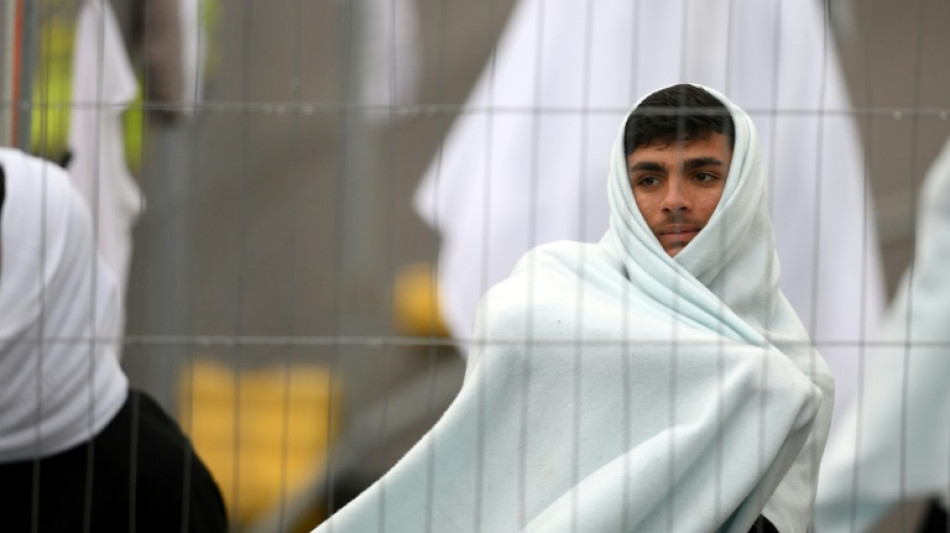
Surge in claims puts UK asylum system under pressure / Photo: Daniel LEAL - AFP

 Physicians Urge Arizona to Ban Medical Gag Clauses and Enable Private Lawsuits

 New Campaign Highlights Knowledge Gaps on Carbon Monoxide Safety Among Americans

 GoodData.AI Launches the Agentic Serving Plane, a New Category of Enterprise Data Infrastructure for AI Agents

 US Government Questions Effectiveness of Waymo’s School Bus Software Fix

 Panthers expected to begin 2027 NRL season away from new stadium

 Sweet As app launches restaurant discovery platform
 MLA seeks inquiry into reported sectarian gestures on Ormeau Road
 Louise O’Reilly attacks Simon Harris over unemployment remarks
Britain is struggling to cope with an increase in asylum-seekers, as numbers risking their lives to cross the Channel on small boats hit record levels.
Overcrowded reception centres and long delays to process applications are causing a political headache for the government, which promised tighter immigration controls post-Brexit.
Several newspapers this week carried the image of a young girl running towards the fence of one facility to hand a scribbled message to journalists, criticising conditions inside.
Her note shone an unflattering light on the Manston reception centre in southeast England, where migrants are first taken for identity checks after their arrival, and the system.
Nearly 40,000 people -- most of them Albanians, Iranians and Afghans -- have been intercepted by patrols already this year, surpassing the total for the whole of the last 12 months.
Increased checks on ferries and lorries by French and British border police have forced desperate migrants onto unsuitable craft to cross one of the world's busiest shipping lanes.
In all, more than 63,000 new asylum applications have been made in the year from June last year -- the highest number since the record of more than 80,000 in 2002.
Both Britain's current interior minister Suella Braverman and her predecessor Priti Patel have described the system as "broken".
- 449 days -
According to official figures, an asylum-seeker in Britain now waits on average 449 days before getting a response to their application.
For non-accompanied minors, the delay can even stretch to 550 days.
As a result, 166,085 applications are outstanding -- double that in June 2020, four MPs told Braverman in a letter on Wednesday.
Peter Walsh, a researcher at the Migration Observatory at the University of Oxford, described the backlog of cases as "the central problem".
"The reason, largely, is because asylum claims are being processed more slowly than they had been in the past," he told AFP.
Walsh has calculated that the number of applications getting a first response within six months -- the government's official policy up to 2019 -- fell from 87 percent in 2014 to just six percent in 2021.
Braverman has characterised the increasing number of asylum-seekers as an "invasion" that had paralysed the system, and said the state was faced with eye-watering costs for accommodation while applications are processed.
Her language was widely denounced as inflammatory and even earned a rebuke from the UN's new human rights supremo.
But a parliamentary committee report published in June said the increasing pressures on the asylum system "are not... a direct consequence of increasing demand", pointing instead to the processing of applications in Britain.
The MPs blamed "inappropriate" software to handle cases and "insufficient administrative and technical specialist staff".
Walsh also pointed to "inadequately trained" staff and a high turnover of employees.
- Pressure -
In a sign of the workload, on September 4 this year, nearly 1,000 people were intercepted on small boats in the Channel and brought ashore.
The subject has come to the fore again this week after reports that some 4,000 people were being held at the Manston reception facility near Dover, when its capacity is 1,600.
Last Sunday, firebombs were thrown at another reception facility in Dover by a man who was later found dead.
Local lawmakers, campaigners supporting asylum-seekers and the political opposition are calling on the government to get a grip on the situation.
In the last few days, hundreds have been moved from Manston to hotels hastily reserved by the government.
Yet even here this has not gone smoothly: in Northallerton, northern England, Ukrainian refugees were forced to give up their hotel rooms for asylum-seekers from Manston, The Times reported.
Others were reportedly taken to central London and dropped off near Victoria railway station, forcing them to spend the night on the streets, several media outlets reported.
The government has denied the claim.
J.Oliveira--PC