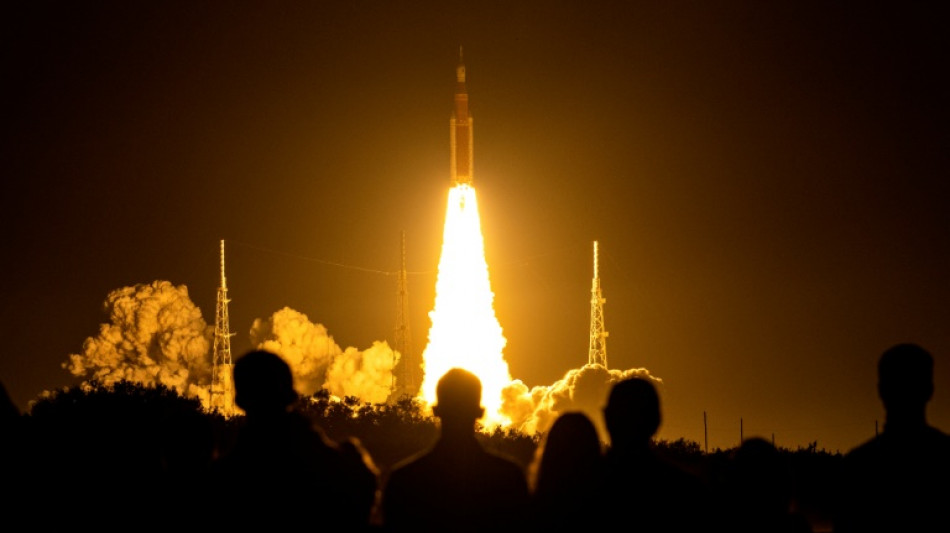
Liftoff! NASA successfully launches mega Moon rocket / Photo: Jim WATSON - AFP

 EU lawmakers demand Brussels force Meta to 'protect' European children

 Clooney turns AFP photographer in jokey red carpet switch

 Retirement Income Planning Florida Launches No-Cost 'Income Gap Analysis' Program for Pre-Retirees

 Iraola hails Barcola mentality after blockbuster Liverpool move

 Michelsen shocks Nakashima in US Open clash of rising Americans

 US govt sides with OpenAI in New York Times copyright lawsuit

 Philadelphia Festival Revisits the Signing and Legacy of the U.S. Constitution

 Honda Presses Suppliers for Deep Cost Cuts in $9.4 Billion Savings Drive

 WMO Says Powerful El Niño Is Likely to Persist Into February 2027

 Maui Wildfire Survivors Report Major Losses to Troubled Rebuilding Contractors

 Grammy-Winning Jazz Vocalist Cassandra Wilson Dies at 70

 Russia to close branches of Germany's Goethe Institute

 Spacecraft bound for Mercury faces 'tricky' arrival

 Philippines holds drills to safeguard students from armed intruders

 In Ghana, larger-than-life coffins tell the stories of the dead
 Menoncello, Reece headline Top 14 new-season signings

 Families descend on Nepal in search of missing tourists

 Far-right AfD eyes huge win in east German state vote

 Brazil-Japan to play World Cup rematch at Singapore tournament

 Defence chiefs back boosting US military presence in Australia

 Nepal seeks climate justice after Himalayan disaster

 Stocks rise, yields ease as oil slips on Trump hint at short bombing campaign

 Brussels Diamond League finals Day 1 - five events to watch

 Thailand's 'Jurassic Park' shines light on dinosaur evolution

 'Role model' Stokes set to open for Adelaide Strikers

NASA launched the most powerful rocket ever built on a journey to the Moon on Wednesday, in a spectacular blaze of light and sound that marked the start of the space agency's new flagship program, Artemis.
The 32-story tall Space Launch System (SLS) blasted off from the storied Kennedy Space Center in Florida at 01:47 am (0647 GMT).
"We are going," tweeted the space agency.
Fixed to its top was the uncrewed Orion spaceship that will later separate and complete an orbit-and-a-half of Earth's nearest neighbor, in a test run for later flights that should see the first woman and first person of color touch down on lunar soil by the mid-2020s.
America last sent astronauts to the Moon during the Apollo era, from 1969-1972. This time it hopes to build a sustained presence -- including a lunar space station -- to help prepare for an eventual mission to Mars.
The launch came despite technical issues that ate into the two-hour launch window that opened at 1:04 am.
Engineers were forced to pause the flow of liquid hydrogen into the core stage Tuesday night because of a valve leak, though a team sent to the launch pad resolved the problem after an hour.
Later, the space agency reported that a radar site monitoring the rocket's flight path was experiencing problems due to a faulty ethernet switch that had to be replaced.
It was third time lucky for NASA after two previous launch attempts were canceled for technical reasons. Launch was also delayed due to weather setbacks, including Hurricane Ian that battered Florida in late September.
- 'Extremely excited' -
About 100,000 people were expected on the coast to watch the launch, with the rocket promising to light up the night sky.
Andrew Trombley, a space enthusiast from St. Louis, Missouri, was anxiously hoping for a successful liftoff after several futile trips made for the launch.
"I've been down here a couple of times already to watch this thing go up and have it canceled, so, this is like, whatever, the third trip down here for this, so I'm excited to see it go," said the network engineer.
"I was too little for the Apollo missions, so ... I wanted to be here in person."
Kerry Warner, 59, a grandmother and semi-retired educator who lives in Florida, was fired up for liftoff, which she said was "part of America and what America is all about."
"Third time's the charm. We're hoping for it."
- Far side of Moon -
The Orion crew capsule was being lifted by two boosters and four powerful engines under the core stage, which detached after only a few minutes.
After a final push from the upper stage, the capsule will be well on its way, taking several days to reach its destination.
Rather than landing on the Moon, it will assume a distant orbit, venturing 40,000 miles (64,000 kilometers) beyond the far side -- further than any other habitable spacecraft so far.
Finally, Orion will embark on the return leg of its journey. When passing through the atmosphere, the capsule's heat shield will need to withstand a temperature half as hot as the Sun's surface.
The mission will last 25 and a half days, with a splashdown in the Pacific Ocean on December 11.
NASA is banking on a successful mission after developing the SLS rocket for more than a decade. It will have invested more than $90 billion in its new lunar program by the end of 2025, according to a public audit.
Artemis 2 will involve a flyby of the Moon with astronauts in 2024, while Artemis 3 will see boots on lunar soil, no sooner than 2025.
E.Paulino--PC