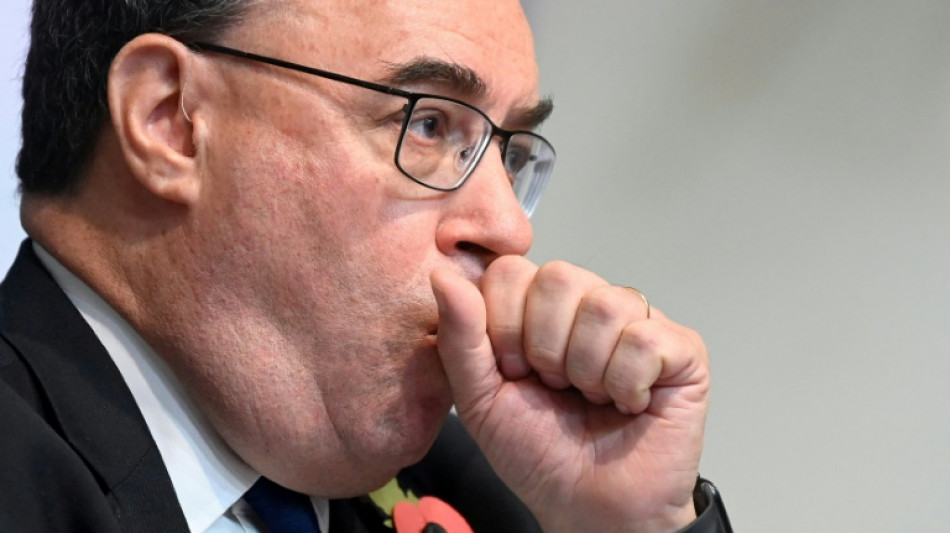
UK central bank blames Brexit for trade slump / Photo: TOBY MELVILLE - POOL/AFP

 Physicians Urge Arizona to Ban Medical Gag Clauses and Enable Private Lawsuits

 New Campaign Highlights Knowledge Gaps on Carbon Monoxide Safety Among Americans

 GoodData.AI Launches the Agentic Serving Plane, a New Category of Enterprise Data Infrastructure for AI Agents

 US Government Questions Effectiveness of Waymo’s School Bus Software Fix

 Panthers expected to begin 2027 NRL season away from new stadium

 Sweet As app launches restaurant discovery platform

 MLA seeks inquiry into reported sectarian gestures on Ormeau Road

 Louise O’Reilly attacks Simon Harris over unemployment remarks
Brexit is hurting the UK economy, Bank of England officials said Wednesday, even as government leaders downplay the impact of the seismic EU withdrawal.
Prime Minister Rishi Sunak's government says the war in Ukraine and the Covid pandemic are the primary reasons why Britain is staring at a painful recession, as it readies budget cuts this week.
But the UK's exit from the European Union is having a disproportionate effect on trade, argued Bank of England monetary policy committee member Swati Dhingra.
"It's undeniable now that we're seeing a much bigger slowdown in trade in the UK compared to the rest of the world," she told the Treasury committee of the House of Commons.
"The simple way of thinking about what Brexit has done to the economy is that in the period after the (2016) referendum, there was the biggest depreciation that any of the world's four major economies have seen overnight," she said.
That contributed to increasing prices and reduced wages, even before inflation soared this year, the economist said.
Bank of England governor Andrew Bailey said the central bank was sticking by its initial prognosis issued after the June 2016 referendum, when it warned that Brexit would shrink the UK economy.
"This (estimate) was done pretty soon after the referendum, it essentially assumes that there is a long-run downshift in the level of productivity, a little over three percent," he told the same committee of MPs.
"As a public official I'm neutral on Brexit per se, but I'm not neutral in saying that these are what we think are the most likely economic effects of it."
- Slump -
Beyond trade flows, one apparent illustration of Brexit's impact emerged this week with new Bloomberg figures showing that the Paris stock market has now outstripped the combined value of London's -- $2.823 trillion to $2.821 trillion.
In 2016, London-listed stocks were collectively worth $1.5 trillion more than those listed in Paris.
Some of the shift since could be explained by the pound's bigger slump against the dollar on currency markets than the euro's.
Former Bank of England policymaker Michael Saunders said without Brexit, the government would have had enough financial firepower to avoid the emergency budget coming on Thursday.
"The UK economy as a whole has been permanently damaged by Brexit," he told Bloomberg TV on Monday.
"It has reduced the economy's potential output significantly, eroded business investment."
Finance minister Jeremy Hunt, who voted in 2016 to stay in the EU, said on Sunday: "I don't deny there are costs to a decision like Brexit, but there are also opportunities, and you have to see it in the round."
T.Batista--PC

