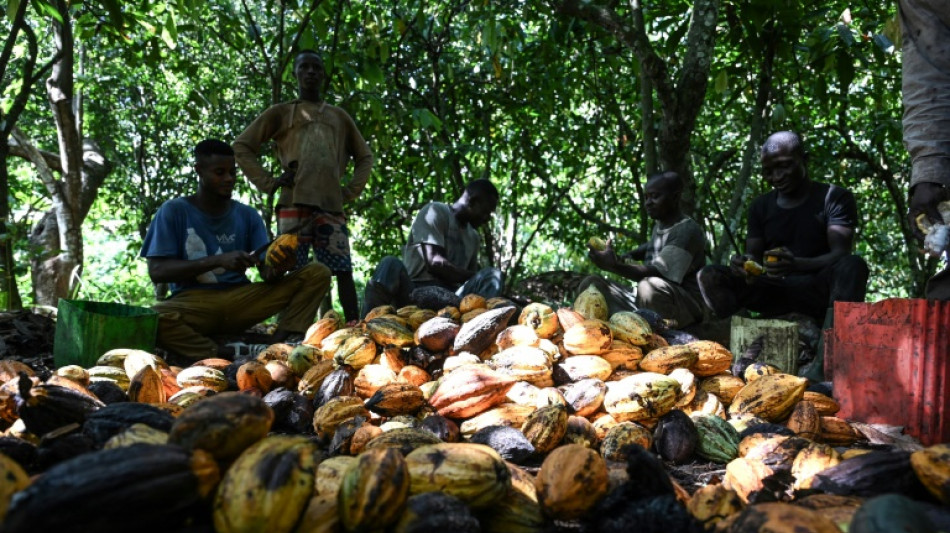
Ivory Coast, Ghana throw down gauntlet on cocoa price / Photo: Sia KAMBOU - AFP

 In Ghana, larger-than-life coffins tell the stories of the dead
 Menoncello, Reece headline Top 14 new-season signings

 Families descend on Nepal in search of missing tourists

 Far-right AfD eyes huge win in east German state vote

 Brazil-Japan to play World Cup rematch at Singapore tournament

 Defence chiefs back boosting US military presence in Australia

 Nepal seeks climate justice after Himalayan disaster

 Stocks rise, yields ease as oil slips on Trump hint at short bombing campaign

 Brussels Diamond League finals Day 1 - five events to watch

 Thailand's 'Jurassic Park' shines light on dinosaur evolution
 'Role model' Stokes set to open for Adelaide Strikers

 Palau urges 'unified' Pacific response to China missile test

 Grinding away: in remote Appalachia, old mills fuel US clean food dreams

 Sabalenka races into US Open third round

 Chinese lucky loser stuns Jodar at US Open

 US Open under the influence: content creators spark debate

 NBA hammers Clippers over Leonard salary cap violations
 NBA strips five first-round draft picks from Clippers for Leonard salary cap violations
 Kane brace helps Bayern win German Cup opener
 Migrant plight, local anger divide Ceuta one month after influx

 Outrage as Maltese tycoon acquitted of reporter's murder

 Rare train of Pacific cyclones fueled by historic El Nino
 Macron, King Charles hail UK-France ties after viewing Bayeux Tapestry

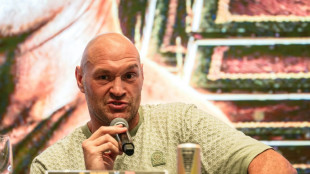 Fury hits out at 'coward' Joshua as 'Battle of Britain' talks go on

 Maltese tycoon acquitted of masterminding reporter's murder

The world's chocolate industry could be in for a turbulent ride as the two biggest cocoa producers set down demands for manufacturers to pay higher prices for their growers.
The quarrel focuses on the Living Income Differential (LID) -- a policy that Ivory Coast and Ghana introduced in 2019 to fight poverty among cocoa farmers in the global $130-billion chocolate market.
Under it, Ivory Coast and Ghana vowed to charge a premium of $400 per tonne on all cocoa sales, starting with the 2020/21 harvest.
But trade boards in the countries -- the Ivorian Coffee-Cocoa Council (CCC) and the Ghana Cocoa Board (Cocobod) -- say the scheme is being undermined as cocoa traders depress the price of another premium that operates in parallel.
"We've introduced the Living Income Differential as a means of improving the farmer income," said Fiifi Boafo, Cocobod's spokesperson.
"You have these companies circumventing these processes to ensure that the Living Income Differential effect is not felt in (their) lives."
The two countries together account for 60 percent of the world's cocoa but their farmers earn less than six percent of the industry's global revenue.
They boycotted a bridge-building meeting in Brussels late last month and set November 20 as a deadline for bringing buyers into line.
They are threatening to punish corporations by barring them from visiting plantations to estimate harvests -- a key factor in cocoa price forecasting.
They are also threatening to suspend sustainability programmes that chocolate giants use to enhance their image with fast-growing ethnic consumers.
"This boycott and also ultimatum is to draw attention to the fact that inasmuch as it is important for us to talk about deforestation, it is important to talk about child labour, it is equally important to talk about the farmer income," said Boafo.
- Premium pressure -
The LID premium is being completed by a price stabilisation fund to help buffer the international price of cocoa in the event of big market fluctuations.
Some experts say the chocolate giants have factored the LID into their costs but claw back some of this by exerting pressure on another premium based on the quality of cocoa beans.
This premium, known as the origin differential, has plunged below zero in recent years, effectively cancelling out part of the LID.
Covid is being used as "a pretext not to pay," CCC President Yves Brahima Kone told AFP. "The thing is, the multinationals have increased their profits -- they are able to pay."
The World Cocoa Foundation, an umbrella group of public entities and corporations aimed at supporting sustainability in the sector, declined to comment on the faceoff.
Among corporations, Nestle said it strongly backed efforts for growers to maintain a decent standard of living and had been paying the LID since its inception.
Some experts say that time may weigh against Ivory Coast and Ghana if the row escalates.
Virtually all of Ivory Coast's crop is purchased by roughly half a dozen majors. Of this, around 80 percent heads to Europe, the wealthy market where sustainability factors -- environmental and labour criteria -- count most for consumers.
"Ivory Coast's economy is heavily dependent on cocoa income," said one specialist. "It needs to sell its beans."
"Stopping sustainability programmes is difficult to explain to the general public, and Ivory Coast's image could (also) suffer."
R.Veloso--PC