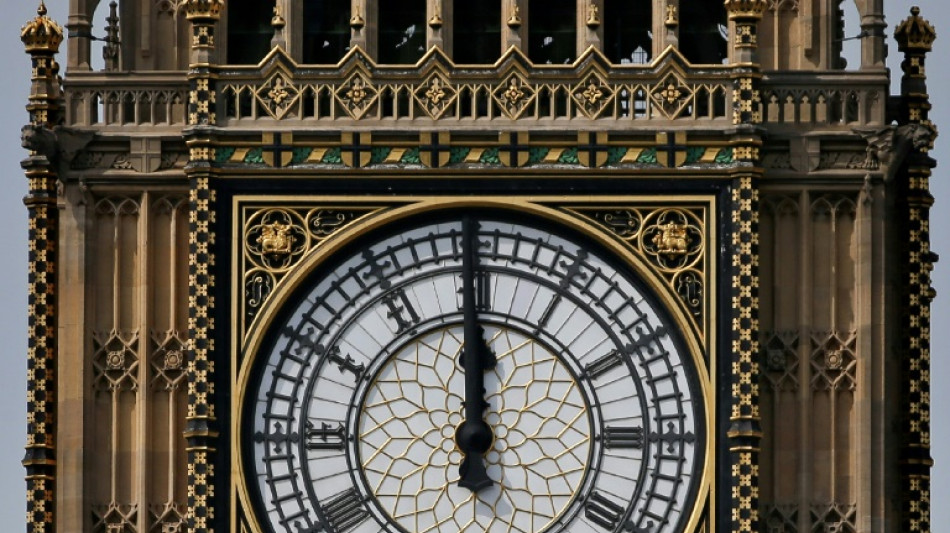
Global timekeepers vote to scrap leap second by 2035 / Photo: Daniel LEAL - AFP/File

 In Ghana, larger-than-life coffins tell the stories of the dead

 Menoncello, Reece headline Top 14 new-season signings

 Families descend on Nepal in search of missing tourists

 Far-right AfD eyes huge win in east German state vote

 Brazil-Japan to play World Cup rematch at Singapore tournament

 Defence chiefs back boosting US military presence in Australia

 Nepal seeks climate justice after Himalayan disaster

 Stocks rise, yields ease as oil slips on Trump hint at short bombing campaign

 Brussels Diamond League finals Day 1 - five events to watch

 Thailand's 'Jurassic Park' shines light on dinosaur evolution

 'Role model' Stokes set to open for Adelaide Strikers

 Palau urges 'unified' Pacific response to China missile test

 Grinding away: in remote Appalachia, old mills fuel US clean food dreams

 Sabalenka races into US Open third round

 Chinese lucky loser stuns Jodar at US Open

 US Open under the influence: content creators spark debate

 NBA hammers Clippers over Leonard salary cap violations

 NBA strips five first-round draft picks from Clippers for Leonard salary cap violations

 Kane brace helps Bayern win German Cup opener

 Migrant plight, local anger divide Ceuta one month after influx

 Outrage as Maltese tycoon acquitted of reporter's murder

 Rare train of Pacific cyclones fueled by historic El Nino

 Macron, King Charles hail UK-France ties after viewing Bayeux Tapestry

 Fury hits out at 'coward' Joshua as 'Battle of Britain' talks go on

 Maltese tycoon acquitted of masterminding reporter's murder

Scientists and government representatives meeting at a conference in France voted on Friday to scrap leap seconds by 2035, the organisation responsible for global timekeeping said.
Similar to leap years, leap seconds have been periodically added to clocks over the last half century to make up for the difference between exact atomic time and the Earth's slower rotation.
While leap seconds pass by unnoticed for most people, they can cause problems for a range of systems that require an exact, uninterrupted flow of time, such as satellite navigation, software, telecommunication, trade and even space travel.
It has caused a headache for the International Bureau of Weights and Measures (BIPM), which is responsible for Coordinated Universal Time (UTC) -- the internationally agreed standard by which the world sets its clocks.
A resolution to stop adding leap seconds by 2035 was passed by BIPM members and others at the 27th General Conference on Weights and Measures, which is held roughly every four years at the Versailles Palace west of Paris.
The head of BIPM's time department, Patrizia Tavella, said the "historic decision" would allow "a continuous flow of seconds without the discontinuities currently caused by irregular leap seconds".
"The change will be effective by or before 2035," she told AFP via email.
"The connection between UTC and the rotation of the Earth is not lost, UTC remains related to Earth," she said, adding that "nothing will change" for the public.
- A leap minute? -
Seconds were long measured by astronomers analysing the Earth's rotation, however the advent of atomic clocks -- which use the frequency of atoms as their tick-tock mechanism -- ushered in a far more precise era of timekeeping.
The problem is that Earth's slightly slower rotation means the two times are out of sync.
To bridge the gap, leap seconds were introduced in 1972, and 27 have been added at irregular intervals since -- the last in 2016.
Under the proposal, leap seconds will continue to be added as normal for the time being.
From around 2035, the difference between atomic and astronomical time will be allowed to grow to a larger value than one second, Judah Levine, a physicist at the US National Institute of Standards and Technology, told AFP.
"The larger value is yet to be determined," said Levine, who spent years helping draft the resolution alongside Tavella.
Negotiations will be held to find a proposal by 2035 to determine that value and how it will be handled, according to the resolution.
The breakdown of which countries voted for the resolution was not yet known, but the United States and France have been among those leading the way for the change.
Levine said it was important to protect UTC time because it is run by "a worldwide community effort" in the BIPM, which has 59 member states and consults with other nations.
GPS time, a potential UTC rival governed by atomic clocks, is run by the United States military "without worldwide oversight", Levine said.
A possible solution to the problem could be letting the discrepancy between the Earth's rotation and atomic time build up to a minute.
It is difficult to say exactly how often that might be needed, but Levine estimated anywhere between 50 to 100 years.
Instead of then adding on a leap minute to clocks, Levine proposed a "kind of smear", in which the last minute of the day takes two minutes.
"The advance of a clock slows, but never stops," he said.
P.L.Madureira--PC