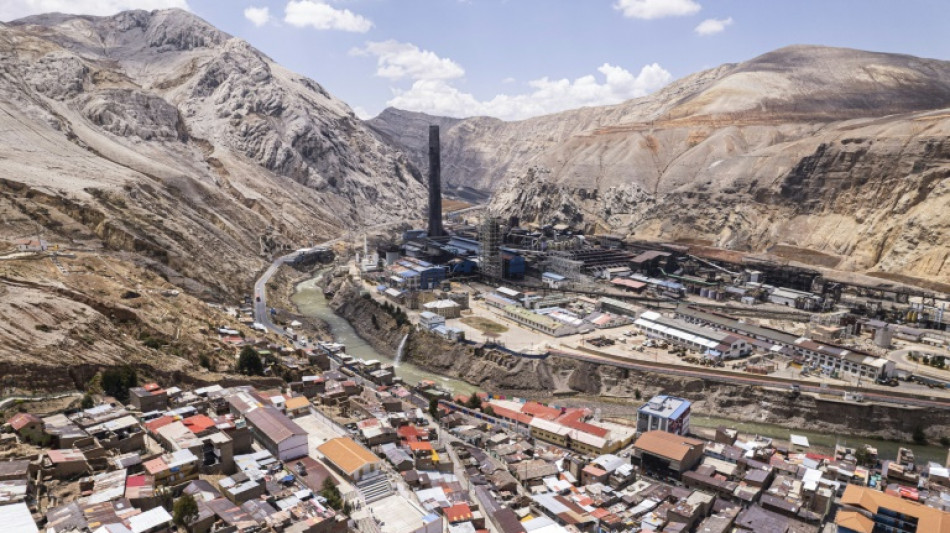
Health or jobs: Peruvian mining town at a crossroads / Photo: Ernesto BENAVIDES - AFP

 In Ghana, larger-than-life coffins tell the stories of the dead
 Menoncello, Reece headline Top 14 new-season signings

 Families descend on Nepal in search of missing tourists
 Far-right AfD eyes huge win in east German state vote

 Brazil-Japan to play World Cup rematch at Singapore tournament

 Defence chiefs back boosting US military presence in Australia

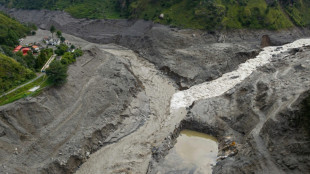 Nepal seeks climate justice after Himalayan disaster

 Stocks rise, yields ease as oil slips on Trump hint at short bombing campaign

 Brussels Diamond League finals Day 1 - five events to watch

 Thailand's 'Jurassic Park' shines light on dinosaur evolution
 'Role model' Stokes set to open for Adelaide Strikers
 Palau urges 'unified' Pacific response to China missile test

 Grinding away: in remote Appalachia, old mills fuel US clean food dreams

 Sabalenka races into US Open third round

 Chinese lucky loser stuns Jodar at US Open

 US Open under the influence: content creators spark debate

 NBA hammers Clippers over Leonard salary cap violations

 NBA strips five first-round draft picks from Clippers for Leonard salary cap violations

 Kane brace helps Bayern win German Cup opener

 Migrant plight, local anger divide Ceuta one month after influx
 Outrage as Maltese tycoon acquitted of reporter's murder

 Rare train of Pacific cyclones fueled by historic El Nino
 Macron, King Charles hail UK-France ties after viewing Bayeux Tapestry

 Fury hits out at 'coward' Joshua as 'Battle of Britain' talks go on

 Maltese tycoon acquitted of masterminding reporter's murder

The Peruvian mining city of La Oroya, one of the most polluted places in the world, is seeking to reopen a heavy metal smelter that poisoned residents for almost a century.
The Andean city, situated in a high-altitude valley at 3,750 meters (12,300 feet), is a grey, desolate place.
Small houses and shops -- many abandoned -- cluster around towering black chimneys, surrounded by ashen mountain slopes corroded by heavy metals and long devoid of vegetation.
In 2009, the gigantic smelter that was the economic heartbeat of La Oroya went bankrupt, forcing residents to leave in droves and bringing local commerce to its knees.
Since 1922, the plant processed copper, zinc, lead, gold, selenium, and other minerals from nearby mines.
If the metallurgical complex reopens, as announced by its new owners in October, it could breathe life back into the economy.
"The large majority of the population is eager and has waited a long time for this to start up again, because it is the source of life, the economic source," said 48-year-old taxi driver Hugo Enrique.
But at what cost?
- A lifetime of disease -
In 2011, La Oroya was listed as the second-most polluted city on Earth, falling into fifth place two years later, according to the Blacksmith Institute, an NGO which works on pollution issues.
It was in insalubrious company, rubbing shoulders with Ukraine's nuclear-sullied Chernobyl and Russia's Dzerzhinsk, the site of Cold War-era factories producing chemical weapons.
According to the International Federation for Human Rights, in 2013, 97 percent of La Oroya children between six months and six years of age, and 98 percent between age seven and 12, had elevated levels of lead in their blood.
Manuel Enrique Apolinario, 68, a teacher who lives opposite the foundry, told AFP his body has high levels of lead, arsenic, and cadmium.
Residents had "gotten used to the way of life, surrounded by smoke and toxic gases," he said.
"Those of us who have lived here for a lifetime have been ill with flu and bronchitis, especially respiratory infections."
- Another 100 years?-
The foundry was opened in 1922, nationalized in 1974, and later privatized in 1997 when US natural resources firm Doe Run took it over.
In June 2009, Doe Run halted work after failing to comply with an environmental protection program and declared itself insolvent.
Now, despite years of residents accusing Lima and Doe Run of turning a blind eye to the harmful effects, some 1,270 former employees want to reopen the smelter next March -- with the vow not to pollute.
Luis Mantari, one of the new owners, who is in charge of logistics, said the plant would operate "with social and environmental responsibility."
"We want this unique complex to last another 100 years," added human resources boss Jose Aguilar.
The company has stockpiled 14 million tonnes of copper and lead slag waste waiting to be converted into zinc.
"Those of us who fought against pollution have never opposed to the company working. Let it reopen with an environmental plan," said Pablo Fabian Martinez, 67, who also lives near the site.
For many, though, the decision comes down to pure pocketbook issues.
"I want it to reopen because, without the company, La Oroya lost its entire economy," added Rosa Vilchez, a 30-year-old businesswoman. Her husband left to work in another city after the closure.
- Respect health -
In 2006, La Oroya residents sued the Peruvian government at the Inter-American Commission on Human Rights for allowing the company to pollute at will.
Hearings began in October with the court sitting in the Uruguayan capital Montevideo, and residents recounted how they struggled with burning throats and eyes, headaches, and difficulty breathing.
Others told of tumors, muscular problems, and infertility blamed on pollution from the smelters.
The commission found last year that the state had failed to regulate and oversee the behavior of the mining company and "compromised its obligation to guarantee human rights."
"We are aware that the metallurgical complex is a source of employment. We don't deny that," said Yolanda Zurita, one of the litigants, who plants trees to counter the pollution.
"But it must respect the population's health."
A.S.Diogo--PC