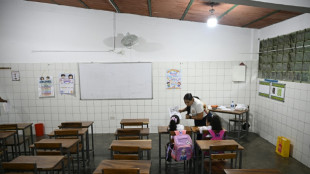
'Work without limits': Japan's teachers battle for change
/ Photo: Kazuhiro NOGI - AFP

 Trump's beef policies irk Texas ranchers, testing their loyalty

 Nvidia, OpenAI CEOs to attend Xi dinner at White House

 Anthropic picks Accenture for in-house AI safety evaluation

 Balogun returns as Monaco beat Lens to continue strong Ligue 1 start

 'Pause' on overt repression in Venezuela, but reforms still needed: HRW

 Global stocks mixed as yen falls despite Bank of Japan rate hike

 Cuba hit with seventh major blackout of the year

 Murray out with concussion so Wentz will start for Vikings

 UN chief 'deeply regrets' US visa refusal to Abbas for annual meeting

 England quick Carse to face no charges over alleged nightclub assault

 Mancini brings nine newcomers into the first squad of his Italy comeback

 Czechs level Davis Cup tie against USA as South Korea eye Finals

 New France boss Zidane confirms Mbappe as captain after naming first squad

 California governor signs order to explore AI 'kill switch'

 Head leads run spree as Australia win Zimbabwe ODI series

 In-form Raphinha wants to finish career at Barcelona

 Warren Buffett steps down as Berkshire Hathaway chairman

 Carrick confident Man Utd can 'work through' tough time

 Mbappe ends Nike partnership to join Swiss brand On

 Liverpool boss Iraola puts Bournemouth love affair on hold

 'A disaster' if Man City do not win says Maresca after flawless start

 Kerry James Marshall: American 'blackness' painter celebrated in Europe

 Spain coach De la Fuente offers 'full support' to people of Ceuta

 Russia seizes assets of Nestle, French firms over West's Ukraine support
 England can build on World Cup 'spirit', says Tuchel

In one of his last diary entries, Japanese teacher Yoshio Kudo lamented workdays that started early and could last until nearly midnight. Two months later, he suffered "karoshi" -- death from overwork.
Kudo's taxing schedule was far from an exception in Japan, where teachers work some of the longest hours in the world, saddled with tasks from cleaning and supervising school commutes to after-school clubs.
A 2018 OECD survey found Japanese middle school teachers work 56 hours a week, versus an average 38 hours in most developed countries.
But that still fails to account for astonishing amounts of overtime.
One probe by a union-affiliated think tank showed school teachers work an average 123 hours of overtime each month, pushing their weekly workload well beyond the so-called "karoshi line" of 80 hours.
Teachers say they are reaching the breaking point, and some have challenged the culture through lawsuits. This year, Japan's ruling party established a task force to study the issue.
That came too late for Kudo, a middle school teacher, who died of a brain haemorrhage aged 40 in 2007.
At his funeral, stunned students told his wife Sachiko that the lively physical education teacher was the "furthest imaginable person from death".
"He just loved working with kids," Sachiko, 55, told AFP.
But in his final weeks, he was struggling with his hours.
"Towards the end, he was telling me that teachers should stop working like this and that he wanted to lead that change in the future," his widow said.
- 'Kiss your weekends goodbye' -
Japanese authorities have ordered steps including outsourcing and digitalising some tasks.
"Our measures to reform work conditions for teachers are making steady progress," education minister Keiko Nagaoka told parliament in October.
But she acknowledged that many "continue to work long hours" and "efforts need to be accelerated".
Education ministry data shows a gradual decline in overtime, but experts see little fundamental change.
From reams of paperwork to tasks like lunch distribution, leading daily cleaning sessions with students and monitoring children on their way to and from school, teachers in Japan "have in a way become handymen", school management consultant Masatoshi Senoo said.
"What should really be the responsibility of parents sometimes spills over onto teachers, who can even be sent to apologise to local residents when students misbehave at parks or convenience stores," he said.
One of the most all-consuming tasks is the supervision of student sports and cultural "club" activities, typically conducted after school and on weekends.
"Being assigned as primary supervisor of one of these clubs usually means you have to kiss your weekends goodbye," said Takeshi Nishimoto, a high school history teacher in Osaka.
In June, Nishimoto, 34, won a rare lawsuit seeking compensation for stress from overwork.
He filed the suit after coming close to a nervous breakdown in 2017, when the then-rugby club supervisor worked 144 hours of overtime in a single month.
- 'Sacred job' -
Experts say teachers are particularly vulnerable to overwork because of a decades-old law that essentially prevents them from being paid for overtime.
Instead, the law adds eight hours' worth of extra pay to their monthly salaries, a framework that Nishimoto says results in "making teachers work without limits for fixed pay".
Masako Shimonomura, a middle school physical education teacher in Tokyo's Edogawa district, says it can feel hard to take a proper break in her day.
"Not everything about this job is 'black' though," she said, using a Japanese term for exploitative labour.
"There are some moments I live for, like watching students in my softball club shine and smile at tournaments," said the 56-year-old, whose desk is covered with stacks of files and documents.
But she fears that if conditions don't improve, "the image of our profession as 'black' will dominate for younger generations".
An investigation by the Mainichi newspaper revealed that in the decade to 2016, there were 63 public school teacher deaths classified as caused by overwork.
But it took Kudo's widow five years to get her husband's death recognised as karoshi, a task complicated by the lack of records for his work hours.
She says teaching is often seen as a "sacred job" devoted to children, so anything viewed as selfish -- including taking note of hours worked -- can be frowned upon.
"So many teachers regret that they lived their lives without stopping to enjoy the growth of their own children," she said.
A former schoolteacher herself, Sachiko now heads an anti-karoshi group in central Japan.
"I feel like my husband and I are working together to follow through on his last words -- that he wants to change the working practices of teachers".
T.Batista--PC