Polish school offers Ukraine teens 'semblance of normalcy'

 Kennedy Center: future unclear for iconic Washington arts hub

 Trump claims 'infinite' Greenland security deal with Denmark

 Helicopters battle wildfire threatening Ecuador's capital

 Brentford batter Chelsea to undo Alonso's promising start

 Kane hits Bundesliga century as Bayern rout Union

 Trump says CNN, MS NOW, Politico banned from White House

 Hushing and hedging: US companies retreat on climate

 Springboks to face Fiji before 2027 Rugby World Cup

 Nigeria miners struggled to breathe in cell before 37 died: survivors

 McIlroy on the charge at PGA Championship as Reed withdraws

 McIlroy on the charge at PGA Championship

 Crisis-wracked Volkswagen warns of 10-bn-euro hit to profits

 Costa Rica's Grynspan tops third informal poll for UN chief: diplomat

 Stock markets retreat after central bank rate hikes

 Russia labels director of Cannes Grand Prix winner a 'foreign agent'

 Macron warns of Russian 'hybrid' threat after meeting presidential hopefuls

 UN holds third informal poll for new chief

 Kulusevski return can spark Spurs: De Zerbi

 Shakira to cap off world tour with Madrid 12-gig run

 Isolated Syrian-Druze city blames Damascus for shortages

 Isolated Syrian-Druze city shortages

 Dutch drop Depay for Germany match in Xavi's first pick

 Ronaldo named in Portugal squad for Nations League

 Stock markets diverge after central bank rate hikes
 Anti-Assad music star makes triumphant return to Syria
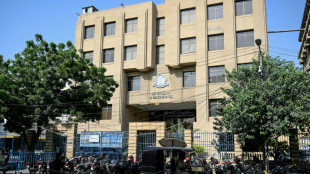
Stuck to the door of one Warsaw high school is the sign "Laskavo prosimo do shkoli", or "Welcome to school" in Ukrainian, along with the flags of Poland and Ukraine.
Chattering in Russian and Ukrainian, teenagers who have just fled their wartorn homeland use magnetic key cards to enter and are welcomed again with a large yellow-blue flag and the slogan "Slava Ukraini" or "Glory to Ukraine".
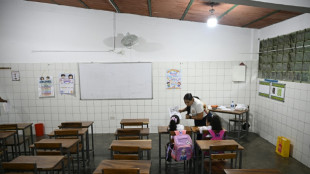
It is their first day of school in Poland, where the 13- to 15-year-olds have sought shelter since Russia invaded their country.
Divided into two groups of 20, they are greeted by their new teacher, who shuttles from one classroom to the other throughout the lesson.
From the Ukrainian city of Lviv, a refugee just like them, Mariana Druchek, lays out the plan for the day and passes out a maths test.
"Uh oh," comes the response. Viktoria, 16, and 15-year-olds Polina and Zoriana are in a panic.
"It's on things we covered three years ago, in grade eight -- I forgot it all," said Viktoria, to which the others chime in with "same".
But they relax soon enough. By break time, they are all smiles, saying the atmosphere is "really good" and "positive" and "the class and school in general are all right".
It is as if their mad dash out of Kyiv with barely any luggage -- to the backdrop of bombs and blasts -- was already fading somewhat into the distance.
But the sense of danger is still there.
"We're afraid the Russians will even make their way over here, because everything is possible," Viktoria told AFP.
- 'Education and peace' -
Limanowski High School has been able to accommodate the new students and hire new teachers thanks to funding from the mayor's office.
On day one, Renata Kozlowska, a city official for the school's neighbourhood of Zoliborz, came to welcome the teenagers.
She told them that "all of Poland is with you" and stressed that they have the right to "an education and peace".
The teenagers -- who come from various cities, including Kyiv, Zhytomyr, Lutsk and Ivano-Frankivsk -- will follow a pared-down version of Poland's curriculum, including English, Polish, history, maths, physics and gym.
The classes will be taught by Ukrainian teachers who themselves had fled the war, with a bilingual educator at the helm of each group.
"What's most important is to offer them some semblance of normalcy and quiet," the school's principal Andrzej Wyrozembski told AFP.
Druchek, who crossed into Poland with her three children just after the invasion, agrees.
"It's not a matter of maintaining their knowledge levels, but to make sure they have psychological support and friends, that they know that everyone wants to help," she said.
- 54,000 Ukrainians enrolled -
Janusz, a Polish student at Limanowski, said he is all for the initiative, calling it "cool" to have welcomed the Ukrainians into their school.
"It means they can keep going to school and won't be thinking non-stop about what's going on in Ukraine," he added.
While the new students will be attending separate classes from their Polish counterparts, the school is keen on helping them integrate.
Each Ukrainian will be partnered up with a Pole their age to join for after-school activities and the like.
Limanowski is the first school in town to have launched such a programme, but others are due to follow soon.
Wyrozembski stressed that it was his teachers who took the lead on the initiative once refugees began flooding Poland.
But he too had his reasons to get involved: when Nazi Germany attacked Poland in September 1939, his father fled Warsaw for Lviv, which was a Polish city at the time.
Since the invasion began, nearly 54,000 Ukrainian children have been enrolled in Polish schools, Education Minister Przemyslaw Czarnek said Wednesday.
For Wyrozembski, the most important thing now would be to set up special schools for Ukrainian students aged 16 and 17, who would normally be preparing for a final exam before college.
Were they to switch to the Polish curriculum now and prepare for the equivalent testing here, it would "put them back three or four years," he said.
M.Carneiro--PC