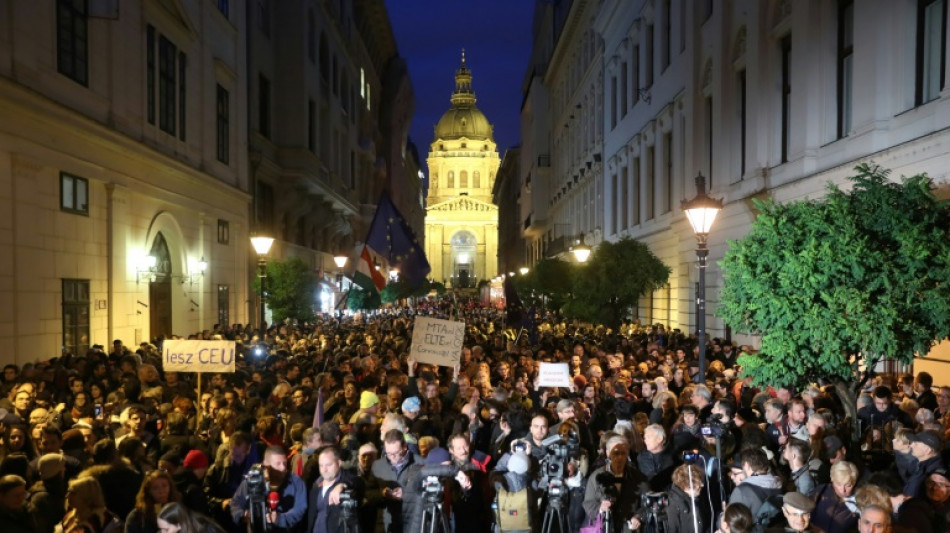
Academic freedom declining globally, index finds / Photo: FERENC ISZA - AFP/File

 Trump's beef policies irk Texas ranchers, testing their loyalty

 Nvidia, OpenAI CEOs to attend Xi dinner at White House

 Anthropic picks Accenture for in-house AI safety evaluation

 Balogun returns as Monaco beat Lens to continue strong Ligue 1 start

 'Pause' on overt repression in Venezuela, but reforms still needed: HRW

 Global stocks mixed as yen falls despite Bank of Japan rate hike

 Cuba hit with seventh major blackout of the year

 Murray out with concussion so Wentz will start for Vikings

 UN chief 'deeply regrets' US visa refusal to Abbas for annual meeting

 England quick Carse to face no charges over alleged nightclub assault

 Mancini brings nine newcomers into the first squad of his Italy comeback

 Czechs level Davis Cup tie against USA as South Korea eye Finals

 New France boss Zidane confirms Mbappe as captain after naming first squad

 California governor signs order to explore AI 'kill switch'

 Head leads run spree as Australia win Zimbabwe ODI series

 In-form Raphinha wants to finish career at Barcelona

 Warren Buffett steps down as Berkshire Hathaway chairman

 Carrick confident Man Utd can 'work through' tough time

 Mbappe ends Nike partnership to join Swiss brand On

 Liverpool boss Iraola puts Bournemouth love affair on hold

 'A disaster' if Man City do not win says Maresca after flawless start

 Kerry James Marshall: American 'blackness' painter celebrated in Europe

 Spain coach De la Fuente offers 'full support' to people of Ceuta

 Russia seizes assets of Nestle, French firms over West's Ukraine support

 England can build on World Cup 'spirit', says Tuchel

Just one in three people live a nation that guarantees the independence of universities and research, according to an annual index warning that academic freedom is declining worldwide, particularly in Russia, China and India.
Attacks on freedom of expression, interference at universities and the imprisonment of researchers are just some ways that "academic freedom globally is under threat," the index said.
The Academic Freedom Index -- based on input from more than 2,300 experts in 179 countries -- was published last month as part of a report on democracy by the V-Dem Institute at Sweden's University of Gothenburg.
It measures changes in higher education and research over the last half century by looking at five different indicators: freedom of research and teaching; of academic exchange; of academic and cultural expression; of institutional autonomy and campus integrity.
Katrin Kinzelbach, professor at Germany's University of Erlangen-Nuremberg and one of the organisers of the index, told AFP that 171 states have ratified a human rights treaty which commits them to respect the freedom of scientific research.
But because of recent "significant deteriorations" in countries with large populations, "only every third person in the world today lives in a country where research and higher education enjoys a high degree of freedom," she said.
Accounting for the world's growing population, the proportion of people living in nations with academic freedom is comparable to 1973, she added.
"Now, 45.5 percent of the world's population -- 3.6 billion people -- live in 27 countries where academic freedom is completely restricted," the report said.
- 'From bad to worse' -
Significant declines were particularly seen in India, China and Russia -- the first, second and ninth most populous nations -- which Kinzelbach called "clear examples of autocratisation".
"Academic freedom has fallen dramatically" in India since Prime Minister Narendra Modi took power in 2014, she said.
Kinzelbach cited the example of British-Indian academic Nitasha Kaul, a politics professor at the UK's University of Westminster denied entry to India for a conference last month.
In Russia and China, "academic freedom was never great, and it has now deteriorated from bad to worse," Kinzelbach said.
Perhaps more surprisingly, the index found academic freedom had also fallen in the United States since 2019, which Kinzelbach called "a shock for many academics".
She emphasised both society and the political system in the US were "highly polarised".
"University campuses have become arenas where this polarisation unfolds," she said, calling for "calm, evidence-based debates on campus -- including about highly divisive issues."
Most European countries had very high academic freedom according to the index, with Hungary scoring the lowest rate followed by Poland.
However Kinzelbach said Poland's score will likely improve under the new government of Prime Minister Donald Tusk.
M.Carneiro--PC