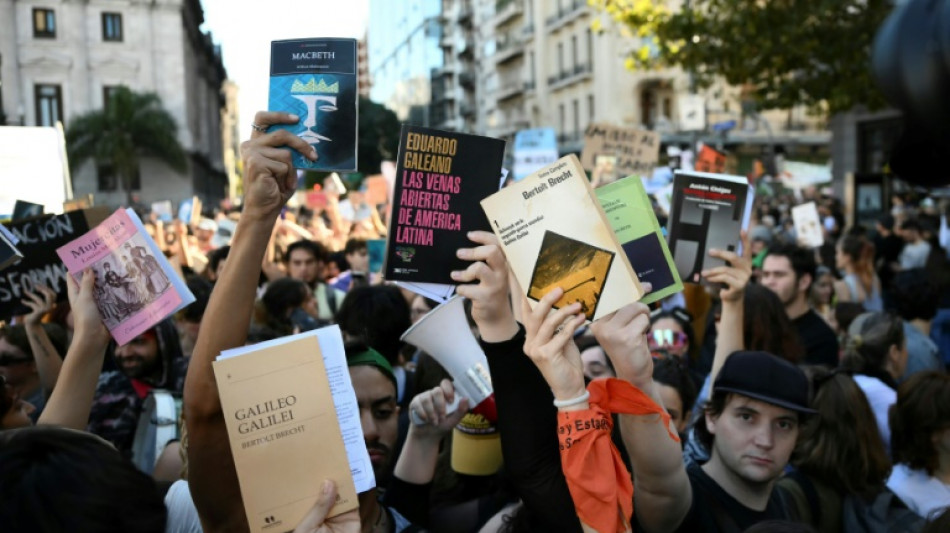
Large crowds march against Argentina public university cuts / Photo: Luis ROBAYO - AFP

 Trump's beef policies irk Texas ranchers, testing their loyalty

 Nvidia, OpenAI CEOs to attend Xi dinner at White House

 Anthropic picks Accenture for in-house AI safety evaluation

 Balogun returns as Monaco beat Lens to continue strong Ligue 1 start

 'Pause' on overt repression in Venezuela, but reforms still needed: HRW

 Global stocks mixed as yen falls despite Bank of Japan rate hike

 Cuba hit with seventh major blackout of the year

 Murray out with concussion so Wentz will start for Vikings

 UN chief 'deeply regrets' US visa refusal to Abbas for annual meeting

 England quick Carse to face no charges over alleged nightclub assault

 Mancini brings nine newcomers into the first squad of his Italy comeback

 Czechs level Davis Cup tie against USA as South Korea eye Finals

 New France boss Zidane confirms Mbappe as captain after naming first squad

 California governor signs order to explore AI 'kill switch'

 Head leads run spree as Australia win Zimbabwe ODI series

 In-form Raphinha wants to finish career at Barcelona

 Warren Buffett steps down as Berkshire Hathaway chairman

 Carrick confident Man Utd can 'work through' tough time

 Mbappe ends Nike partnership to join Swiss brand On

 Liverpool boss Iraola puts Bournemouth love affair on hold

 'A disaster' if Man City do not win says Maresca after flawless start

 Kerry James Marshall: American 'blackness' painter celebrated in Europe

 Spain coach De la Fuente offers 'full support' to people of Ceuta

 Russia seizes assets of Nestle, French firms over West's Ukraine support

 England can build on World Cup 'spirit', says Tuchel
Hundreds of thousands of Argentines took to the streets on Tuesday, protest organizers said, to voice outrage at cuts to higher public education under budget-slashing new President Javier Milei.
Joined by professors, parents and alumni from the economic crisis-riddled South American country's 57 state-run universities, students rose up "in defense of free public university education."
Labor unions, opposition parties and private universities backed the protests in Buenos Aires and other major cities such as Cordoba -- in one of the biggest demonstrations yet against the austerity measures introduced since Milei took office in December.
Police said around 100,000 people turned out Tuesday in the capital alone, while organizers put the number at closer to half-a-million -- paralyzing the city center for hours on end.
A teachers' union reported a million protesters countrywide.
Third-year medicine student Pablo Vicenti, 22, told AFP in Buenos Aires he was outraged at the government's "brutal attack" on the university system.
"They want to defund it with a false story that there is no money. There is, but they choose not to spend it on public education," he said.
Milei won elections last November vowing to take a chainsaw to public spending and reduce the budget deficit to zero.
To that end, his government has slashed subsidies for transport, fuel and energy even as wage-earners have lost a fifth of their purchasing power.
Thousands of public servants have lost their jobs, and Milei has faced numerous anti-austerity protests.
His government dismissed Tuesday's protests as "political."
- Under the poverty line -
Universities declared a financial emergency after the government approved a 2024 budget the same as the one for 2023, despite annual inflation approaching 290 percent.
On top of that, higher learning institutions say a near 500-percent monthly increase in energy costs has brought them to their knees.
"At the rate at which they are funding us, we can only function between two or three more months," said University of Buenos Aires (UBA) rector Ricardo Gelpi.
As the ire has built, Milei conceded a 70-percent increase in funding for public universities' operating expenses in March, to be followed by another 70 percent in May and a one-off grant to university hospitals.
Operating expenses exclude teacher salaries, which make up about 90 percent of a university budget.
"Of the four teaching categories, three have fallen under the poverty line," said the rector of the National University of San Luis, Victor Morinigo.
In a post on X over the weekend, Milei called into question how public universities spend their funds, and said the institutions "are used for shady business and to indoctrinate."
On Monday, presidential spokesman Manuel Adorni argued that Argentina's public education system has been declining for decades, with plunging rates of university passes.
Some 2.2 million people study in the public university system in a country where the poverty level has reached nearly 60 percent of the population, according to a recent study.
"Don't expect a way out through public spending," Milei warned on Monday, as he hailed Argentina's first quarterly budget surplus since 2008.
X.Brito--PC