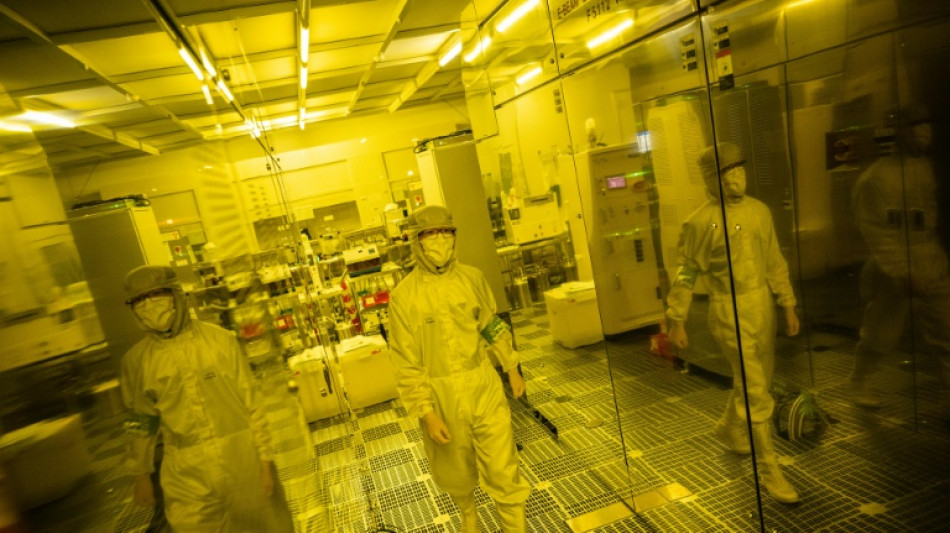
Inside a semiconductor 'clean room' at Japan's top university / Photo: Yuichi YAMAZAKI - AFP

 Trump's beef policies irk Texas ranchers, testing their loyalty

 Nvidia, OpenAI CEOs to attend Xi dinner at White House

 Anthropic picks Accenture for in-house AI safety evaluation

 Balogun returns as Monaco beat Lens to continue strong Ligue 1 start

 'Pause' on overt repression in Venezuela, but reforms still needed: HRW

 Global stocks mixed as yen falls despite Bank of Japan rate hike

 Cuba hit with seventh major blackout of the year

 Murray out with concussion so Wentz will start for Vikings

 UN chief 'deeply regrets' US visa refusal to Abbas for annual meeting

 England quick Carse to face no charges over alleged nightclub assault

 Mancini brings nine newcomers into the first squad of his Italy comeback

 Czechs level Davis Cup tie against USA as South Korea eye Finals

 New France boss Zidane confirms Mbappe as captain after naming first squad

 California governor signs order to explore AI 'kill switch'

 Head leads run spree as Australia win Zimbabwe ODI series

 In-form Raphinha wants to finish career at Barcelona

 Warren Buffett steps down as Berkshire Hathaway chairman

 Carrick confident Man Utd can 'work through' tough time

 Mbappe ends Nike partnership to join Swiss brand On

 Liverpool boss Iraola puts Bournemouth love affair on hold

 'A disaster' if Man City do not win says Maresca after flawless start

 Kerry James Marshall: American 'blackness' painter celebrated in Europe

 Spain coach De la Fuente offers 'full support' to people of Ceuta

 Russia seizes assets of Nestle, French firms over West's Ukraine support

 England can build on World Cup 'spirit', says Tuchel

To study semiconductors at Japan's top university, first you need the right clothes -- protective overalls, shoe covers, plastic gloves and a lightweight balaclava to keep your hair out of the way.
Then, surgical mask in place, you step inside an "air shower" to remove all the dust from your body that could potentially contaminate the precision equipment.
Now, you are ready to enter the University of Tokyo's clean room, a highly controlled space where microchips are handled.
Clean rooms, a vital part of semiconductor factories, are also found at such universities, where aspiring tech innovators conduct research.
Chips are an indispensable part of the modern economy, used in everything from smartphones to cars and weapons.
That has made them politically sensitive, with the industry frequently caught in the crossfire as the United States and China tussle over access to advanced tech.
Japan is also ramping up its efforts to revive its once-world-leading chip industry: the government has promised up to $25 billion in subsidies to help triple sales of domestically produced chips by 2030.
Taiwanese chip behemoth TSMC opened a semiconductor factory in southern Japan in February and is planning a second facility for more advanced chips.
And a multi-billion-dollar joint venture called Rapidus, involving Sony, Toyota, IBM and others, aims to mass produce next-generation logic chips in Japan from 2027.
Chip expert and University of Tokyo professor Tadahiro Kuroda said Japan's push into a sector where it was once dominant feels like "spring has returned".
At the university's 600 square-metre (6,500 square-foot) chip lab, filled with cutting-edge machines, students use tweezers to handle the delicate materials.
With pipettes, they drip a red liquid chemical onto gleaming, pristine silicon wafers designed to contain a dizzying number of tiny transistors.
PhD student Kei Misumi, 27, who regularly works in the clean room, told AFP he hopes such advanced technology will further enrich people's lives.
L.Torres--PC