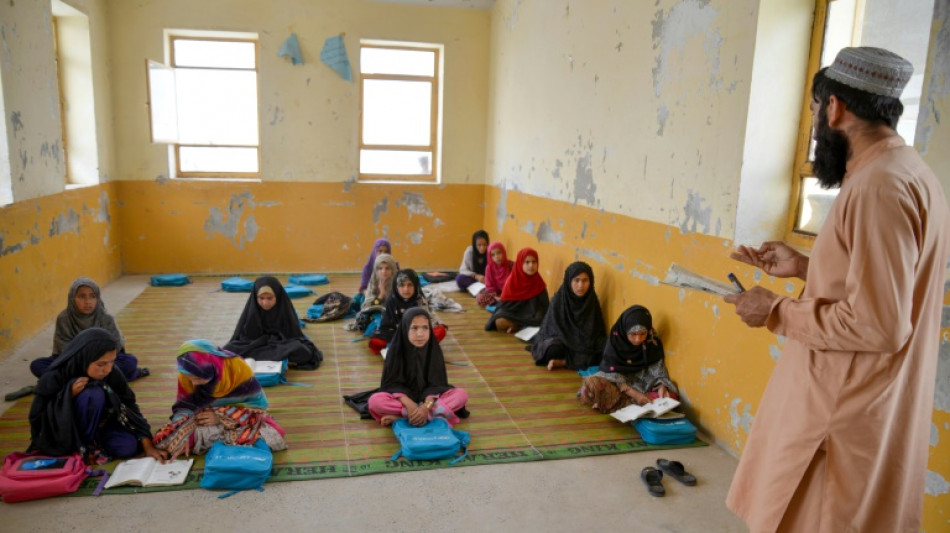
1.4 mn girls banned from Afghan schools since Taliban return: UNESCO / Photo: Sanaullah SEIAM - AFP

 Hong Kong court set to sentence activist Joshua Wong in security case
 Australia raises benchmark rate to highest level in 18 years

 'The Remarried Empress' Cast Discusses Bringing Fantasy Royal Drama to Life

 Asian stocks retreat as AI worries outweigh steep oil-price drop

 Hamad International Airport stages emergency drills during WATAN 2026

 Global failure to punish attacks leaves journalists at continuing risk

 Researchers Warn 'Bookkeeping Trick' Masks Beef Industry's Methane Emissions

 Climate Change Intensified Atlantic Hurricanes, Study Finds

 Qatar solar expansion opens scope for technical performance gains

 IXOPAY Announces IXO One, a Modular Payments Platform Built for an Era of Fluid Commerce
At least 1.4 million girls in Afghanistan have been denied access to secondary education since the Taliban returned to power in 2021, with the future of an entire generation now "in jeopardy", the United Nations' cultural agency said Thursday.
Access to primary education has also fallen sharply, with 1.1 million fewer girls and boys attending school, UNESCO said in a statement as the Taliban authorities marked three years since retaking Afghanistan on August 15, 2021.
"UNESCO is alarmed by the harmful consequences of this increasingly massive drop-out rate, which could lead to a rise in child labour and early marriage," the agency said.
"In just three years, the de facto authorities have almost wiped out two decades of steady progress for education in Afghanistan, and the future of an entire generation is now in jeopardy."
There are now nearly 2.5 million girls deprived of their right to education, representing 80 percent of Afghan school-age girls, the UN agency said.
The Taliban administration, which is not recognised by any other country, has imposed restrictions on women that the UN has described as "gender apartheid."
Afghanistan is the only country in the world to stop girls and women attending secondary schools and universities.
"As a result of bans imposed by the de facto authorities, at least 1.4 million girls have been deliberately denied access to secondary education since 2021," UNESCO said.
This represents an increase of 300,000 since the previous count carried out by the UN agency in April 2023.
UNESCO Director General Audrey Azoulay urged the international community to remain mobilised "to obtain the unconditional reopening of schools and universities to Afghan girls and women."
The number of primary pupils has also fallen. Afghanistan had only 5.7 million girls and boys in primary school in 2022, compared with 6.8 million in 2019, UNESCO said.
The UN agency blamed the drop on the authorities' decision to ban female teachers from teaching boys as well as the lack of incentive for parents to send children to school.
Enrolment in higher education in equally concerning, the statement said, adding that the number of university students had decreased by 53 percent since 2021.
"As a result, the country will rapidly face a shortage of graduates trained for the most highly-skilled jobs, which will only exacerbate development problems," UNESCO said.
S.Pimentel--PC