Fleeing jihadist violence, Niger pupils return to school / Photo: BOUREIMA HAMA - AFP

 Kennedy Center: future unclear for iconic Washington arts hub

 Trump claims 'infinite' Greenland security deal with Denmark

 Helicopters battle wildfire threatening Ecuador's capital

 Brentford batter Chelsea to undo Alonso's promising start

 Kane hits Bundesliga century as Bayern rout Union

 Trump says CNN, MS NOW, Politico banned from White House

 Hushing and hedging: US companies retreat on climate

 Springboks to face Fiji before 2027 Rugby World Cup

 Nigeria miners struggled to breathe in cell before 37 died: survivors

 McIlroy on the charge at PGA Championship as Reed withdraws

 McIlroy on the charge at PGA Championship

 Crisis-wracked Volkswagen warns of 10-bn-euro hit to profits

 Costa Rica's Grynspan tops third informal poll for UN chief: diplomat

 Stock markets retreat after central bank rate hikes

 Russia labels director of Cannes Grand Prix winner a 'foreign agent'

 Macron warns of Russian 'hybrid' threat after meeting presidential hopefuls

 UN holds third informal poll for new chief

 Kulusevski return can spark Spurs: De Zerbi

 Shakira to cap off world tour with Madrid 12-gig run

 Isolated Syrian-Druze city blames Damascus for shortages

 Isolated Syrian-Druze city shortages

 Dutch drop Depay for Germany match in Xavi's first pick

 Ronaldo named in Portugal squad for Nations League

 Stock markets diverge after central bank rate hikes

 Anti-Assad music star makes triumphant return to Syria

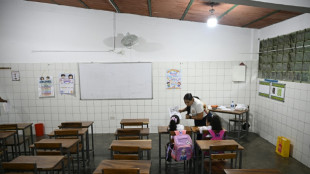
With blue schoolbags bouncing off their backs, hundreds of schoolchildren hurtle down small sand dunes eager to attend class again.
But these boys and girls are survivors of suffering and trauma that few children of their age could conceive.
Their new school is in the town of Ouallam in southwestern Niger, a region that for five years has been plagued by attacks unleashed by groups linked with Al-Qaeda and the Islamic State group.
The pupils come from 18 villages near Mali whose inhabitants fled to the relative safety of Ouallam in 2021 after jihadist killings that also forced the closure of schools.
The UN children's agency UNICEF says 817 schools with 72,421 pupils -- including 34,464 girls -- have closed in Niger, mostly in the Tillaberi, the border region where Ouallam is located.
In Ouallam alone, around one hundred schools have had to shut their doors.
The chronic insecurity has prompted the authorities to create dedicated educational centres where displaced children can resume their schooling, Mahamadou Illo Abarchi, an education official in Ouallam, told AFP.
Some 17,000 pupils have already re-entered the school system and another 55,300 are set to follow suit, enrolling in around 20 centres for displaced children across southwestern Niger, the government says.
- 'Killed by the bandits' -
In Ouallam, almost 1,600 schoolchildren -- some of whom had not attended class for three years -- are registered with three centres built near a site for displaced people.
The sites offer free canteens, a vital resource for families who have escaped violence in a nation that, by the UN's human development index, is the poorest in the world.
Lessons take place in shelters or classrooms equipped with tables and benches provided by NGOs. But in others, the pupils must learn on the floor.
Fatima and Aissa, two young girls from Ngaba, a settlement near Mali, expressed their delight at returning to school as they clutched their slate boards.
But the euphoria of returning to school cannot wipe out the painful memories.
"My uncle was a village chief, he was killed by the bandits in front of our eyes," said Mariama, who also lived in Ngaba. "There was a lot of blood."
Nassirou, Malick, Hasane, Abdou and their parents fled their village of Adabdab on foot after a series of jihadist attacks, the last of which on October 22 claimed the lives of 11 civilians.
"It was the bandits who chased us away, they killed many men," Nassirou said quietly in the playground.
Moussa, who hails from a hamlet in the same area, said: "I'm not afraid anymore, I no longer hide when I hear the sound of motorcycles" often used by jihadists to attack villages.
- 'Encouraging results' -
When they first arrived at the new centres, many children showed "signs of distress and trauma, others were very aggressive", said education official Morou Chaibou.
He spoke of how some pupils recounted harrowing memories -- including seeing their parents being shot.
Adamou Dari, the regional director of the centres, said they also offered the children psychological and social support to give them some stability after their traumatic experience.
"Now they concentrate in class and the results are encouraging," said a teacher as she played in the courtyard with some of her pupils.
Absenteeism is minor but a source of worry, Dari said, explaining that some pupils played truant to work in the town and feed their families.
Harlem Desir of the International Rescue Committee, who recently visited the site for displaced people in Ouallam, said impoverished families often put their children to work or marry their daughters at a young age.
In 2021, Amnesty International warned that boys aged between 15 and 17 were filling the ranks of armed groups, especially the Al-Qaeda-affiliated GSIM, in the Torodi region near Burkina Faso -- with the blessing of their parents.
Ferreira--PC