Chinese quadriplegic runs farm with just one finger / Photo: Jade GAO - AFP

 Germans vote in elections threatening fresh blow to Merz

 US fears rapid escalation in Mideast after Houthis attack Riyadh

 Japan triathlete Hojo wins first gold of Asian Games

 IOC president impressed by 'beautiful' Asian Games wooden huts

 First Asian Games gold goes to Japan as China's 13-year-old Yu lights up pool

 Data centre command hub keeps AI up and running

 Pope Leo in France: the issues on the table

 Packing for a pope: behind the scenes on foreign trips

 Republicans find transgender issues a powerful political weapon in midterm campaigning

 German state elections threaten new shock waves for Merz

 Chile's Bachelet quits race to be next UN chief

 Raphinha treble fires perfect Barca to win at Sevilla

 Thiam makes winning heptathlon return at Decastar meet

 Czechs beat USA to qualify for Davis Cup finals

 Dortmund sink Stuttgart to climb to Bundesliga summit

 Trump says will not tolerate attempts to slow AI growth

 'It has to stop': runners protest women's murders in S.Africa district

 Fire erupts near Riyadh airport as Houthis claim strikes

 Cuba works to restore power after another blackout

 England thrash Sri Lanka again to return to top of T20 rankings

 Arsenal thrashed by Brighton, sorry Spurs lose again
 South Korea, Austria qualify for Davis Cup finals

 Seare shocks Ingebrigtsen to win world 5km gold

 Brigitte Bardot widower slams sale of star's belongings

 Aston Villa compound Tottenham's misery despite late rally

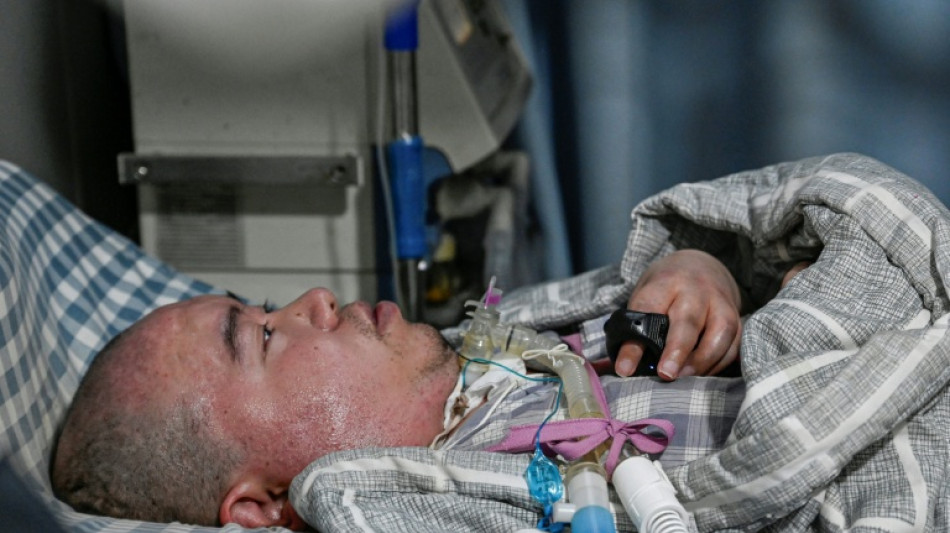
Quadriplegic and bedridden in a prefabricated home, 36-year-old Li Xia can only move one finger and one toe -- yet he runs a high-tech farm in southwestern China using sensors, cameras and a computer.
Li, who suffers from a genetic degenerative condition that progressively weakens muscles, relies on a ventilator permanently connected to his windpipe to breathe, but grows celery with the help of his 62-year-old mother.
From his bed, he operates four greenhouses that lie 10 metres (33 feet) away via a programme he created and a computer screen hanging above him on an adjustable arm.
"Through this microcomputer and the programme I developed, and a mobile app, I can monitor various data points from the farm, such as temperature, humidity, nutrient solution concentration, and pH levels," Li told AFP.
"With the cameras, I can see if the water pump is working or if the fans are running."
With the one finger he is able to move, he controls the on-screen cursor using a trackball.
"To click, I use a flex sensor attached to my toe," said Li from his home in Shiping village, near the southwestern city of Chongqing.
Duchenne muscular dystrophy (DMD), which he suffers from, is an incurable genetic disease that affects almost exclusively males, at a rate of one in 5,000 births.
Over the years, it causes muscles to weaken, increasing the risk of falls, before paralysis sets in, affecting cardiac activity and breathing.
Until the early 2000s, boys with the condition rarely lived beyond their teens. But with comprehensive care, survival into the 30s and even 40s is possible.
Li, who was once able to get around in a wheelchair, experienced a sudden medical crisis in 2020 when he was 30 years old. He fell into a coma, became incontinent and quadriplegic.
"I was devastated," he said.
"But after a few months, I pulled myself together and looked for things that made sense."
- A way forward -
He discovered hydroponics, an innovative cultivation technique where vegetables are grown not in soil, but in a solution of water enriched with essential nutrients.
Partially automated, it requires little manual labour, allows for crops to be precisely controlled and ensures good yields.
"I grew up in the countryside, so I've always been in contact with seeds, soil and vegetables," he said.
"I also love digital technologies and programming. I realised I could combine the two."
Li taught himself computer programming and learned how to design a circuit board.
His case is in many ways similar to others with severe neuromotor disorders, such as British physicist and cosmologist Stephen Hawking, who was confined to a wheelchair and could only communicate through a voice synthesiser.
Or Jean-Dominique Bauby, who was paralysed after a stroke and authored his 1997 book "The Diving Bell and the Butterfly" by blinking his left eye, the only movement he could still control.
For the farm tasks involving manual labour, Li is reliant on his mother Wu Dimei.
"She is my arms and legs, and I am her brain," he said.
- 'Quite happy' -
Li explains what needs to be done and supervises her work in the greenhouses via a video link to his smartphone.
Wu operates tools, measures out fertiliser, installs equipment and connects cables.
In addition to farm work, she provides for her son day and night, including cooking and cleaning the ventilation tube in his windpipe.
"I don't have time to rest," Wu told AFP.
Even with the help of her daughter, who regularly helps bathe her brother, Wu only sleeps three to five hours a night.
"But it's worth it," said Wu, who is divorced. "It may not seem like it, but our family is quite happy."
They mainly rely on the income of Li's sister, who works, and their mother's pension.
Li said he saw the high-tech farm as a "niche" with "great prospects", and hoped to provide his family with a livelihood.
"If I succeed, it would allow me to fulfil a dream, but also to earn money and improve our living conditions," he said.
They moved to a prefabricated portable home in 2022, and his celery is now sold to a local supermarket chain.
"We're not making a profit yet," said Li, who embarked on his venture in 2022
"But my dream is to expand this farm, turn it into a successful business, produce more and earn more.
"My motivation is to see our vegetables grow, be harvested, sold and end up on people's plates."
A.Santos--PC