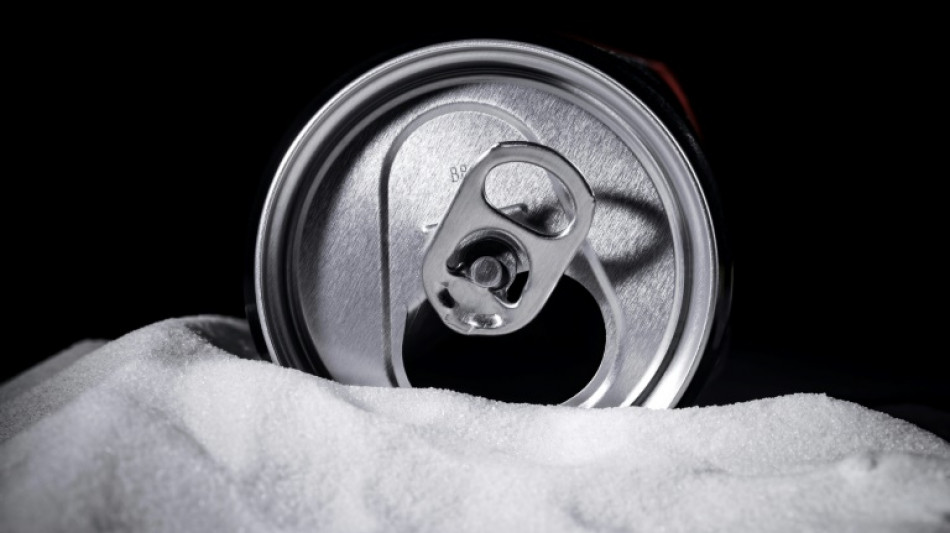
Sweeteners may be linked to heart disease risk, study suggests / Photo: JOEL SAGET - AFP/File

 US warns of rapid escalation in Mideast war

 Iran 'put hearts on the court' to win Asian Games basketball bronze

 School girl Yu helps China dominate in Asian Games swimming openers

 Myanmar win first Asian Games teqball gold as Spain great Puyol watches

 China's 13-year-old Yu scorches to first major gold at Asian Games

 Russians vote on last day of parliamentary elections

 Hong Kong pays final respects to former city leader Tung

 Typhoon put people off Asian Games opening ceremony, official says

 China's 13-year-old Yu cruises as Asian Games swimming begins

 AI 'warning shots' focus Beijing on national security risks

 Philippine tribe in limbo over US-led tech hub

 Leo XIV, first US pope transcends his restrained style

 Singer Ed Sheeran says Gaza situation 'unjustifiable' following controversy

 In 'Tenzing', a Sherpa mountaineer gets his due

 Ed Sheeran set to return to stage after Palestinian controversy

 Toulouse edge Vannes, Lyon beat Pau to take Top 14 summit

 Germans arrested for Louvre stunt in Mona Lisa hall

 Saudi-led coalition says Houthis fired ballistic missile at Riyadh

 France's debt climbs to highest since 1978: ministry

 McIlroy two shots off the lead at Wentworth after eagle on 18

 Martinez brace saves Inter in Serie A top-two clash with Roma

 Rosenior abused but guides Paris FC past old club Strasbourg

 Seven-try Lyon beat Pau, climb to Top 14 summit

 Brighton defeat a 'big lesson' against complacency for Arsenal, says Arteta

 Thousands protest inaction over climate crisis in Switzerland

A large study suggested Thursday that artificial sweetener could be associated with a higher risk of heart disease, however experts urged caution about the findings.
Sweeteners are consumed by millions every day in products like diet soda, partly as a way to avoid weight gain from sugar -- but the healthiness of these substitutes has long been a matter of controversy.
Aiming to assess the heart disease risk of sweeteners, researchers at the French INSERM institute analysed the data of more than 100,000 adults in France who self-reported their diet, lifestyle and medical history between 2009-2021 as part of the NutriNet-Sante study.
Thirty-seven percent of the participants consumed artificial sweeteners, with an average intake of 42 milligrams a day -- the equivalent of one packet of sweetener or about a third of a can of diet soda.
During the nine-year follow-up period, 1,502 heart problems were recorded, including heart attack, angina and stroke.
The research, published in the journal BMJ, indicated that heart disease occurred in 346 out of 100,000 people who consume a high level of sweetener, compared to 314 per 100,000 for non-consumers.
"These results, in line with the latest WHO report published this year, do not support the use of sweeteners as a safe alternative to sugar," said INSERM's Mathilde Touvier, who coordinated the study.
An April report from the World Health Organization said that "there is no clear consensus on whether non-sugar sweeteners are effective for long-term weight loss or maintenance, or if they are linked to other long-term health effects".
Another study published earlier this year using Nutri-Net data found a correlation between cancer and sweeteners such as aspartame, acesulfame potassium and sucralose.
However such observational studies have come under increased criticism because they cannot establish the cause of the differences they find, which could come from other sources.
Naveed Sattar, a professor of metabolic medicine at Glasgow University not involved in the sweetener study, said that it "cannot answer the question posed".
"This is because there are clearly major differences in many characteristics of people who consume artificial sweeteners compared to those who do not consume any," he said.
He called for governments to fund long-term, randomised trials "to get closer to the truth".
F.Moura--PC