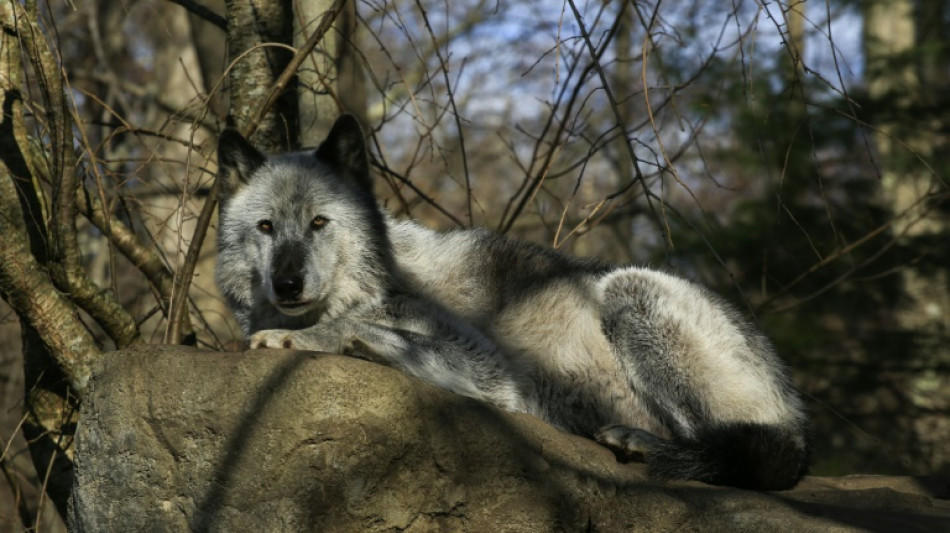
How bringing back lost species revives ecosystems / Photo: Kena Betancur - AFP/File

 Drone owners rush to offload devices ahead of Beijing ban

 Trump's beef policies irk Texas ranchers, testing their loyalty

 Nvidia, OpenAI CEOs to attend Xi dinner at White House

 Anthropic picks Accenture for in-house AI safety evaluation

 Balogun returns as Monaco beat Lens to continue strong Ligue 1 start

 'Pause' on overt repression in Venezuela, but reforms still needed: HRW

 Global stocks mixed as yen falls despite Bank of Japan rate hike

 Cuba hit with seventh major blackout of the year

 Murray out with concussion so Wentz will start for Vikings

 UN chief 'deeply regrets' US visa refusal to Abbas for annual meeting

 England quick Carse to face no charges over alleged nightclub assault

 Mancini brings nine newcomers into the first squad of his Italy comeback

 Czechs level Davis Cup tie against USA as South Korea eye Finals

 New France boss Zidane confirms Mbappe as captain after naming first squad

 California governor signs order to explore AI 'kill switch'

 Head leads run spree as Australia win Zimbabwe ODI series

 In-form Raphinha wants to finish career at Barcelona

 Warren Buffett steps down as Berkshire Hathaway chairman

 Carrick confident Man Utd can 'work through' tough time

 Mbappe ends Nike partnership to join Swiss brand On

 Liverpool boss Iraola puts Bournemouth love affair on hold

 'A disaster' if Man City do not win says Maresca after flawless start

 Kerry James Marshall: American 'blackness' painter celebrated in Europe

 Spain coach De la Fuente offers 'full support' to people of Ceuta

 Russia seizes assets of Nestle, French firms over West's Ukraine support

Scientists often study the grim impacts of losing wildlife to hunting, habitat destruction and climate change. But what happens when endangered animals are brought back from the brink?
Research has shown restoring so-called "keystone" species -- those with an outsized impact on their environment -- is vital for the health of ecosystems, and can come with unexpected benefits for humans.
Here are some notable examples from North America.
- Wolves -
Few species evoke the American wild as much as wolves.
Though revered by Indigenous communities, European colonists who arrived in the 1600s embarked on widespread extermination campaigns through hunting and trapping.
By the mid-20th century, fewer than a thousand gray wolves were left in the continental United States, down from at least a quarter million before colonization.
Extinction was averted in the 1970s when lawmakers passed the Endangered Species Act, helping revive the apex predator in parts of its former range.
Then, in the mid-1990s, the government took wolves from Canada and reintroduced them to Yellowstone National Park.
This generated a wealth of data that scientists are still working to understand.
The new arrivals kept elk numbers down, preventing them from over-browsing vegetation that provides material for birds to build nests and beavers to build dams -- a phenomenon known as a trophic cascade.
The recovered vegetation helped stop soil erosion into rivers, changing their course by reducing meandering.
While building their dams, the beavers also create deep ponds that juvenile fish and frogs need to survive.
When they embark on hunts, wolves focus on weak and diseased prey, ensuring survival of the fittest.
A recent paper even found that wolves brought back in the midwestern state of Wisconsin kept deer away from roads, reducing collisions with cars.
Amaroq Weiss, a biologist and senior wolf advocate for the Center for Biological Diversity compared ecosystems to tapestries, "and when we take out some of the threads, we weaken that tapestry," she told AFP.
It's thought there are now more than 6,000 gray wolves in the US. The main threat is legalized hunting in some states.
- Buffalo -
The story of the American buffalo -- also known as bison -- is inextricably linked to the dark history of the early United States.
From an estimated 30 million, their number plummeted to just hundreds by the late 19th century as the US government sought to wipe out plains tribe Indians whose way of life depended on the animal.
"It was an intentional genocide to remove the buffalo, to the remove the Indians and force them onto reservations," Cody Considine of The Nature Conservancy (TNC) told AFP.
Buffalo, he explained, are an integral part of TNC's efforts to re-establish prairies in the Nachusa Grasslands of Illinois.
The buffalo, who were introduced there in 2014 and now number around a hundred, favor eating grass over flowering plants and legumes, which in turn allows a variety of birds, insects and amphibians to flourish.
"Some of these species without that grazing simply just disappear off the landscape due to the high competition of the grasses," added Considine.
As they forage, bisons' hooves kick up and aerate the soil, further aiding in plant growth as well as seed dispersion.
TNC currently manages some 6,500 buffalo, and is creating a pilot program with tribal partners that involves transferring excess animals to Indigenous communities, as part of broader efforts to revive America's national mammal.
Some 20,000 buffalo are now thought to roam in "conservation herds," though none are truly free roaming, added Considine.
- Sea otters -
As the dominant predator of marine nearshore environments, sea otters play a hugely important role in their ecosystem.
Historically they spanned from Baja California up the West Coast up to Alaska, Russia and northern Japan, but hunting in the 1700s and 1800s decimated their numbers, which were once up to 300,000.
They were thought for a while to have been completely exterminated off California, but a small surviving population of around 50 helped them partially recover to some 3,000 today.
Jess Fujii, sea otter program manager at the Monterey Bay Aquarium, told AFP that research during the 1970s in the Aleutian Islands showed the otters maintained the balance of kelp forest by keeping a check on the sea urchins that graze on them.
In the last decade, more complex interactions have come to light. These include the downstream benefits of otters for eelgrass habitats in California estuaries.
Here, the sea otters controlled the population of crabs, which meant there were more sea slugs who were able to graze algae, keeping the eelgrass healthy.
Eelgrass is considered a "nursery of the sea" for juvenile fish, and it also reduces erosion, which can factor in coastal floods.
"Kelp and eelgrass are often considered good ways to sequester carbon which can help mitigate the ongoing impacts of climate change," stressed Fujii, a prime example of how destruction of nature can worsen planetary warming.
M.A.Vaz--PC



