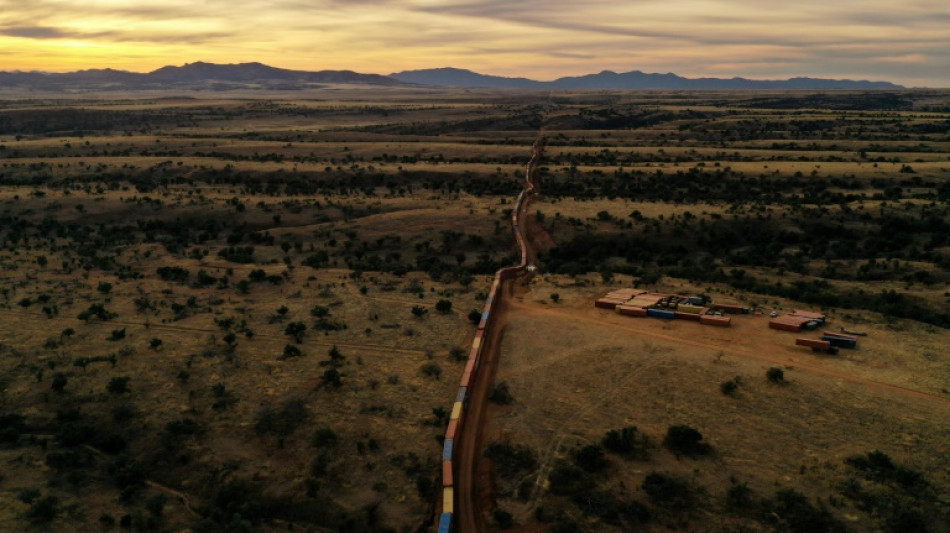
Arizona to remove shipping container wall on US-Mexico border / Photo: Patrick T. Fallon - AFP

 Drone owners rush to offload devices ahead of Beijing ban

 Trump's beef policies irk Texas ranchers, testing their loyalty

 Nvidia, OpenAI CEOs to attend Xi dinner at White House

 Anthropic picks Accenture for in-house AI safety evaluation

 Balogun returns as Monaco beat Lens to continue strong Ligue 1 start

 'Pause' on overt repression in Venezuela, but reforms still needed: HRW

 Global stocks mixed as yen falls despite Bank of Japan rate hike

 Cuba hit with seventh major blackout of the year

 Murray out with concussion so Wentz will start for Vikings

 UN chief 'deeply regrets' US visa refusal to Abbas for annual meeting

 England quick Carse to face no charges over alleged nightclub assault

 Mancini brings nine newcomers into the first squad of his Italy comeback

 Czechs level Davis Cup tie against USA as South Korea eye Finals

 New France boss Zidane confirms Mbappe as captain after naming first squad

 California governor signs order to explore AI 'kill switch'

 Head leads run spree as Australia win Zimbabwe ODI series

 In-form Raphinha wants to finish career at Barcelona

 Warren Buffett steps down as Berkshire Hathaway chairman

 Carrick confident Man Utd can 'work through' tough time

 Mbappe ends Nike partnership to join Swiss brand On

 Liverpool boss Iraola puts Bournemouth love affair on hold

 'A disaster' if Man City do not win says Maresca after flawless start

 Kerry James Marshall: American 'blackness' painter celebrated in Europe

 Spain coach De la Fuente offers 'full support' to people of Ceuta

 Russia seizes assets of Nestle, French firms over West's Ukraine support

Arizona agreed Wednesday to dismantle a wall of shipping containers at the Mexican border that critics said was an expensive, ecologically damaging political stunt that did nothing to keep migrants out of the United States.
The state's Republican Governor Doug Ducey spent $90 million of taxpayers' money lining up rusting boxes in what he said was a bid to stem the flow of people crossing into the country.
The corrugated containers, which snake for four miles (seven kilometers) through federal lands like a huge stationary cargo train, divide an important conservation area that is home to vulnerable species, but which is so difficult to traverse that people traffickers routinely avoid it.
Now Ducey, who leaves office early next year, will have to get rid of the 915 containers from the Coronado National Forest.
In an agreement reached Wednesday with the federal government, Ducey's administration said it will "remove all previously installed shipping containers and associated equipment, materials, vehicles, and other objects from the United States' properties on National Forest System lands within the Coronado National Forest."
- Biodiversity -
From close up, the double-stacked container wall looks like the clumsy handiwork of a giant playing with building blocks.
Its presence is so jarring that, in addition to the federal court case, it was also the subject of two lawsuits by the Center for Biological Diversity, an environmental organization that has been active in the area for three decades.
"The biodiversity of this region is off the charts," Russ McSpadden, a member of the organization, told AFP.
"It's one of the most important conservation areas in the entire United States."
Arizona shares around 370 miles (600 kilometers) of border with Mexico, including environmental preservation areas, national parks, military zones, and indigenous reservations.
Until the 2017 arrival in the White House of Donald Trump -- who was propelled to power on his pledge to "Build That Wall" -- there was very little in the way of a physical barrier separating it from Mexico.
Now vast stretches of the border have a fence that towers up to nine meters high.
Before the containers arrived in the Coronado National Forest -- an area that can only be reached by dirt roads -- the border here was demarcated by a wire fence.
That meager barrier was more than equal to the task of keeping people at bay, says McSpadden, whose cameras have picked up jaguars, and who has worked with teams collecting data on ocelots.
"I've never captured migrant traffic on any of the remote cameras," he said.
"It's an incredibly wild valley. There's no real urban population anywhere nearby. It's a very difficult part of the border for migrants to cross."
And even if this were a heavily trafficked route, a casual observer can see that the shipping containers would not be very effective.
In several places that AFP visited, the boxes do not line up because of the uneven terrain, leaving gaps easily large enough for a person to walk through.
Others have holes rusted in them, and in some spots, it appears to have been impossible for workers to find a place stable enough to put a container.
A viral video shows a determined climber scaling the six-meter-high barrier in a matter of seconds, gaining easy purchase on the textured box walls.
But what the shipping containers do block is a waterway and the migration routes of the animals McSpadden studies.
"Jaguars know no borders," he says.
"Southern Arizona, northern Mexico, it's the same for them."
With males known to range hundreds of miles, it's easy for animals that came north to hunt to get trapped away from breeding populations south of the border.
"Jaguars want to move back and forth freely," he says.
"This is their range, and the border wall bisects the jaguars' home."
L.Mesquita--PC



