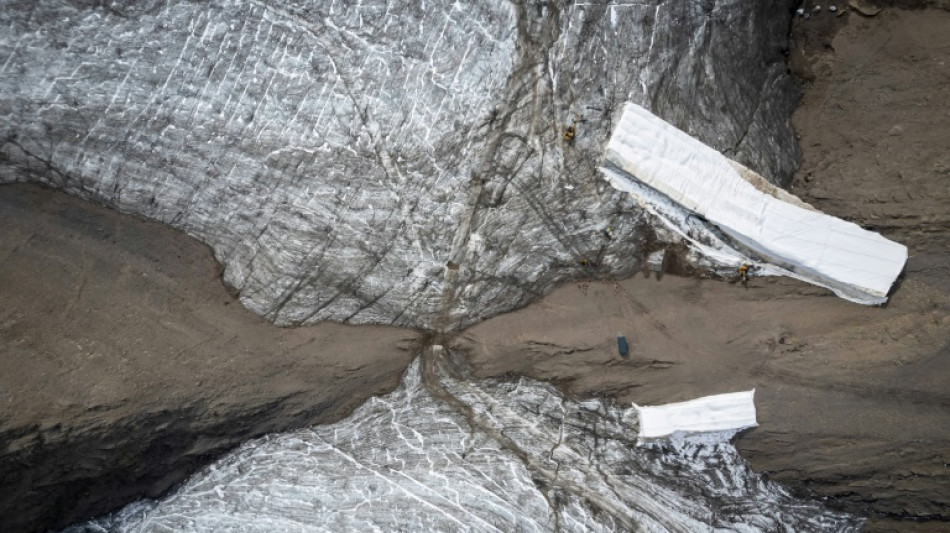
Meltdown: 2023 looking grim for Swiss glaciers / Photo: Fabrice COFFRINI - AFP/File

 Ed Sheeran returns to stage after Palestinian controversy

 Asian Games to open in Japan after troubled build-up

 Drone owners rush to offload devices ahead of Beijing ban

 Trump's beef policies irk Texas ranchers, testing their loyalty

 Nvidia, OpenAI CEOs to attend Xi dinner at White House

 Anthropic picks Accenture for in-house AI safety evaluation

 Balogun returns as Monaco beat Lens to continue strong Ligue 1 start

 'Pause' on overt repression in Venezuela, but reforms still needed: HRW

 Global stocks mixed as yen falls despite Bank of Japan rate hike

 Cuba hit with seventh major blackout of the year

 Murray out with concussion so Wentz will start for Vikings

 UN chief 'deeply regrets' US visa refusal to Abbas for annual meeting

 England quick Carse to face no charges over alleged nightclub assault

 Mancini brings nine newcomers into the first squad of his Italy comeback

 Czechs level Davis Cup tie against USA as South Korea eye Finals

 New France boss Zidane confirms Mbappe as captain after naming first squad

 California governor signs order to explore AI 'kill switch'

 Head leads run spree as Australia win Zimbabwe ODI series

 In-form Raphinha wants to finish career at Barcelona

 Warren Buffett steps down as Berkshire Hathaway chairman

 Carrick confident Man Utd can 'work through' tough time

 Mbappe ends Nike partnership to join Swiss brand On

 Liverpool boss Iraola puts Bournemouth love affair on hold

 'A disaster' if Man City do not win says Maresca after flawless start

 Kerry James Marshall: American 'blackness' painter celebrated in Europe

This year is already shaping up to be another bad one for glaciers in the Swiss Alps, with the snowpack covering them around 30 percent below the 10-year average, according to the scientist tracking their decline.
Every year in April, when the snowpack reaches its peak, the Glacier Monitoring in Switzerland (GLAMOS) organisation surveys around 15 glaciers.
"This year, the conditions are quite similar to 2022 which had record ice losses. Once again, we have very little snow," GLAMOS chief Matthias Huss told AFP.
"It's not as dramatic in every region as it was in 2022, but we're still well below average," the glaciologist said, referring to snowpack cover.
"There are even regions with a deficit of up to 50 percent" below the 10-year average for the depth of snowpack covering the surface of the glaciers.
"The preconditions for the coming summer are therefore bad, as it stands. But we cannot say if we will once again have a record melt during the summer," as that will depend on the temperatures over the coming months.
The snowpack is doubly important for glaciers because the fresh snowfall not only feeds them but also provides them with a protective layer in the summer sunshine.
For the first time this year, snowpack measurements were made on a glacier located at around 4,100 metres (13,450 feet) above sea level.
"We had zero centimetres of snow depth. There was really nothing there at all. It was surprising," said Huss. The situation is "serious for the glaciers when even at 4,000 metres there is no snow towards the end of winter".
- 6.2% volume lost in 2022 -
According to the UN's World Meteorological Organization (WMO), the past eight years have been the warmest on record and the average temperature of the planet in 2022 was 1.15 degrees Celsius warmer than the 1850-1900 average.
In the European Alps, glaciers melted to a record degree last year due to low winter snowfall, Saharan dust settling on the surface in March and then heatwaves between May and early September.
The situation was particularly dramatic in Switzerland, with the glaciers having lost 6.2 percent of their ice volume.
Huss is struck by how quickly the glaciers are shrinking.
"2022 was an absolute record. And what strikes me is that now, at the end of winter, we once again have a situation that is very particular," he said.
The WMO says the game is already up for glaciers and there is no way to stop them melting further unless a way is found to remove carbon dioxide from the atmosphere.
The disappearance of glaciers is "symbolic of climate change", said Huss.
He noted the effects they will have on humans in the short term -- ranging from natural hazards, loss of tourism -- and in the longer term, as they supply rivers and hydroelectric power plants.
Much of the water that flows into the Rhine and the Rhone, two of Europe's major rivers, comes from the Alpine glaciers.
But Huss has not lost all hope.
"If we manage to limit global warming to 1.5C or 2C, we could still save about a third of the volume of the Alpine glaciers," he said.
"On the other hand, if climate change exceeds 4C, there will be an almost total loss of glaciers by around 2100."
G.M.Castelo--PC



