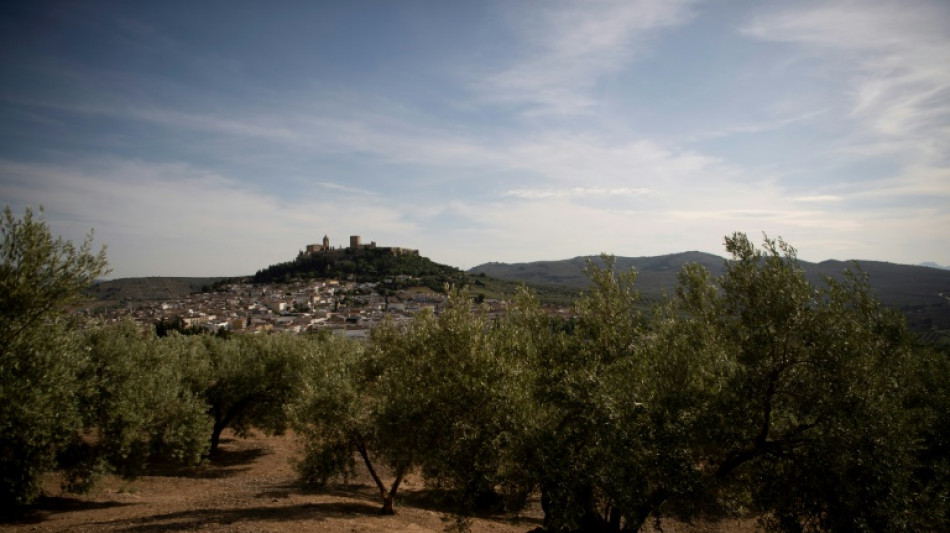
Drought spells 'catastrophe' for Spain's olive harvest / Photo: JORGE GUERRERO - AFP

 Ed Sheeran returns to stage after Palestinian controversy

 Asian Games to open in Japan after troubled build-up

 Drone owners rush to offload devices ahead of Beijing ban

 Trump's beef policies irk Texas ranchers, testing their loyalty

 Nvidia, OpenAI CEOs to attend Xi dinner at White House

 Anthropic picks Accenture for in-house AI safety evaluation

 Balogun returns as Monaco beat Lens to continue strong Ligue 1 start

 'Pause' on overt repression in Venezuela, but reforms still needed: HRW

 Global stocks mixed as yen falls despite Bank of Japan rate hike

 Cuba hit with seventh major blackout of the year

 Murray out with concussion so Wentz will start for Vikings

 UN chief 'deeply regrets' US visa refusal to Abbas for annual meeting

 England quick Carse to face no charges over alleged nightclub assault

 Mancini brings nine newcomers into the first squad of his Italy comeback

 Czechs level Davis Cup tie against USA as South Korea eye Finals

 New France boss Zidane confirms Mbappe as captain after naming first squad

 California governor signs order to explore AI 'kill switch'

 Head leads run spree as Australia win Zimbabwe ODI series

 In-form Raphinha wants to finish career at Barcelona

 Warren Buffett steps down as Berkshire Hathaway chairman

 Carrick confident Man Utd can 'work through' tough time

 Mbappe ends Nike partnership to join Swiss brand On

 Liverpool boss Iraola puts Bournemouth love affair on hold

 'A disaster' if Man City do not win says Maresca after flawless start

 Kerry James Marshall: American 'blackness' painter celebrated in Europe

An ongoing drought and soaring temperatures have unleashed fears of an olive "catastrophe" in Spain, the world's largest producer of olive oil, which suffered a very difficult year in 2022.
"It's barely rained since January. The ground is very dry," worries Cristobal Cano, secretary general of the small farmers' union (UPA) in the southern region of Andalusia, the heart of Spain's olive oil industry.
Cano, who owns 10 hectares of olive trees in Alcala la Real near Granada, has never seen such a worrying situation in the 20 years he's been a farmer.
"If something doesn't change radically in the next few weeks, it's going to be a catastrophe," he warned.
According to the AEMET weather agency, accumulated rainfall since October 1 has been 25 percent lower than normal across Spain and 50 percent lower in most of Andalusia, where reservoirs are at 25 percent capacity.
And the situation worsened at the end of April, when an early heatwave brought exceptionally high temperatures that saw the mercury hit 38.8 degrees Celsius (101.8 degrees Fahrenheit) in southern Spain.
"This happened as the olive trees were in bloom," says Rafael Pico, director of Asoliva, the Spanish association of olive oil producers and exporters, who fears the blooms will dry up.
"If there are no flowers, there's no fruit. And if there's no fruit, there's no oil."
- 'On the brink of collapse' -
For Spain -- which normally supplies 50 percent of the world's olive oil and exports close to 3.0 billion euros ($3.3 billion) worth every year -- the situation is even more worrying given the sector's disastrous output in 2021-2022.
During that season too, a lack of rain and extreme temperatures saw olive oil production plummeting 55 percent to 660,000 tonnes, compared to 1.48 million tonnes in 2021-2022, agriculture ministry figures show.
The scene is set to play out again this year.
"Looking at the forecasts, it's almost a given -- it's going to be another grim year," says Rafael Sanchez de Puerta, head of Dcoop, Spain's leading olive cooperative.
If the predictions prove true, it could spell the end for many olive farms.
"We can cope with one difficult year. It's a natural part of the growing cycle. But two years in a row will be a disaster. Many are on the brink of collapse," he says.
With the cost of machinery, paying salaries and repaying loans, "farmers need liquidity" to remain afloat, says Asoliva's Pico, recalling that many in Spain live from olive oil production.
- Runaway prices -
For consumers, the outlook is also bleak.
"The global price of olive oil depends largely on Spain," says Pico.
In recent months, the price of oil has jumped.
"In mid-April, olive oil was selling at 5,800 euros ($6,400) per tonne, up from 5,300 euros in January," says Fanny de Gasquet of Baillon Intercor, a brokerage firm specialising in oils and fats.
In January 2022, it was selling at 3,500 euros.
And the upward trend looks set to continue.
In Andalusia, young olive trees "don't have sufficiently developed roots to be able to extract water" from deep underground, meaning "there will be losses" that will have an impact on production over the next two or three years, she warns.
At the end of 2022, the Spanish government moved to lower VAT on olive oil from 10 percent to five percent as part of a package of measures to help consumers in the face of soaring inflation.
And to help farmers cope with the drought, the government has reduced the sector's income tax by 25 percent.
But for many, it's too little in the face of the looming crisis.
"Lowering taxes for people who will have almost no income is of little use to them," says Dcoop's Sanchez de Puerta, calling for more ambitious moves to combat "a drought that is lasting longer than it should".
X.M.Francisco--PC



