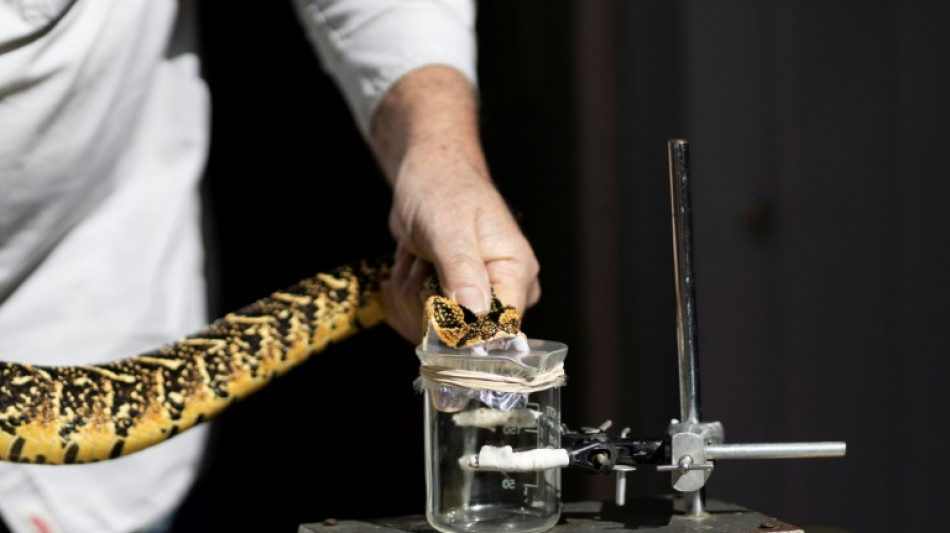
Dogs die as South Africa snake antivenom shortage bites / Photo: WIKUS DE WET - AFP

 Indians living in Japan on stand-by to house Asian Games athletes

 Trump signs bill authorizing sweeping Russia sanctions

 Protesters form human chain at Kennedy Center after Trump threat

 Death toll from attack at police HQ in Pakistan rises to 31

 Trump says Denmark to give US 'permanent control' over Greenland security

 Kennedy Center: future unclear for iconic Washington arts hub

 Trump claims 'infinite' Greenland security deal with Denmark

 Helicopters battle wildfire threatening Ecuador's capital

 Brentford batter Chelsea to undo Alonso's promising start

 Kane hits Bundesliga century as Bayern rout Union

 Trump says CNN, MS NOW, Politico banned from White House

 Hushing and hedging: US companies retreat on climate

 Springboks to face Fiji before 2027 Rugby World Cup

 Nigeria miners struggled to breathe in cell before 37 died: survivors

 McIlroy on the charge at PGA Championship as Reed withdraws

 McIlroy on the charge at PGA Championship

 Crisis-wracked Volkswagen warns of 10-bn-euro hit to profits

 Costa Rica's Grynspan tops third informal poll for UN chief: diplomat

 Stock markets retreat after central bank rate hikes

 Russia labels director of Cannes Grand Prix winner a 'foreign agent'

 Macron warns of Russian 'hybrid' threat after meeting presidential hopefuls

 UN holds third informal poll for new chief

 Kulusevski return can spark Spurs: De Zerbi

 Shakira to cap off world tour with Madrid 12-gig run

 Isolated Syrian-Druze city blames Damascus for shortages

Zarza, a much-loved Staffordshire terrier, ended up at a South African animal hospital with a bite from a Mozambique spitting cobra on her snout.
The snake's powerful venom can stop the breathing muscles from working, but normally the bites are treatable with an antidote.
The problem, say South African veterinarians, is that they currently have virtually no vials of the antiserum left.
"We've been out of antivenom for quite some months now," said Dean de Kock, a vet at the Valley Farm Animal Hospital in Pretoria, where Zarza was treated but eventually died.
Vets and snake experts say the shortage started getting serious towards the end of last year -- though the authorities are denying there is a problem.
"Snakebite antivenom is available in the country," the National Health Laboratory Service (NHLS), a government body in charge of antidote production, told AFP.
Experts in the field disagree.
- A 'countrywide shortage' -
In April, a group of snakebite treatment specialists pleaded with the health minister over what they described as "a major health risk".
While the supply problems may be easing in some quarters, vets say they are still struggling.
Hospitals treating humans get priority when any new doses come available, said Johan Marais, a herpetologist -- specialist in reptiles and amphibians -- who heads the African Snakebite Institute.
"At the moment, if you're a veterinarian, you cannot get antivenom," said Marais, 65.
Speaking from his headquarters in Pretoria, he casually handled a black mamba during his conversation with AFP.
He said he receives up to a dozen calls a day from desperate animal doctors and dog owners looking for antidotes.
"If your dog gets a serious snakebite today, there's a likelihood it's going to die," Marais said.
Alan Kloeck, of the South African Veterinary Association, confirmed Marais's remarks, describing a "countrywide shortage" with vets unable to get their hands on the antiserum they needed.
- Horse blood, spitting cobras -
South Africa is home to about 160 species of snakes, many of them poisonous.
South African Vaccine Producers -- a NHLS subsidiary and the only antivenom maker in the country -- produces two antidotes.
One can treat bites from 10 snakes including the cape cobra, the puff adder and the green mamba, while another is for relatively rare boomslang bites.
Making the antiserums is a laborious process, said Mike Perry of African Reptiles and Venom, a venom-extraction firm in Centurion, outside Johannesburg, that houses around 900 snakes in small glass cages.
He said his team forces the hissing reptiles to spit out their poison by forcing them to bite a glass jar.
Small quantities of the toxins are then injected into horses, which over time develop immunity.
Their plasma is then harvested and processed to make the serum.
But that process requires constant refrigeration, and the production backlog has been blamed in large part on South Africa's energy crisis, which has caused repeated power blackouts.
In April, NHLS said it required "a consistent and dependable power supply" to produce antivenom.
The continuous switchover to generators during outages interrupted production and affected stockpiles, it said, forcing it to invest in backup power systems and renewable energy.
- 'Last vial' -
Last week, NHLS said it had increased manufacturing in recent months.
Since January, it said, it had delivered antivenom to more than 230 institutions, including hospitals and veterinary clinics, fulfilling all orders apart from "a small backlog" affecting a provincial depot.
But de Kock, whose veterinary practice is in a different province, has not received any shipments since December. For a while, they were using expired doses from other hospitals, but these too have dried up.
"We have used the last vial on Sunday evening," he said last week.
Over the past three months, the hospital treated 25 dogs for snakebites.
Of the 16 who could get expired antivenom, only one did not survive, while six of the nine who could not get doses died.
Zarza was among them, dying in May after a two-day struggle on a ventilator.
"It's tough," said de Kock, 53. "You're doing everything you can but the vital thing that you actually need is the antivenom, and you don't have that".
His hope was that the austral winter months, when snakes are less active, would bring some relief.
A.Motta--PC



