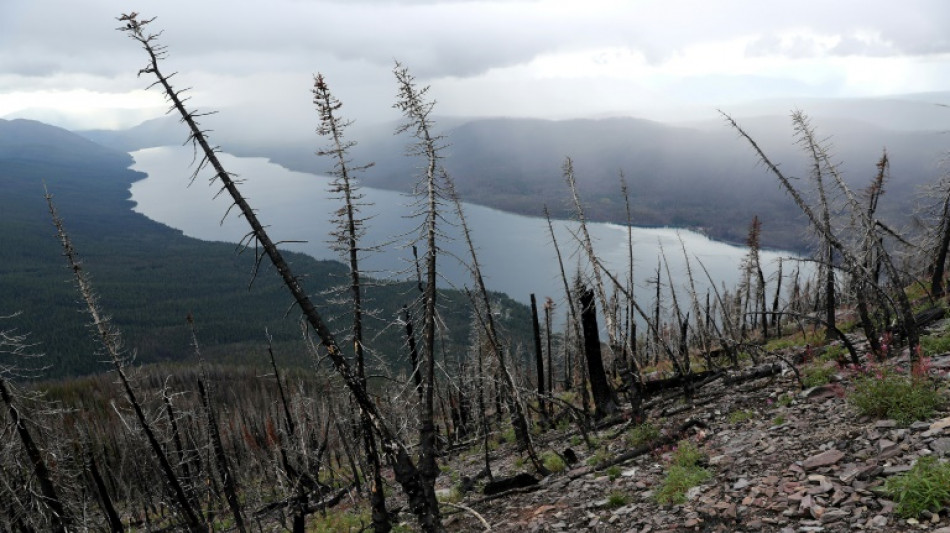
Verdict awaited in historic US climate trial / Photo: CHIP SOMODEVILLA - GETTY IMAGES NORTH AMERICA/AFP/File

 Indians living in Japan on stand-by to house Asian Games athletes

 Trump signs bill authorizing sweeping Russia sanctions

 Protesters form human chain at Kennedy Center after Trump threat

 Death toll from attack at police HQ in Pakistan rises to 31

 Trump says Denmark to give US 'permanent control' over Greenland security

 Kennedy Center: future unclear for iconic Washington arts hub

 Trump claims 'infinite' Greenland security deal with Denmark

 Helicopters battle wildfire threatening Ecuador's capital

 Brentford batter Chelsea to undo Alonso's promising start

 Kane hits Bundesliga century as Bayern rout Union

 Trump says CNN, MS NOW, Politico banned from White House

 Hushing and hedging: US companies retreat on climate

 Springboks to face Fiji before 2027 Rugby World Cup

 Nigeria miners struggled to breathe in cell before 37 died: survivors

 McIlroy on the charge at PGA Championship as Reed withdraws

 McIlroy on the charge at PGA Championship

 Crisis-wracked Volkswagen warns of 10-bn-euro hit to profits

 Costa Rica's Grynspan tops third informal poll for UN chief: diplomat

 Stock markets retreat after central bank rate hikes

 Russia labels director of Cannes Grand Prix winner a 'foreign agent'

 Macron warns of Russian 'hybrid' threat after meeting presidential hopefuls

 UN holds third informal poll for new chief

 Kulusevski return can spark Spurs: De Zerbi

 Shakira to cap off world tour with Madrid 12-gig run

 Isolated Syrian-Druze city blames Damascus for shortages

A verdict is awaited in a landmark US climate trial involving 16 young people accusing the state of Montana of violating their rights to a "clean and healthful environment."
Held v. Montana, which concluded Tuesday, has been closely watched as it could bolster similar litigation that has been filed across the country.
It is the first case involving a constitutional claim against a state, and also represents a rare instance in which climate experts have been questioned on the witness stand.
Judge Kathy Seeley, who oversaw the trial in the state capital Helena, instructed lawyers for both sides to file post-trial written submissions within two weeks, after which she would render her verdict.
She has the power to declare as unconstitutional a state law preventing agencies from considering the impacts of greenhouse gasses when issuing permits for fossil fuel development.
Earlier, a large group of supporters waved placards and cheered the plaintiffs and their lawyers as they entered the courthouse, according to footage seen on social media.
- Closing arguments -
At the heart of the case is a provision within the fossil fuel friendly state's constitution that says: "The state and each person shall maintain and improve a clean and healthful environment in Montana for present and future generations."
The youths, ranging in age from five up to 22, have said they have been harmed by the "dangerous impacts of fossil fuels and the climate crisis," with children "uniquely vulnerable" to its worsening impacts.
During his closing arguments, the plaintiffs' lawyer Nate Bellinger, of the nonprofit Our Children's Trust, said his clients "did not ask for money, but they asked only that their government embrace its constitutional responsibility to alleviate the harms of its own conduct."
While Montana argues climate change is a global issue, the plaintiffs "localized this harm in their backyards of felled, diseased trees; the melting of Montana's majestic glaciers; ...skies that are full of choking smoke, and rivers that run dry."
"The plaintiffs acknowledge that the work to stop and reverse climate change will be a lifetime journey, but they are asking this court for help," he said.
Montana Assistant Attorney General Michael Russell on the other hand argued that the matter of energy policy should be decided by the people, through their representatives in the legislature.
"This case has received national attention in part because it has been billed or at least perceived as a sort of referendum on climate change. This is not supposed to be a town hall meeting or a popularity contest, it's a court of law," he added.
Russell said that while the state accepted that man-made emissions were responsible for warming, expert witnesses for the prosecution had not been able to quantify the extent to which Montana's laws were responsible for impacts on the ground.
- 'Compelling stories' -
The trial began on June 12 and concluded a few days earlier than expected after Montana declined to call to the stand several experts, including its only climate scientist, Judith Curry.
Curry has contested the scientific consensus on climate change, declaring for example "there's no emergency."
Over the course of proceedings, the court heard direct and emotional testimony from the plaintiffs about specific ways their health, emotional wellbeing, family finances and cultural traditions had been impacted.
Lead plaintiff Rikki Held, 22, whose family runs a ranch in Montana, said that their livelihoods and wellbeing had been increasingly impacted by wildfires, extreme temperatures and drought.
Claire Vlases, 20, said: "When I think about summer, I think about smoke. It sounds like a dystopian movie, but it's real life."
Lawyers for the plaintiffs also called renowned climate, health and psychiatry experts to testify.
These included eminent climatologist Steve Running, who was part of the UN body that won a Nobel prize in 2007.
Michael Gerrard, who founded the Sabin Center for Climate Change Law at Columbia University, told AFP the plaintiffs lawyers "did a wonderful job presenting and giving a human face to the case by having all these young people tell their own personal compelling stories."
Should the judge find in their favor, "we've seen in other cases that a favorable verdict in one jurisdiction can have a reverberating effect in many other places," said Gerrard. "It would be very energizing to young people and activists around the country."
V.Fontes--PC



