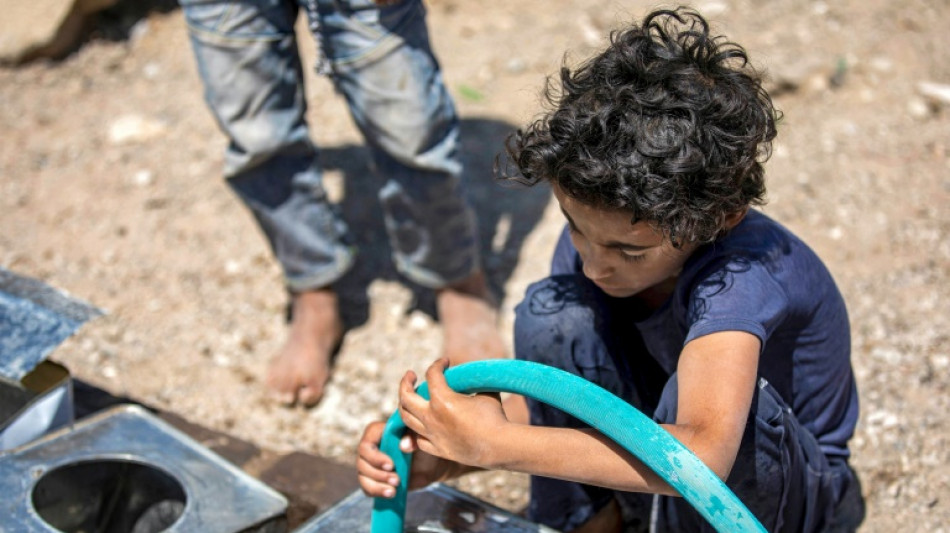
Global goals on fighting poverty, inequality 'in peril': UN / Photo: AHMAD AL-BASHA - AFP/File

 Indians living in Japan on stand-by to house Asian Games athletes

 Trump signs bill authorizing sweeping Russia sanctions

 Protesters form human chain at Kennedy Center after Trump threat

 Death toll from attack at police HQ in Pakistan rises to 31

 Trump says Denmark to give US 'permanent control' over Greenland security

 Kennedy Center: future unclear for iconic Washington arts hub

 Trump claims 'infinite' Greenland security deal with Denmark

 Helicopters battle wildfire threatening Ecuador's capital

 Brentford batter Chelsea to undo Alonso's promising start

 Kane hits Bundesliga century as Bayern rout Union

 Trump says CNN, MS NOW, Politico banned from White House

 Hushing and hedging: US companies retreat on climate

 Springboks to face Fiji before 2027 Rugby World Cup

 Nigeria miners struggled to breathe in cell before 37 died: survivors

 McIlroy on the charge at PGA Championship as Reed withdraws

 McIlroy on the charge at PGA Championship

 Crisis-wracked Volkswagen warns of 10-bn-euro hit to profits

 Costa Rica's Grynspan tops third informal poll for UN chief: diplomat

 Stock markets retreat after central bank rate hikes

 Russia labels director of Cannes Grand Prix winner a 'foreign agent'

 Macron warns of Russian 'hybrid' threat after meeting presidential hopefuls

 UN holds third informal poll for new chief

 Kulusevski return can spark Spurs: De Zerbi

 Shakira to cap off world tour with Madrid 12-gig run

 Isolated Syrian-Druze city blames Damascus for shortages

The goals the world set to ease extreme poverty, improve access to drinking water and take steps toward sustainable development for all humanity are "in peril," the United Nations has said in a report published Monday.
"Unless we act now, the 2030 Agenda could become an epitaph for a world that might have been," UN Secretary-General Antonio Guterres warns in a preamble to a report assessing the UN's Sustainable Development Goals for 2030.
In 2015, UN member states adopted 17 goals intended to build a better, more sustainable future for the entire globe by the end of this decade.
"But halfway to 2030, that promise is in peril," the report says, with more than half the world likely to be left behind.
The sustainable development goals are "disappearing in the rear-view mirror."
Experts assessed 140 target areas established under the Sustainable Development Goals, ranging from access to health care and the fight against climate change to combating inequality and leveling access to energy, the report notes.
On more than 30 percent of the targets, either no progress has been reported or even regression has been noted since 2015, and moderate or severe deviation from the desired trajectory has been seen in about half of them.
For example, the Covid-19 pandemic ended a downward trend in extreme poverty, defined as living on less than $2.15 a day.
But at the current rate, 575 million people will still be living in such conditions in 2030, most of them in sub-Saharan Africa. That is down 30 percent since 2015, but far from the hoped-for eradication, the report says.
"Shockingly, the world is back at hunger levels not seen since 2005," the report says.
Around one in three people (2.3 billion) faced moderate or severe food insecurity in 2021, and child malnutrition is still a "global concern," it notes.
"Approximately 1.1 billion people currently live in slums or slum-like conditions in cities, with two billion more expected in the next 30 years," it says.
- Gender equality progress 'too slow' -
The pandemic, which highlighted the fragility of many advances, has had a "devastating" impact on education.
Without new measures, only one country in six will reach the goal of universal access to secondary education by 2030, and 84 million children will not attend school, the report says.
In terms of gender equality, the report highlights "too slow" progress, noting that at the current rate, it would take 286 years to close the gap in legal protection and to abolish discriminatory laws, and 300 years to end child marriage.
And developing countries, "buried under a mountain of debt," are "the hardest hit by our collective failure to invest in the Sustainable Development Goals," said Guterres, who repeatedly called for reform of international financial institutions.
"We cannot persist with a morally bankrupt financial system and expect developing countries to meet targets that developed countries met with far fewer constraints," the report adds.
Against this backdrop, the UN is calling for a September 18-19 summit to adopt "a rescue plan" for the goals.
This would seek a strong new political commitment from member states, as well as support for Guterres's proposal for a stimulus package of an additional $500 billion per year by 2030 to finance sustainable development.
Despite the gloomy picture painted by the report, the UN does point to some hopeful signs.
Infant mortality, for example, fell by 12 percent between 2015 and 2021, and by 2030, almost 150 countries are expected to meet their targets in this area.
Internet access has increased significantly, with 5.3 billion people connected by 2022, while the number of AIDS-related deaths has fallen by 52 percent since 2010.
Since 2015, the proportion of the population with access to safe drinking water or sanitation has also increased.
But as with many of the UN targets, progress does not mean success: 2.2 billion people still had no access to safe drinking water in 2022, and 419 million had no choice but to relieve themselves in the open.
L.Torres--PC



