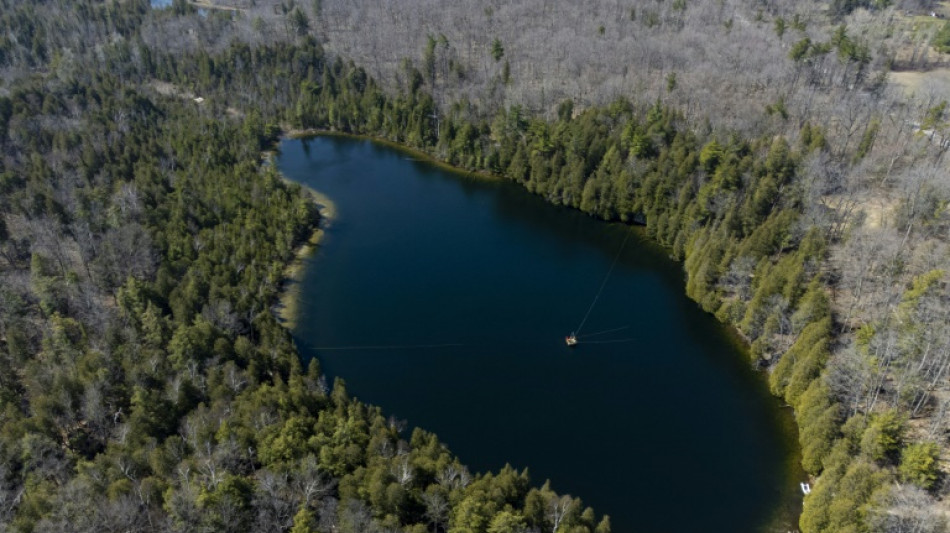
To track human impact on Earth, scientists probe Crawford Lake / Photo: Peter POWER - AFP

 Indians living in Japan on stand-by to house Asian Games athletes
 Trump signs bill authorizing sweeping Russia sanctions

 Protesters form human chain at Kennedy Center after Trump threat

 Death toll from attack at police HQ in Pakistan rises to 31

 Trump says Denmark to give US 'permanent control' over Greenland security

 Kennedy Center: future unclear for iconic Washington arts hub

 Trump claims 'infinite' Greenland security deal with Denmark

 Helicopters battle wildfire threatening Ecuador's capital

 Brentford batter Chelsea to undo Alonso's promising start

 Kane hits Bundesliga century as Bayern rout Union

 Trump says CNN, MS NOW, Politico banned from White House

 Hushing and hedging: US companies retreat on climate

 Springboks to face Fiji before 2027 Rugby World Cup

 Nigeria miners struggled to breathe in cell before 37 died: survivors

 McIlroy on the charge at PGA Championship as Reed withdraws

 McIlroy on the charge at PGA Championship

 Crisis-wracked Volkswagen warns of 10-bn-euro hit to profits

 Costa Rica's Grynspan tops third informal poll for UN chief: diplomat

 Stock markets retreat after central bank rate hikes

 Russia labels director of Cannes Grand Prix winner a 'foreign agent'

 Macron warns of Russian 'hybrid' threat after meeting presidential hopefuls

 UN holds third informal poll for new chief

 Kulusevski return can spark Spurs: De Zerbi

 Shakira to cap off world tour with Madrid 12-gig run

 Isolated Syrian-Druze city blames Damascus for shortages

On first glance, it looks like just another small lake in Canada, one of thousands across the vast country. But the view under the surface of Crawford Lake outside Toronto tells a very different story.
Scientists believe the lake's exceptionally well-preserved sediment layers serve as a reference point for a proposed new geological chapter in the planet's history, defined by the considerable changes wrought by human activity: the Anthropocene.
For years, geologists have tried to find the Anthropocene's so-called "golden spike" -- the spot on Earth with the best evidence of this global transformation.
And Crawford Lake -- located in Ontario province, in the greater Toronto area, is that place, according to the International Commission on Stratigraphy's Anthropocene Working Group, which revealed its decision on Tuesday.
Local legend has it that the lake is bottomless. But in fact, it's the exact opposite -- its depths hold unparalleled riches, a phenomenon that put the lake on the short list to be the "spike" years ago.
The pristinely preserved sediments show better than anywhere else on Earth that humans have irrevocably changed the planet at all levels, including its physical composition.
"It's very deep, but it's not very large. So that means that the waters don't mix all the way to the bottom," explains Francine McCarthy, a professor at Brock University who has led the research into Crawford Lake.
"And so the sediments that accumulate in the lake are not disturbed," she told AFP in April, when samples were taken for the ICS's Anthropocene working group.
- 'Distinct fingerprint' -
For centuries, Crawford Lake has been slowly absorbing signs of change. Everything that once floated on the water's surface is now embedded in some form in its sediments.
The first humans to leave their mark on the lake were Iroquois villagers who built homes along its shores. The sediments then showed the mounting influence of European settlers on the landscape, as trees vanished and new species emerged.
Then in the 20th century, fly ash from the use of coal and other fossil fuels settled in the lake, as cities developed and become more industrialized. Heavy metals such as copper and lead also appear progressively in the layers.
"We can see local disturbance. Or we can look at regional effects (like) pollution, said Paul Hamilton, a researcher at the Canadian Museum of Nature.
The lake's sediments can also document global change, he said, such as atmospheric deposition of chemicals.
For McCarthy, the other sites in contention to be the Anthropocene's "golden spike" did not have "such a distinct fingerprint of exactly what the core looks like and what each year looks like."
"Each year has its own personality, like people," she said.
- 'Everything changed' -
Extracting samples from Crawford Lake that can serve as markers for a new geological period requires skill, precision and speed.
Tim Patterson, a researcher at Carleton University in Canada, and his team are specialists. To recover the sediments from the depths of Crawford Lake without damaging them, they fill huge metal tubes with dry ice and alcohol.
The tubes -- about two meters (6.5 feet) long and 15 centimeters wide -- are then plunged into the lake's bed for 30 minutes, so that the sediments can freeze onto them, forming a series of distinct lines for each year, like the rings of a tree.
In April, what interested Patterson the most was traces of plutonium.
The start of the Anthropocene has been set in 1950 "to pick up something that was utterly unique in the history of the world. It was this nuclear testing in the air," he explained.
"Humans had never done that before. And that leaves a record, not just regionally but all around the world."
McCarthy, who has been working at Crawford Lake for nearly four decades, says 1950 also marks when humankind entered into a seemingly endless cycle of consumption, production and pollution.
"So for 12,000 years, it was happening the same way. And then suddenly, very suddenly, within a few years, everything changed," she told AFP.
But McCarthy nevertheless remains hopeful for the future.
"If geologists, who after all are the people who found the plutonium in the rocks and the petroleum in the rocks, if they accept that there is a fundamental change that's due to humans, then maybe action will be taken," she said.
L.Mesquita--PC



