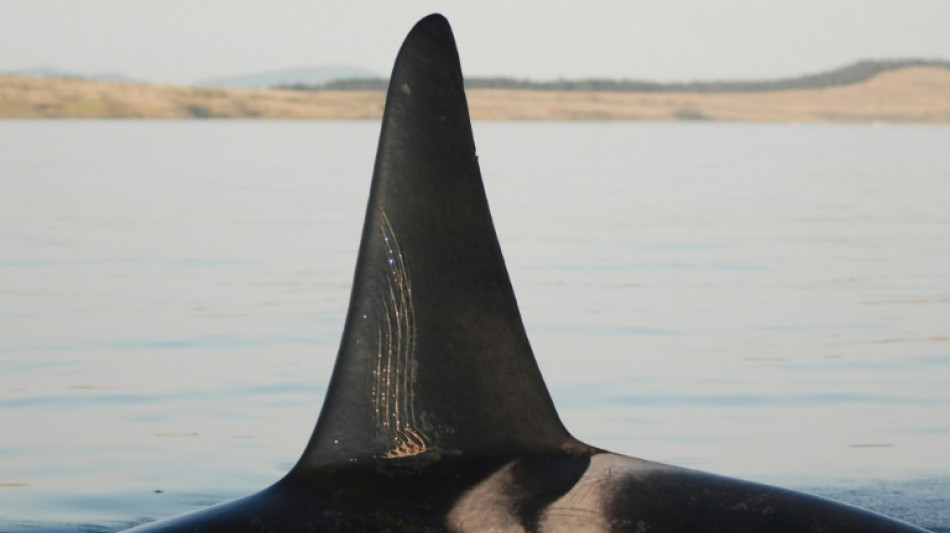
Mama's boys: Elder orca moms protect sons from fights / Photo: David Ellifrit - Center for Whale Research/AFP

 Indians living in Japan on stand-by to house Asian Games athletes

 Trump signs bill authorizing sweeping Russia sanctions

 Protesters form human chain at Kennedy Center after Trump threat

 Death toll from attack at police HQ in Pakistan rises to 31

 Trump says Denmark to give US 'permanent control' over Greenland security

 Kennedy Center: future unclear for iconic Washington arts hub

 Trump claims 'infinite' Greenland security deal with Denmark

 Helicopters battle wildfire threatening Ecuador's capital

 Brentford batter Chelsea to undo Alonso's promising start

 Kane hits Bundesliga century as Bayern rout Union

 Trump says CNN, MS NOW, Politico banned from White House

 Hushing and hedging: US companies retreat on climate

 Springboks to face Fiji before 2027 Rugby World Cup

 Nigeria miners struggled to breathe in cell before 37 died: survivors

 McIlroy on the charge at PGA Championship as Reed withdraws

 McIlroy on the charge at PGA Championship

 Crisis-wracked Volkswagen warns of 10-bn-euro hit to profits

 Costa Rica's Grynspan tops third informal poll for UN chief: diplomat

 Stock markets retreat after central bank rate hikes

 Russia labels director of Cannes Grand Prix winner a 'foreign agent'

 Macron warns of Russian 'hybrid' threat after meeting presidential hopefuls

 UN holds third informal poll for new chief

 Kulusevski return can spark Spurs: De Zerbi

 Shakira to cap off world tour with Madrid 12-gig run

 Isolated Syrian-Druze city blames Damascus for shortages

A male orca's best friend is his old mother.
That's according to a new scientific paper published Thursday in Current Biology, which found female killer whales that have undergone menopause prevent their sons -- though not their daughters -- from getting injured in fights.
Lead author Charli Grimes told AFP what drew her to the subject was just how rare menopause is in the natural world. Most animals with ovaries remain capable of reproducing until they die, with humans and five species of toothed whales the only known exceptions.
"A big question in our own evolutionary history is, how and why has menopause evolved?" she said.
"In human societies, older females play a role in moderating conflict, and now this latest research has found that that might also be the case in killer whales," added the animal behavior scientist at the University of Exeter.
The study looked at Southern Resident killer whales, which live off the Pacific coast of North America.
These whales live in matriarchal social units -- typically consisting of a grandmother, her male and female offspring, and her daughters' daughters. Female killer whales survive up to 90 years in the wild, and live more than 20 years beyond menopause.
Males will outbreed with females from other pods, but both males and females will stay within the social unit of their birth. Sons remain especially close to their mothers throughout their lives.
- Bite marks -
For their research, Grimes and colleagues examined the accumulation of "tooth rake marks" -- scarring left behind when an orca bites another during rough play or fighting.
"These marks are really great for quantifying social interactions that are otherwise really difficult to observe, since most of the behavior takes place below the surface," she said.
The Center for Whale Research in Washington state has carried out photographic censuses of Southern Resident killer whales since 1976, identifying individuals by their unique dorsal fins and saddle patches.
Orcas have no natural predators, and this subspecies feeds exclusively on salmon, as opposed to prey that can bite back. This means the tooth marks could only be inflicted by their own kind.
By analyzing thousands of photos in a computer program, the team found males who lived with post-reproductive mothers had 35 percent fewer tooth rake injuries compared to males who lived with breeding mothers, and 45 percent fewer than those who lived without their mothers.
It's thought that ceasing breeding frees up time and energy for mothers to protect their sons.
How exactly the post-menopausal moms are helping isn't yet clear, said Grimes. It could be that older females use their knowledge of other pods to steer their sons away from troublemakers.
Or, they could be intervening more directly when a fight is brewing, perhaps using vocalizations to call off their sons. It's not thought that they get involved in fighting themselves, since they have very low rates of scarring.
- Pass the fish -
Daughters, however, were not found to have fewer tooth rakes with their mothers around.
Females are probably less involved in conflict to begin with, said Grimes. Sons moreover breed with multiple females, meaning there is a higher chance of their mother passing on their genes.
Ruth Mace, an anthropologist and biologist at the University College London who was not involved in the study, told AFP that the idea that post-reproductive life had evolved so women can help children is well established in humans.
"So it is very interesting that this is also being established in killer whales," she said.
"It's (a) remarkable study, utilizing an extremely valuable long-term dataset," added Stephanie King, who specializes in dolphin research at the University of Bristol and was also not involved.
Prior work has shown older female orcas share their own fish, pass on ecological knowledge of where and when to find food, and improve their grandchildren's survival rates.
An outstanding question is how exactly they bring about some of these benefits -- something Grimes and her colleagues hope to answer by flying drones over the orcas, documenting what they do under the waves.
T.Batista--PC



