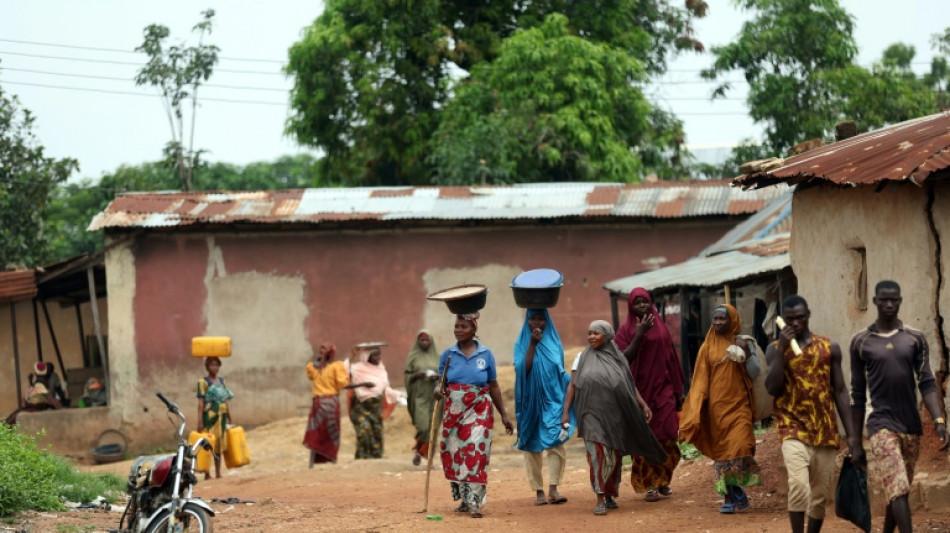
Solar mini-grids offer clean-power hope to rural Africa / Photo: Kola Sulaimon - AFP

 Indonesia accepts Malaysia's help to tackle wildfires
 Indians living in Japan on stand-by to house Asian Games athletes
 Trump signs bill authorizing sweeping Russia sanctions

 Protesters form human chain at Kennedy Center after Trump threat

 Death toll from attack at police HQ in Pakistan rises to 31

 Trump says Denmark to give US 'permanent control' over Greenland security

 Kennedy Center: future unclear for iconic Washington arts hub

 Trump claims 'infinite' Greenland security deal with Denmark

 Helicopters battle wildfire threatening Ecuador's capital

 Brentford batter Chelsea to undo Alonso's promising start

 Kane hits Bundesliga century as Bayern rout Union

 Trump says CNN, MS NOW, Politico banned from White House

 Hushing and hedging: US companies retreat on climate

 Springboks to face Fiji before 2027 Rugby World Cup

 Nigeria miners struggled to breathe in cell before 37 died: survivors

 McIlroy on the charge at PGA Championship as Reed withdraws

 McIlroy on the charge at PGA Championship

 Crisis-wracked Volkswagen warns of 10-bn-euro hit to profits

 Costa Rica's Grynspan tops third informal poll for UN chief: diplomat

 Stock markets retreat after central bank rate hikes

 Russia labels director of Cannes Grand Prix winner a 'foreign agent'

 Macron warns of Russian 'hybrid' threat after meeting presidential hopefuls

 UN holds third informal poll for new chief

 Kulusevski return can spark Spurs: De Zerbi

 Shakira to cap off world tour with Madrid 12-gig run

Working as a nurse in her rural Nigerian village, Andat Datau faced more than her share of challenges. But delivering babies by torchlight was always hard.
Off-grid for years, her Sabon Gida village relied on diesel generators or lamps and, like millions of other Africans, Datau often got no light at all.
But a year ago, Datau's village in north central Nasarawa State hooked up to a solar-powered mini-grid supplying half of her community's households and most businesses with almost constant electricity.
Sabon Gida now has more light at times than Lagos, Nigeria's economic capital, where many get by on around half a day's power -- at times much less -- from the unstable network.
Mini-grids -- small power stations usually supplying rural communities -- are not new. But the drop in solar technology costs over a decade has prompted a growth in clean energy mini-grids, with rural Africa poised to benefit the most.
"It was stressful holding torchlights," Datau told AFP at her clinic.
"Even giving injections without electric light would make it difficult for us."
Nearly 600 million Africans live without electricity access, and in Nigeria alone that figure is 90 million -- about 40 percent of the population in the continent's most populous nation.
And while Africa may have the most potential to generate solar power, according to the International Energy Agency (IEA), the continent lags behind installed capacity.
Tripling renewable energy, including solar, will be on the agenda for COP28 climate talks next month in Dubai.
Africa is responsible for the smallest amount of greenhouse gas emissions, but is often impacted the most while also under pressure to avoid fossil-based development.
Solar mini-grids are not a low-scale solution: the World Bank and IEA see them as one of the most viable ways to get fossil-free access to electricity for rural sub-Saharan Africa.
In a report this year, the bank said solar mini-grid use expanded from only 500 installed in 2010 to more than 3,000 installed now. Another 9,000 are seen coming online in a few years.
Still, scaling up solar in Africa faces huge challenges, including securing investors wary of its viability, inflationary pressures on equipment, better state financing and clear policies to promote its use.
To meet the sustainable development goals of bringing power to 380 million in Africa by 2030, 160,000 mini-grids are needed. The current pace sees only 12,000 new grids by then, according to the World Bank's Energy Sector Management Assistance Program.
Already though for Sabon Gida -- a rice-farming community an hour from Nasarawa state capital Lafia -- a year of solar power has brought changes beyond light to Datau's small clinic.
Sabon Gida is one community in a private-public initiative involving the World Bank and US-based mini-grid maker Husk Power Systems with the country's Rural Electrification Agency.
"Light... it was only for the rich before, they were the ones using power generators in their homes," Dauda Yakubu, a traditional Sabon Gida community chief, said.
- Viable solution? -
Solar is now the cheapest source of energy for utility-scale power -- an attractive proposition for Africa where poor investment and badly maintained power networks often mean limited energy.
The World Bank says Nigeria's "market-driven" approach to solar mini-grids already helped bring more than 100 projects online, while Ethiopia and Zambia have passed new regulations to attract private investment.
Kenya also introduced favourable regulations for a public-private initiative for 150 mini-grids, the bank said.
"Solar mini-grids are integral to Nigeria's energy transition plan," Abba Aliya at Nigeria's Rural Electrification Agency said.
"The government views this model as the most effective means to rapidly increase electricity access."
Solar in Africa still needs more work, especially financing and creating profitable models. States often lack funds for large-scale projects while small-scale projects aren't viable for the private sector, said Abel Gaiya, a researcher for Abuja-based think tank Clean Technology Hub.
Still, combining new technology such as electric transport and green hydrogen with solar mini-grids could make projects more attractive as well as efforts to "bundle" mini-grid investments together, he said.
"If you remove mini-grids from the equation, you remain with the problem of extension of national grids not being available to so many communities. So mini-grids are essential," he said.
- Bikes and more -
Husk, which also works in India and other African nations, operates 12 grids in Nigeria, but plans 60 more by the end of next year.
An hour from Lafia along an unpaved earth road, Igbabo village in Nasarawa joined the scheme two years ago. Now around 350 households and businesses access Husk Power's 172-panel solar plant.
His diesel generator sitting quiet in his roadside workshop, welder Jesse Eneh couples his tools to the solar grid.
Where he spent almost 30,000 naira ($30) a week on diesel, he now pays the same price a month as a business for access to the solar grid.
Private households pay an average of 2,500 naira a month for power. Businesses pay an average of 10,000 naira a month though more energy-consuming operations like the welder rack up more.
Nearby, Husk Power has a pilot project for electric motorbikes, part of its integrated approach offering power and equipment to rural communities.
John Buhari still offers the same price at his phone-charging business, but now makes more profit because he no longer pays to fuel his generator.
In Sabon Gida, no one could be happier with solar than Shagari Abari, owner of a viewing salon, where locals gather on concrete benches to watch football and movies.
"Most times with my generator, there are failures and breakdowns during the matches, and the crowds would start screaming at me," he said.
"But with solar it's steady and it's cheaper."
V.Fontes--PC



