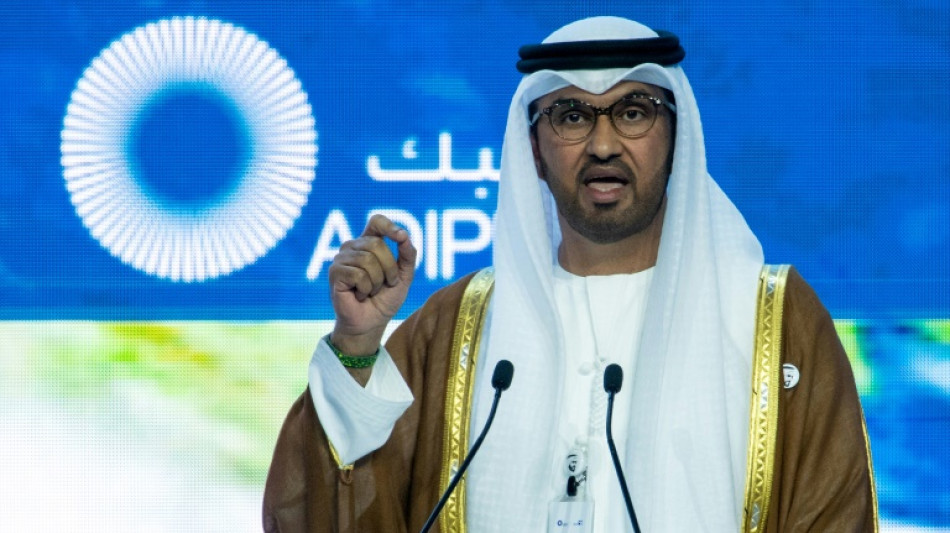
Climate experts warn of fossil fuel tactics at COP28 / Photo: Ryan LIM - AFP/File

 Indonesia accepts Malaysia's help to tackle wildfires

 Indians living in Japan on stand-by to house Asian Games athletes
 Trump signs bill authorizing sweeping Russia sanctions

 Protesters form human chain at Kennedy Center after Trump threat

 Death toll from attack at police HQ in Pakistan rises to 31

 Trump says Denmark to give US 'permanent control' over Greenland security

 Kennedy Center: future unclear for iconic Washington arts hub

 Trump claims 'infinite' Greenland security deal with Denmark

 Helicopters battle wildfire threatening Ecuador's capital

 Brentford batter Chelsea to undo Alonso's promising start

 Kane hits Bundesliga century as Bayern rout Union

 Trump says CNN, MS NOW, Politico banned from White House

 Hushing and hedging: US companies retreat on climate

 Springboks to face Fiji before 2027 Rugby World Cup

 Nigeria miners struggled to breathe in cell before 37 died: survivors

 McIlroy on the charge at PGA Championship as Reed withdraws

 McIlroy on the charge at PGA Championship

 Crisis-wracked Volkswagen warns of 10-bn-euro hit to profits

 Costa Rica's Grynspan tops third informal poll for UN chief: diplomat

 Stock markets retreat after central bank rate hikes

 Russia labels director of Cannes Grand Prix winner a 'foreign agent'

 Macron warns of Russian 'hybrid' threat after meeting presidential hopefuls

 UN holds third informal poll for new chief

 Kulusevski return can spark Spurs: De Zerbi

 Shakira to cap off world tour with Madrid 12-gig run

Oil-rich Gulf states have positioned themselves as both champions of climate innovation and guardians of fossil fuel interests -- a balancing act experts warn could derail action at COP28 in Dubai.
This year's United Nations climate summit is being chaired and hosted by the United Arab Emirates, a country dubbed "an oil company with a state attached" by one observer who requested anonymity so they could speak freely about the negotiations.
According to COP28 director general Majid Al Suwadi, "the UAE has been a leader when it comes to climate change".
"We have been doing our part," he said in September.
But one of the "inherent flaws of the COP system" is that national interests -- particularly the host's -- inevitably influence the outcome, said Ahmed El Droubi, international campaigns manager at Climate Action Network.
Indeed, the UAE has appointed Sultan Al Jaber, the head of state-owned oil company ADNOC, as COP president, drawing protests from environmentalists.
At COP27 in Egypt, where oil and gas lobbyists outnumbered most delegations, the final text included a last-minute provision to boost "low-emission energy".
That term includes natural gas, into which Egypt has invested billions of dollars in recent years.
In Dubai, activists expect the fight will be even harder, with the hydrocarbons industry intent on "not just delaying, denying, diverting meaningful climate action, but also greenwashing their polluting work", Farhana Sultana, professor of geography and the environment at Syracuse University, told AFP.
With time running out, the stakes are higher than ever at COP28.
To keep global warming at an average of 1.5C above pre-industrial temperatures, greenhouse gas emissions must drop 43 percent by 2030 from 2019 levels, according to the Intergovernmental Panel on Climate Change, the UN's climate body.
"At the moment, we're not cutting anything, and the situation gets more urgent every year," Karim Elgendy, associate fellow at Chatham House, told AFP.
- Delay the 'inevitable' -
Jaber, who is also the UAE's climate envoy and co-founder of state-owned renewable energy company Masdar, is not the only oil industry veteran on the front lines of the climate fight.
The European Union's COP28 delegation is led by Dutch former foreign minister and ex-Shell employee Wopke Hoekstra, an appointment that has also been controversial.
According to Droubi, despite Jaber's clear "conflict of interest" as ADNOC chief, he "has actually said the most progressive thing of any COP president: that phasing down fossil fuels is inevitable".
But "inevitable", Elgendy says, "is a very calculated word".
In the name of energy market stability, fossil fuel giants including the UAE, Saudi Arabia and the United States have argued for continued new investments in hydrocarbons before an eventual transition.
In October, Jaber said "we cannot unplug the energy system of today before we build the new system of tomorrow", and encouraged activists to separate "reality from fantasies".
But "no one is saying turn it off immediately", Elgendy said.
"What they're saying is don't dig any more wells, don't expand capacity."
To stick to the 1.5C threshold, the International Energy Agency has called for an end to new investments in coal, oil and natural gas.
Saudi Arabia, the world's biggest oil exporter, has slammed the IEA as a "political" body, and the industry is proceeding with vast expansion globally.
According to Elgendy, more attention should be given to the solutions that matter, including cutting oil and gas subsidies -- which according to the International Monetary Fund were $7 trillion in 2022, or seven percent of global GDP.
- De-link and keep drilling -
The UAE has long been diversifying its economy, and says 70 percent of its GDP comes from non-oil sectors. It has pledged tens of billions of dollars in renewable energy investments.
"But for them, that means expanding into renewables, not actually limiting fossil fuels," according to Droubi.
At COP28, many countries, and the EU, will argue for an unprecedented commitment to move away from "unabated" fossil fuels.
Droubi said what the UAE is pushing, and what activists "are pushing back on, is de-linking the phase-in of renewables from the phase-out of fossil fuels".
On one hand, Gulf states say there will always be the need for some oil. And because theirs is the world's "cheapest and cleanest", they should be "the last producers standing", Elgendy said.
On the other hand, they have adopted what he calls an "unorthodox" climate approach where the key is not to cut carbon -- as scientists insist is necessary -- but to "manage carbon; we'll reuse it and recycle it and ultimately we'll sequester it underground".
- Running out of time -
Instead of cutting fossil fuels outright, oil giants have touted several once-marginal technologies as promising solutions to cut emissions.
They include carbon capture and storage (CCS), direct air capture and carbon credit trading -- all carbon management mechanisms that amount to "false climate solutions", according to Sultana.
CCS prevents CO2 from entering the atmosphere by siphoning exhaust from power plants, while direct air capture pulls CO2 from thin air.
Both technologies have been demonstrated to work, but remain far from maturity and commercial scalability.
Carbon credit trading schemes -- which underpin much of the world's "net zero" ambitions -- have long been dogged by charges of deception, poor transparency, dodgy accounting practices and in-built conflicts of interest.
According to Elgendy, these solutions "need several years to be viable, and we simply don't have that time".
In September, UN chief Antonio Guterres warned: "We must make up time lost to foot-dragging, arm-twisting and the naked greed of entrenched interests raking in billions from fossil fuels."
F.Carias--PC



