Dogs, antennas and honey for Japan's big bear problem / Photo: Richard A. Brooks - AFP

 Inter Milan and Italy icon Mazzola dies aged 83

 Saudi capital issues first air raid alert since renewed fighting in Yemen

 Martin edges title rival Marquez for Austrian MotoGP pole

 Indonesia accepts Malaysia's help to tackle wildfires

 Indians living in Japan on stand-by to house Asian Games athletes

 Trump signs bill authorizing sweeping Russia sanctions

 Protesters form human chain at Kennedy Center after Trump threat

 Death toll from attack at police HQ in Pakistan rises to 31

 Trump says Denmark to give US 'permanent control' over Greenland security

 Kennedy Center: future unclear for iconic Washington arts hub

 Trump claims 'infinite' Greenland security deal with Denmark

 Helicopters battle wildfire threatening Ecuador's capital

 Brentford batter Chelsea to undo Alonso's promising start

 Kane hits Bundesliga century as Bayern rout Union

 Trump says CNN, MS NOW, Politico banned from White House

 Hushing and hedging: US companies retreat on climate

 Springboks to face Fiji before 2027 Rugby World Cup

 Nigeria miners struggled to breathe in cell before 37 died: survivors

 McIlroy on the charge at PGA Championship as Reed withdraws

 McIlroy on the charge at PGA Championship

 Crisis-wracked Volkswagen warns of 10-bn-euro hit to profits

 Costa Rica's Grynspan tops third informal poll for UN chief: diplomat

 Stock markets retreat after central bank rate hikes

 Russia labels director of Cannes Grand Prix winner a 'foreign agent'

 Macron warns of Russian 'hybrid' threat after meeting presidential hopefuls

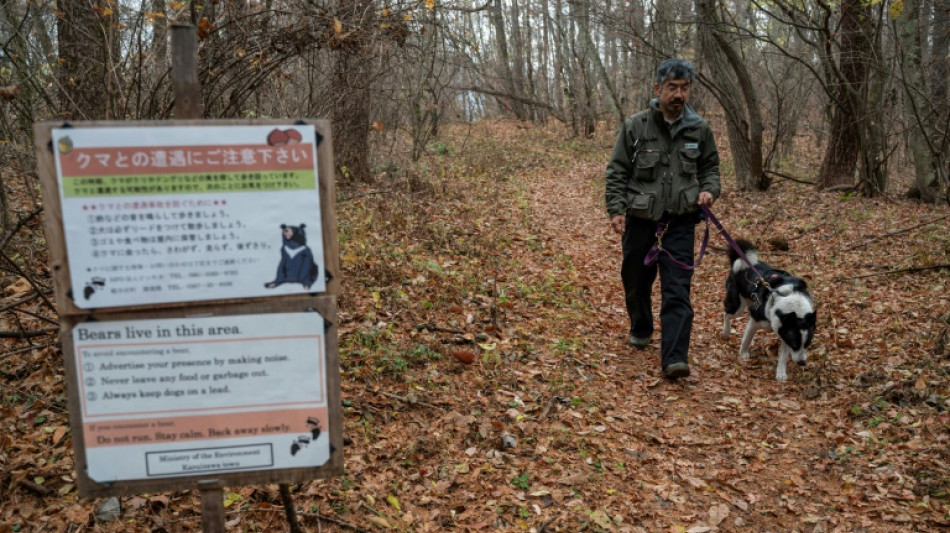
Thousands of bears are being shot in Japan each year as they become more and more of a problem. Junpei Tanaka and his dog Rela, straining at her leash in the woods, have a kinder, smarter way.
People moving from rural areas and Japan's ageing society -- plus climate change affecting bears' food and hibernation time -- are prompting ever more of the hungry animals to approach towns.
Reliable data is hard to find but bear numbers also appear to have rocketed, with one newspaper estimating they had roughly tripled in 11 years in some places. Sightings have almost doubled this year.
The increasing frequency of these powerful animals -- which in the case of brown bears can weigh half a tonne (1,100 pounds) and outrun a human -- coming into contact with people has created alarming headlines.
This year is on track to be the deadliest for humans since the government started collating data in 2006, with six people killed by bears, including one elderly woman in her garden in October.
The severed head of a fisherman was found by a lake in May. A bear was reportedly spotted with his waders dangling from its mouth.
Another 212 people, also a record, have been injured in attacks.
One bear attacked six people in a single day in October, including an 83-year-old woman and a schoolgirl waiting for a bus in the northern town of Kitaakita.
- Animal-lovers -
It's been far worse for the bears.
On average over the past five years, 4,895 have been killed each year, according to figures from the Environment Ministry.
As of November 30, 6,287 have died in this fiscal year (to March), around 2,000 of them in November alone. Usually, they are shot.
"This year, it's expected to go as high as 8,000," said Tanaka, 50, a bear expert who works for the Picchio Wildlife Research Center.
This is prompting unease in a country -- three-quarters of it mountainous -- that thinks of itself as living in harmony with nature.
"For a long time, Japanese people co-existed with wild animals... They believed in the presence of gods in every kind of living thing and avoided unnecessary killing," Tanaka said.
"But now, it has become difficult to segregate the wild and human areas due to the change in environment, change in social structures and change in people's lifestyles," he said.
- Reliable -
Tanaka says his project in Karuizawa, a town surrounded by woods in the shadow of a volcano 90 minutes from Tokyo by bullet train, is a "forerunner" of what can be done without resorting to killing the bears.
In the dead of night -- when the bears are most active -- Tanaka demonstrates the methods used by his organisation, which he says keeps both humans and bears safe.
He and his team set barrel traps, with honey inside, to capture any bears that start to lose their fear of humans. They are fitted with a radio collar and released, far away.
The town has also installed bear-proof rubbish collection points -- the slot for the door handle is too small for a paw -- and appealed to locals to be more aware.
But the key component in the non-lethal efforts is Tanaka's amber-eyed, keen-nosed canine Rela and the rest of the team of specially trained Karelian Bear Dogs, a sturdy and fearless breed originally from Finland.
"They are very reliable staff of the team. They are our colleagues," Tanaka tells AFP.
Picchio acquired Rela's mother from the Wind River Bear Institute in the United States, whose bear biologist founder Carrie Hunt has pioneered the use of dogs in bear control.
Heading out in his small van in the pre-dawn mist, Tanaka first waggles around a metre-long (three-foot) antenna to triangulate the location of any nearby bears fitted with a radio collar.
"You got the bear scent? Okay, let's go!" Tanaka says in English -- like all his commands -- to the dog.
He and Rela then head fearlessly out over the hill and once they find a bear -- unseen by AFP staying safely at a distance -- the dog emits a fierce bark and scares it away.
- 'Bear shepherding' -
This "bear shepherding" method is unique in Japan, although other places are interested, said city official Masashi Tsuchiya.
"Bears are dangerous animals, so it is true that we did receive some voices from local residents that bears should be killed," Tsuchiya told AFP.
"But thanks to the Picchio programme, we have learned that we can control and monitor bears' behavioural patterns by identifying each individual animal, attaching a radio collar and pushing them away from the town," he said.
Japan has two types of bears. Around Karuizawa they are all Asian black bears -- also known as moon bears -- and the bigger brown bears live on the northern island of Hokkaido.
Moon bears always live in forests and don't like being seen but brown bears, which are bigger, come out in the open. And while brown bears "bluff" attacks, moon bears do not.
"Most of the time they run away from humans. But once they get in trouble with a human and get into a panic, they attack," Tanaka said.
"And they don't retreat."
P.Queiroz--PC



