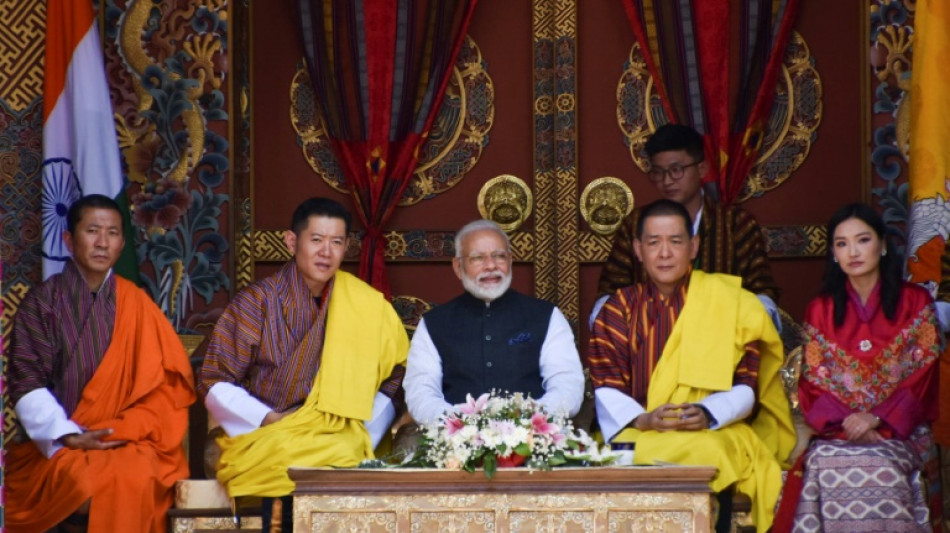
India, China eye strategic areas bordering 'last barrier' Bhutan / Photo: Upasana DAHAL - AFP/File

 Inter Milan and Italy icon Mazzola dies aged 83

 Saudi capital issues first air raid alert since renewed fighting in Yemen

 Martin edges title rival Marquez for Austrian MotoGP pole

 Indonesia accepts Malaysia's help to tackle wildfires
 Indians living in Japan on stand-by to house Asian Games athletes

 Trump signs bill authorizing sweeping Russia sanctions

 Protesters form human chain at Kennedy Center after Trump threat

 Death toll from attack at police HQ in Pakistan rises to 31

 Trump says Denmark to give US 'permanent control' over Greenland security

 Kennedy Center: future unclear for iconic Washington arts hub

 Trump claims 'infinite' Greenland security deal with Denmark

 Helicopters battle wildfire threatening Ecuador's capital

 Brentford batter Chelsea to undo Alonso's promising start

 Kane hits Bundesliga century as Bayern rout Union

 Trump says CNN, MS NOW, Politico banned from White House

 Hushing and hedging: US companies retreat on climate

 Springboks to face Fiji before 2027 Rugby World Cup

 Nigeria miners struggled to breathe in cell before 37 died: survivors

 McIlroy on the charge at PGA Championship as Reed withdraws

 McIlroy on the charge at PGA Championship

 Crisis-wracked Volkswagen warns of 10-bn-euro hit to profits

 Costa Rica's Grynspan tops third informal poll for UN chief: diplomat

 Stock markets retreat after central bank rate hikes

 Russia labels director of Cannes Grand Prix winner a 'foreign agent'

 Macron warns of Russian 'hybrid' threat after meeting presidential hopefuls

Squeezed between giant arch-rivals India and China, the landlocked mountain kingdom of Bhutan was long isolated by icy Himalayan peaks.
But as Bhutan readies to elect a new parliament in Thimphu on January 9, China and India are watching the contest with keen interest as they eye strategic contested border zones, analysts warn.
A "cooperation agreement" inked between Bhutan and China in October after talks over their disputed northern frontier sparked concern in India, which has long regarded Bhutan as a buffer state firmly under its orbit.
Bhutan is "one of the last barriers" in China's bid to exert influence in South Asia, said Harsh V. Pant, an international relations professor at King's College London told AFP.
India is determined not to let China extend its influence further across what New Delhi sees as its natural sphere of influence, wary after a swathe of muscular trade deals and loans by Beijing, including with Bangladesh, Nepal, the Maldives and Sri Lanka.
Thimphu and Beijing do not have formal diplomatic relations.
India, however, effectively oversaw Bhutan's foreign policy until 2007.
The relationship was "in exchange for free-trade and security arrangements", Britain's Chatham House think tank wrote in a December report.
The report included satellite photographs it said showed an "unsanctioned programme of settlement construction" by China in Bhutan's northern frontier region, which could "become permanent Chinese territory" pending the outcome of a border deal.
China's foreign ministry told AFP in a statement of its "determination to strive for an early resolution of the boundary issue and the establishment of diplomatic relations".
- 'Far-reaching implications' -
"Beijing will anticipate that a deal consolidating its gains in northern Bhutan may lead to formal diplomatic relations and the opportunity to draw Thimphu into its orbit", Chatham House said.
"Any such deal would have far-reaching implications for India."
If China succeeds in that, Beijing "can push a view that India is now marginal in its immediate neighbourhood", Pant added.
New Delhi has been wary of Beijing's growing military assertiveness and their 3,500-kilometre (2,175-mile) shared frontier has been a perennial source of tension.
In 2017, there was a 72-day military standoff after Chinese forces moved into the disputed Doklam plateau, on the China-India-Bhutan border.
The plateau pushes south towards India's critical Siliguri Corridor, dubbed the "Chicken's Neck".
The perilously narrow strip of land lies between Nepal and Bangladesh, and connects India's northeastern states with the rest of the country.
China and India fought a month-long war in the region in 1962.
"New Delhi would be concerned that, in the event of a deal demarcating Bhutan's northern border, attention may turn to territory in Bhutan's west which China disputes, including the Doklam plateau," Chatham House added.
For Bhutan, dwarfed by China, striking a deal makes sense, said Pant.
"If they don't resolve their border now, tomorrow they will be in an even more unfavourable position," he said.
- 'Quiet concern' -
Suhasini Haidar, diplomatic editor of The Hindu newspaper, said India was worried that a Bhutan-China border deal "seems imminent".
She said that Bhutan's "fast-tracking" of boundary talks with China after the 2017 Doklam standoff was a decision that "India has viewed with quiet concern".
Analysts say foreign policy plays little role in the domestic concerns of voters in Bhutan -- about the size of Switzerland with around 800,000 people -- who are more worried about high unemployment and young people migrating abroad seeking jobs.
However, India is the biggest source of investment and infrastructure in Bhutan -- Thimphu's ngultrum currency is pegged to New Delhi's rupee -- and boosting bilateral relations is key.
"Any government coming to power will seek to shore up ties," Haidar said.
Bhutan has strong economic and strategic relations with India, "particularly as its major trading partner, source of foreign aid and as a financier and buyer of surplus hydropower", according to the World Bank. About 70 percent of Bhutan's imports come from India.
In December, Bhutan's King Jigme Khesar Namgyel Wangchuck announced a special economic zone along its border with India.
Both hopefuls to become Bhutan's new prime minister speak enthusiastically about boosting links with New Delhi to lift Bhutan's $3 billion economy.
India has already announced a slew of connectivity projects including a railway line to Bhutan, but much would depend on Indian investors.
"Bhutan will be seeking investments from other countries," said Haidar, adding it will be "significant" if Thimphu welcomes funds from China.
X.Brito--PC



