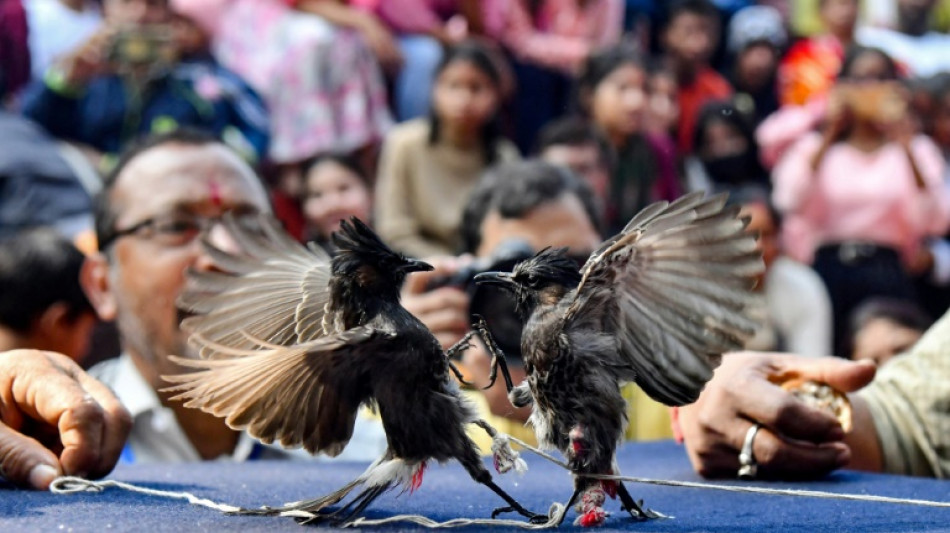
Indian songbird fights return after cruelty ban overturned / Photo: Biju BORO - AFP

 Inter Milan and Italy icon Mazzola dies aged 83

 Saudi capital issues first air raid alert since renewed fighting in Yemen

 Martin edges title rival Marquez for Austrian MotoGP pole

 Indonesia accepts Malaysia's help to tackle wildfires

 Indians living in Japan on stand-by to house Asian Games athletes

 Trump signs bill authorizing sweeping Russia sanctions

 Protesters form human chain at Kennedy Center after Trump threat

 Death toll from attack at police HQ in Pakistan rises to 31

 Trump says Denmark to give US 'permanent control' over Greenland security

 Kennedy Center: future unclear for iconic Washington arts hub

 Trump claims 'infinite' Greenland security deal with Denmark

 Helicopters battle wildfire threatening Ecuador's capital

 Brentford batter Chelsea to undo Alonso's promising start

 Kane hits Bundesliga century as Bayern rout Union

 Trump says CNN, MS NOW, Politico banned from White House

 Hushing and hedging: US companies retreat on climate

 Springboks to face Fiji before 2027 Rugby World Cup

 Nigeria miners struggled to breathe in cell before 37 died: survivors

 McIlroy on the charge at PGA Championship as Reed withdraws

 McIlroy on the charge at PGA Championship

 Crisis-wracked Volkswagen warns of 10-bn-euro hit to profits

 Costa Rica's Grynspan tops third informal poll for UN chief: diplomat

 Stock markets retreat after central bank rate hikes

 Russia labels director of Cannes Grand Prix winner a 'foreign agent'

 Macron warns of Russian 'hybrid' threat after meeting presidential hopefuls

Squawking and screeching, tiny songbirds flutter around a fighting ring in a centuries-old Indian tradition decried by some as cruel but returning after an eight-year ban was overturned.
The red-vented bulbuls are cheered on by a packed crowd, with chanting spectators encouraging them to peck each other with their hooked beaks to win their freedom.
Bird fights at the Haigriva Madhav temple in Hajo in northeast India's Assam state returned on Monday, after a ban was scrapped because Hindu priests argued it was part of their tradition.
"We have seen the birds fight since our childhood... the ritual of bird fight is very close to the people," said Kichin Das, one of three judges who decides the winner based on the moves of the birds.
Supporters say the battles began after an 18th-century king saw two birds fighting, and it became a popular pastime to mark the harvest festival in January.
"This is a game from the era of kings," said bird fighter Biswajit Biswasi, 49. "Since childhood, I have learned how to catch these birds and how to train them."
- 'Faith and tradition' -
Traditionally, captured wild birds were goaded to fight through hunger before being fed an intoxicating spice mix -- reportedly including cannabis, pepper, cinnamon and cloves.
"It's a short game," said Babul Mazumdar, who has captured birds to fight for 30 years.
"Whichever bird overpowers the other in, say three to four moves, is declared the winner."
In the past, losing birds had their fine head crest clipped to stop them from being entered into another fight. New rules mean the birds are now just inked on their tail feathers.
"This game is related to our faith and tradition," said Satya Nath Bharali, 85, one of the thousands of spectators who came to watch around 100 birds fight on Monday. "This has been happening for hundreds of years."
The fights have a loyal local following, but activists condemn the practice -- which is like cockfighting but with songbirds netted from the wild -- as cruel.
After a 2014 Supreme Court order banned popular bull-taming festivals long blighted by allegations of animal cruelty, activists sought to also restrict bird fights.
A year later, Assam's High Court ordered the bulbul fights to stop, sparking protests.
- 'Inhumane and barbaric' -
In India's Tamil Nadu state, the ban on bull-wrestling was lifted in 2017 after massive protests.
Last year, the Assam state government said the songbird fights could resume -- as long as organisers observe strict guidelines.
Fights must be "conducted in a disciplined manner", with the birds well fed and watered.
Once the fight is over, organisers must ensure the birds are "released in the open air in perfect condition", the government ordered.
"We are happy that the government allowed the bird fight to take place this year," said Pradyumna Bhagawati, one of the thousands of spectators who came to watch.
But Tushar Kol, from the People for the Ethical Treatment of Animals (PETA), condemned the return of the fights.
"Inciting an animal to fight another animal is outdated, inhumane and barbaric and such events have no place in a modern civilized society," Kol wrote in a letter to the Assam authorities, pleading for the fights to be stopped.
"Confining them and forcing them to fight denies them their natural behaviour, causing immense stress and suffering," Kol added.
India has about two dozen bulbul species, some with eye-catching yellow and red colours.
While many species are common, some are listed as "vulnerable" and "near threatened" by the International Union for the Conservation of Nature.
T.Batista--PC



