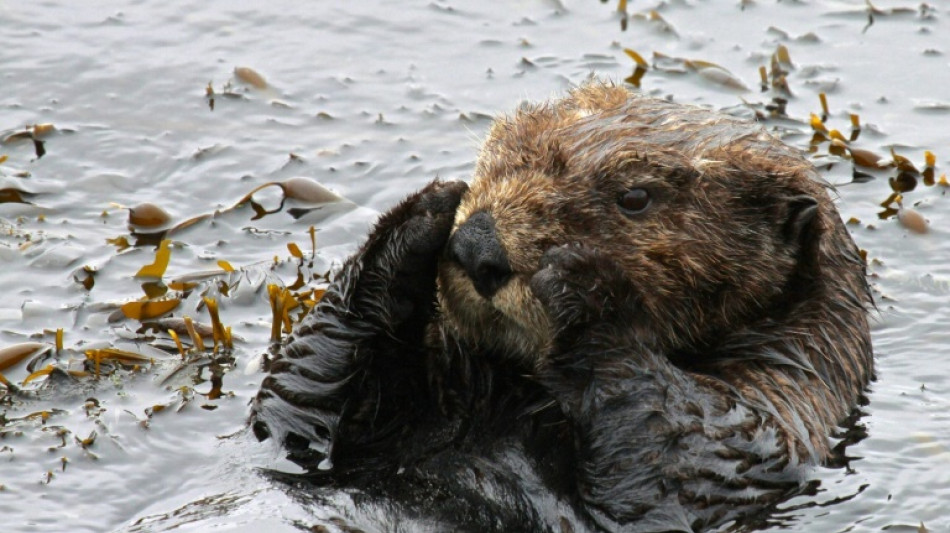
Return of hungry sea otters protects key coastal ecosystem: study / Photo: Lilian Carswell - US Fish and Wildlife Services/AFP/File

 Inter Milan and Italy icon Mazzola dies aged 83

 Saudi capital issues first air raid alert since renewed fighting in Yemen

 Martin edges title rival Marquez for Austrian MotoGP pole

 Indonesia accepts Malaysia's help to tackle wildfires

 Indians living in Japan on stand-by to house Asian Games athletes

 Trump signs bill authorizing sweeping Russia sanctions

 Protesters form human chain at Kennedy Center after Trump threat

 Death toll from attack at police HQ in Pakistan rises to 31

 Trump says Denmark to give US 'permanent control' over Greenland security

 Kennedy Center: future unclear for iconic Washington arts hub

 Trump claims 'infinite' Greenland security deal with Denmark

 Helicopters battle wildfire threatening Ecuador's capital

 Brentford batter Chelsea to undo Alonso's promising start

 Kane hits Bundesliga century as Bayern rout Union

 Trump says CNN, MS NOW, Politico banned from White House

 Hushing and hedging: US companies retreat on climate

 Springboks to face Fiji before 2027 Rugby World Cup

 Nigeria miners struggled to breathe in cell before 37 died: survivors

 McIlroy on the charge at PGA Championship as Reed withdraws

 McIlroy on the charge at PGA Championship

 Crisis-wracked Volkswagen warns of 10-bn-euro hit to profits

 Costa Rica's Grynspan tops third informal poll for UN chief: diplomat

 Stock markets retreat after central bank rate hikes

 Russia labels director of Cannes Grand Prix winner a 'foreign agent'

 Macron warns of Russian 'hybrid' threat after meeting presidential hopefuls

Back from the brink of extinction, sea otters in central California have started restoring the degraded landscape of a key estuary -- thanks to their insatiable appetite for crabs, according to a study published on Wednesday.
The research depicts the ripple effects of the sea otters' return to Monterey Bay, California, highlighting how successful conservation efforts can improve the health and resilience of whole ecosystems.
Once hunted for their fur to the verge of local extinction, sea otters have made a dramatic recovery in central California after more than four decades of extensive conservation efforts in the region.
The otters have returned to coastal kelp forests and the the salt marsh-dominated coastal estuary, Elkhorn Slough.
And their return has heralded wide-ranging improvements around the estuary, a critical habitat that protects the shoreline.
In a new paper published in Nature, scientists in the United States and Canada found that the marine mammal slowed the erosion of parts of the estuary by up to 90 percent between the time they recolonised the area in the mid 1980s and 2018.
"One of the most remarkable things about this is that it's truly a conservation success story," study author Christine Angelini, director of the Center for Coastal Solutions at the University of Florida, told AFP.
Previous studies on salt marshes have shown the physical and chemical explanations for erosion.
But this study points a pincer at another culprit -- the shore crab.
These abundant crabs eat plant roots, burrow into the salt marsh soils and eventually can cause erosion and even collapse.
Sea otters eat around 25 percent of their body weight every day and researchers said they have an especially large appetite for these crabs.
"After a few decades, in areas the sea otters had recolonised, salt marshes and creekbanks were becoming more stable again, said lead author Brent Hughes, associate professor of biology at Sonoma State University, in a statement.
This was "despite rising sea levels, increased water flow from inland sources, and greater pollution".
- 'Crab feast' -
Researchers combined decades of data, over 35,000 observations of sea otters and three years of experiments manipulating the presence of top predators in a salt marsh ecosystem.
Top predators have declined in nearly every ecosystem on Earth, but conservation efforts over the past decades have helped recover species like wolves, brown bears, and eagles.
And growing research shows that reintroduction can have a wide-ranging impact on restoring ecosystems.
In this case researchers said sea otter conservation has unlocked several decades worth of benefits.
"It would cost tens of millions of dollars for humans to rebuild these creek banks and restore these marshes," said study author Brian Silliman, professor of Marine Conservation Biology at Duke University.
"The sea otters are stabilising them for free in exchange for an all-you-can-eat crab feast."
G.Machado--PC



