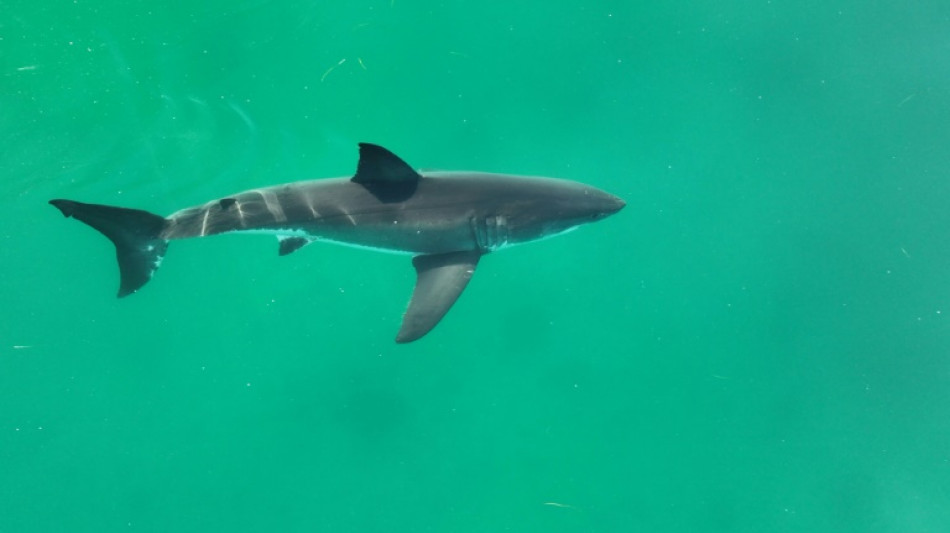
Shark bites and deaths up even as species faces crisis: study / Photo: Handout - @TheMalibuArtist/AFP/File

 Inter Milan and Italy icon Mazzola dies aged 83

 Saudi capital issues first air raid alert since renewed fighting in Yemen

 Martin edges title rival Marquez for Austrian MotoGP pole

 Indonesia accepts Malaysia's help to tackle wildfires

 Indians living in Japan on stand-by to house Asian Games athletes

 Trump signs bill authorizing sweeping Russia sanctions

 Protesters form human chain at Kennedy Center after Trump threat

 Death toll from attack at police HQ in Pakistan rises to 31

 Trump says Denmark to give US 'permanent control' over Greenland security

 Kennedy Center: future unclear for iconic Washington arts hub

 Trump claims 'infinite' Greenland security deal with Denmark

 Helicopters battle wildfire threatening Ecuador's capital

 Brentford batter Chelsea to undo Alonso's promising start

 Kane hits Bundesliga century as Bayern rout Union

 Trump says CNN, MS NOW, Politico banned from White House

 Hushing and hedging: US companies retreat on climate

 Springboks to face Fiji before 2027 Rugby World Cup

 Nigeria miners struggled to breathe in cell before 37 died: survivors

 McIlroy on the charge at PGA Championship as Reed withdraws

 McIlroy on the charge at PGA Championship

 Crisis-wracked Volkswagen warns of 10-bn-euro hit to profits

 Costa Rica's Grynspan tops third informal poll for UN chief: diplomat

 Stock markets retreat after central bank rate hikes

 Russia labels director of Cannes Grand Prix winner a 'foreign agent'

 Macron warns of Russian 'hybrid' threat after meeting presidential hopefuls

Shark bites and fatalities ticked up worldwide last year, with Australia accounting for a disproportionate number of deaths resulting from heightened contact with humans even as the ancient predators face a wider extinction crisis.
There were 69 unprovoked attacks in 2023, up slightly from 63 in 2022, and ten deaths, which is double the year before and a 12-year-high, according to the International Shark Attack File, an annual global report published Monday by the University of Florida.
Gavin Naylor, director of the Florida Program for Shark Research at the Florida Museum of Natural History who co-authored the study, told AFP that the uptick didn’t mean sharks were becoming more numerous or fierce.
Three of the deaths happened off the coast of southern Australia in a region called the Eyre Peninsula, where a rebounding seal population has brought great whites into closer proximity to surfers in a remote region.
"If you get nobbled by a white shark you're probably not going to have all of the helicopters being able to be there within five minutes and stretchers and all the medical infrastructure," he said.
In all, Australia saw four deaths, followed by two in the United States, and one each in the Bahamas, Egypt, Mexico and New Caledonia.
The US saw 36 unprovoked attacks -- just over half of the total number worldwide. Most of these are "test" bites when a shark mistakes a human for prey.
"Provoking" a shark was defined as intentionally approaching one or swimming in an area where bait was used to lure fish -- and such incidents were not included in the study's headline figures.
Data was collected through media reports then independently validated by Naylor and his co-author Joe Miguez.
- Global numbers down -
"Globally shark numbers are down," said Naylor, with a broad trend of sharks moving closer to coastal waters as overfishing causes the collapse of fish stocks in the ocean. A study in Nature in 2021 found the global abundance of oceanic shark and rays down 71 percent since 1970.
This in turn had led to a disconnect between what scientists are reporting globally and coastal fishermen say locally about increased encounters, added Naylor.
What's more, shark encounters are often a consequence of people spending more time in the water, with bites spiking during the summer time of the northern and southern hemispheres.
Improving water quality off the coast of New York had, for example, attracted more fish, which in turn had brought more sand tiger sharks.
Last summer, several people were bitten off Long Island, forcing increased shark patrols.
Increasing heat meanwhile was driving shark species to pursue prey in new waters.
"Coral trout are supposed to be on the Barrier Reef, we see them in Tasmania, which is super cold water," said Naylor, and "predators follow the food."
Practical advice to avoid sharks varies from place to place, said Naylor, and people should do local research.
For instance, off the coast of Florida, wearing jewelry that reflects light can look like fish scales and attract black tip sharks. People should also get out of the water if they see schools of bait fish.
E.Borba--PC



