
Burning question: what can we expect in a 1.5C world? / Photo: Joseph Prezioso - AFP/File

 Lettermen co-founder Tony Butala dies at 87

 James Talarico defeats Ken Paxton in historic Texas Senate result

 Goa plans relationship-readiness course amid concern over divorces

 India introduces four-layer motor insurance choice from December 15

 Nikkei Falls 1.42% as AI Sector Faces Pressure Post-US Elections
 IndiGo holds talks with Embraer over potential order for 100 aircraft
 Real Madrid Visits AEK Athens in Champions League Liga Phase

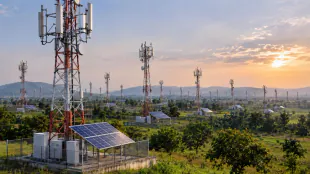 Indus Towers expands solar-powered network to 50,000 telecom sites

 Equitas Small Finance Bank rebounds after naming interim chief executive

 Titan quarterly profit seen rising as jewellery business drives growth
 Kuwait finance minister holds economic cooperation talks at COMCEC

 Abdul El-Sayed declares victory in Michigan Senate contest

 Democrats capture US Congress in sweeping midterm victory

 Manchester United rallies past Roma as PSG dominates in Champions League

 Qatar sees tentative opening for renewed regional diplomacy

 Qatar Tourism joins Pacific Asia Travel Association at London travel market

 Abdul El-Sayed Wins Michigan Senate Seat in Historic Election

 Qatar media bodies discuss support for humanitarian initiatives
Massive wildfires exposing millions to toxic smoke, drought shrivelling crops and key waterways, destructive storms supercharged by record ocean temperatures -- in the last year the world has had a taste of what to expect with warming of 1.5C.
For the first time on record, Earth has endured 12 consecutive months of temperatures 1.5 degrees Celsius hotter than the pre-industrial era, Europe's climate monitor said Thursday.
That does not signal a breach of the more ambitious limit agreed by countries in the 2015 Paris Agreement -- because that is measured as an average over two decades.
Temperatures since the middle of last year have been ramped up by the naturally-occurring El Nino warming event, which is likely to recede in the coming months.
But underlying planetary heating has cranked up the global thermometer, driven largely by the burning of fossil fuels as well as deforestation and agriculture.
"Although this news does not mean the Paris limit is exceeded, it is undeniably bad news," said Joeri Rogelj, director of research at the Grantham Institute, Imperial College London.
"Unless global emissions are urgently brought down to zero, the world will soon fly past the safety limits set out in the Paris climate agreement."
- Limits of endurance -
That 1.5C milestone is no longer in the distant future, with the UN's IPCC climate science panel warning that a breach is likely sometime between 2030 and 2035.
What would a 1.5C world mean for humans and the natural world they rely on to survive?
Scientists estimate current global temperatures are around 1.2C hotter overall than the pre-industrial benchmark, averaged across the period 1850 to 1900.
Severe climate impacts are already visible around the world and would be amplified once the 1.5C threshold is reached.
Some parts of the world, like the Arctic and high mountain areas, are warming far faster than others.
In other regions, even small temperature increases can expose vulnerable communities to dangerous threats, including heat that tests the very limit of human endurance.
Coral reefs -- ecosystems that provide habitat for an immense array of marine life and protect coastlines -- are projected to decline 70 to 90 percent in a world that has warmed 1.5C.
The loss of biodiversity globally will be among the most pronounced impacts of a 1.5C warmer climate, according to the IPCC.
- Over the line -
Climate experts are also concerned that accelerating permafrost thaw will release carbon dioxide and methane into the atmosphere, creating a vicious cycle of warming.
The IPCC currently classifies the risk of permafrost melt in some regions as "moderate", but it would become "high" in a 1.5C or even warmer climate.
Some impacts of warming are already irreversible, and will continue to worsen, like sea level rise, driven by melting ice sheets and glaciers.
Higher ocean levels are already threatening the future of low-lying islands, while in the longer term metres of sea level rise will likely swamp many of the world's major coastal cities.
Even if the 1.5C limit is breached, reducing greenhouse gas emissions remains crucial to stay "well below" 2C of warming, the maximum warming limit set by the Paris Agreement.
That is because "every increment of global warming will intensify multiple and concurrent hazards," the IPCC warns.
Halting deforestation and the rampant destruction of ecosystems are also crucial to maintain nature's ability to drawn down carbon from the atmosphere.
Oceans absorb 90 percent of the excess heat produced by the carbon pollution from human activity since the dawn of the industrial age.
V.F.Barreira--PC



