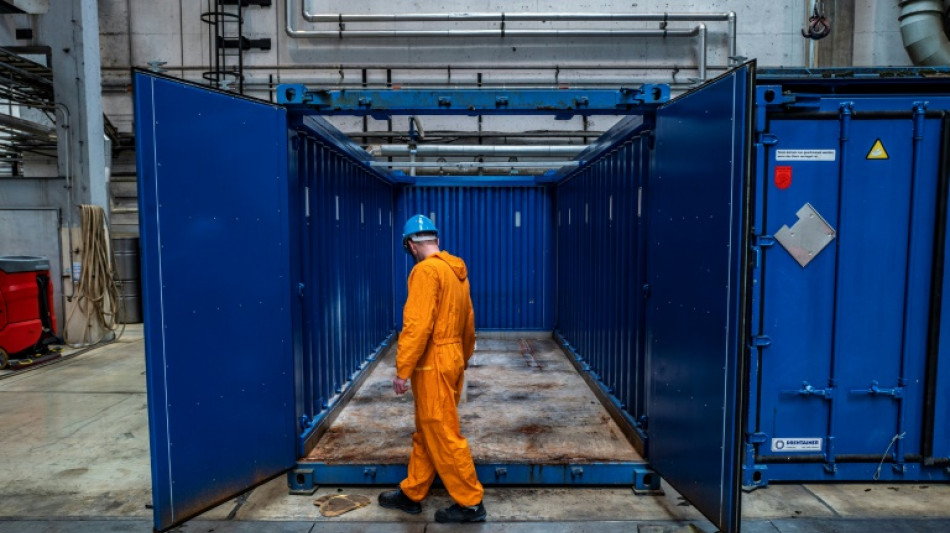
US nuclear industry upbeat on small reactors, despite setback / Photo: John MACDOUGALL - AFP

 Inter Milan and Italy icon Mazzola dies aged 83

 Saudi capital issues first air raid alert since renewed fighting in Yemen

 Martin edges title rival Marquez for Austrian MotoGP pole

 Indonesia accepts Malaysia's help to tackle wildfires

 Indians living in Japan on stand-by to house Asian Games athletes
 Trump signs bill authorizing sweeping Russia sanctions

 Protesters form human chain at Kennedy Center after Trump threat

 Death toll from attack at police HQ in Pakistan rises to 31

 Trump says Denmark to give US 'permanent control' over Greenland security

 Kennedy Center: future unclear for iconic Washington arts hub

 Trump claims 'infinite' Greenland security deal with Denmark

 Helicopters battle wildfire threatening Ecuador's capital

 Brentford batter Chelsea to undo Alonso's promising start

 Kane hits Bundesliga century as Bayern rout Union

 Trump says CNN, MS NOW, Politico banned from White House

 Hushing and hedging: US companies retreat on climate

 Springboks to face Fiji before 2027 Rugby World Cup

 Nigeria miners struggled to breathe in cell before 37 died: survivors

 McIlroy on the charge at PGA Championship as Reed withdraws

 McIlroy on the charge at PGA Championship

 Crisis-wracked Volkswagen warns of 10-bn-euro hit to profits

 Costa Rica's Grynspan tops third informal poll for UN chief: diplomat

 Stock markets retreat after central bank rate hikes

 Russia labels director of Cannes Grand Prix winner a 'foreign agent'

 Macron warns of Russian 'hybrid' threat after meeting presidential hopefuls

Despite the recent cancellation of a next-generation US nuclear plant, backers of the carbon-free power source remain hopeful new projects will come on line by the end of the decade.
Late last year, the US energy company NuScale announced it was pulling the plug on a small modular reactor (SMR) project in the western state of Idaho.
The project -- the sole SMR design yet to be approved by the US Nuclear Regulatory Commission -- faced exploding costs that took the estimated price from $5.3 billion up to $9.3 billion.
The "collapse of NuScale's project should spell the end for small modular nuclear reactors," MV Ramana, a professor at the University of British Columbia, predicted.
But according to Mason Lester, an analyst at S&P Global Commodity Insights, there are "a lot of positives that have been coming over the last year" for US nuclear prospects.
He pointed to Darlington in Ontario, Canada, where GE Hitachi aims for its new SMR design, the BWRX-300, to begin producing power in 2029.
"Pending regulatory approval, nuclear construction work will begin in 2025," Ontario Power Generation told AFP.
The Tennessee Valley Authority, a federally-owned US power company covering several southern states, has also invested in the BWRX-300.
"At the end of the day, it was one project," John Kotek of the Nuclear Energy Institute, an industry group, said of NuScale's Idaho venture.
In that case, the initial estimated costs "weren't the problem," said Kotek, a former Department of Energy official.
"The problem was the potential for the upside risk."
He said the takeaway is to improve "risk sharing" across the first new models before the industry can "get to the place where we're building these with some repeatability."
- Proof still needed -
Some of the reason for swelling costs are not particular to nuclear power but the result of higher prices for steel and other commodities, said Marcia Burkey, chief financial officer at TerraPower.
She noted that uranium prices have also risen.
TerraPower plans to begin construction on a nuclear reactor in June in Kemmerer, Wyoming at a retired coal plant.
"I could see people saying, 'There goes nuclear, again' when it's really very different," Burkey said of the cost pressures, which are "common to any area of infrastructure."
"We're hoping innovation can help to solve that," Burkey said.
TerraPower, which is also partnering with GE Hitachi and is supported by an investor group that includes Bill Gates, is focusing on a novel "molten chloride" technology that it says can operate at higher temperatures than conventional reactors, enabling greater efficiency.
Burkey said the US nuclear industry realizes it needs to "standardize" across multiple projects to lower costs.
Another project in development is by Ultra Safe Nuclear Corporation, which has selected Gadsden, Alabama for its Micro-Modular Reactor (MMR) assembly plant, which is supposed to go on line in 2027.
While China and Russia already have operational small reactors, the United States is ahead of Europe in this area of nuclear, said Sylvain Cognet-Dauphin of S&P Global Insights.
"My impression is that Europe is lagging behind the US in the SMRs," said Cognet-Dauphin.
"There are some discussions taking place. And there are some new designs being proposed, but nothing as advanced" as the projects in the United States, he added.
In Washington, the US House of Representatives approved a bill in late February to speed up the licensing of advanced nuclear power. The Senate has also passed similar legislation.
Lester called the move a "great step."
The efforts come amid increased recognition of the need to address rising energy demand, due in part to swelling use by data centers.
In March, Google, Microsoft and steel company Nucor announced a joint venture to boost clean energy, including by using advanced nuclear power.
PacificCorp, an energy utility in the western United States, is also studying adding nuclear capacity through a partnership with TerraPower.
"There is that appetite now and people are really interested in nuclear," said Cognet-Dauphin.
But "you still need to convince the client," he said. "You need to prove your product."
J.Pereira--PC



