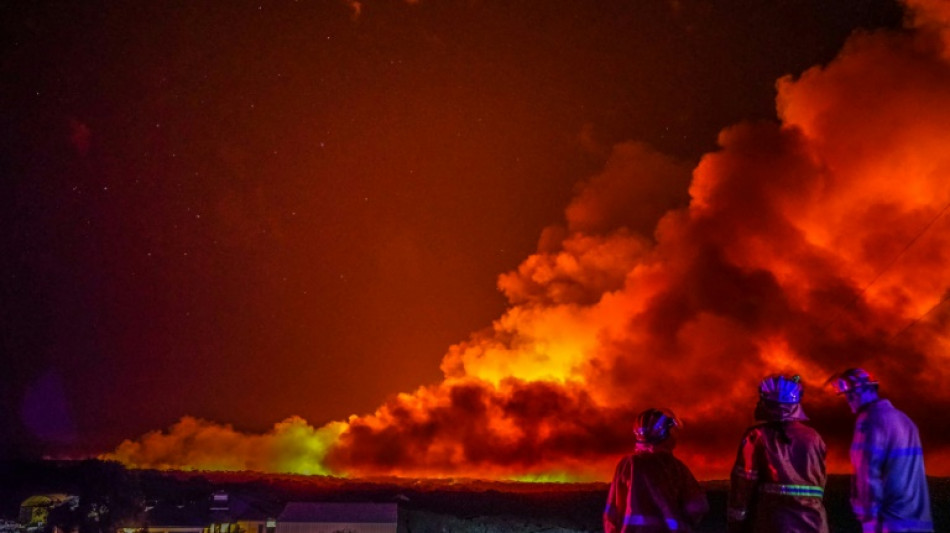
Floods, fires drive Australian home insurance 'crisis' / Photo: Sean BLOCKSIDGE - WESTERN AUSTRALIA DEPARTMENT OF FIRE AND EMERGENCY SERVICES/AFP/File

 Trump's beef policies irk Texas ranchers, testing their loyalty

 Nvidia, OpenAI CEOs to attend Xi dinner at White House

 Anthropic picks Accenture for in-house AI safety evaluation

 Balogun returns as Monaco beat Lens to continue strong Ligue 1 start

 'Pause' on overt repression in Venezuela, but reforms still needed: HRW

 Global stocks mixed as yen falls despite Bank of Japan rate hike

 Cuba hit with seventh major blackout of the year

 Murray out with concussion so Wentz will start for Vikings

 UN chief 'deeply regrets' US visa refusal to Abbas for annual meeting

 England quick Carse to face no charges over alleged nightclub assault

 Mancini brings nine newcomers into the first squad of his Italy comeback

 Czechs level Davis Cup tie against USA as South Korea eye Finals

 New France boss Zidane confirms Mbappe as captain after naming first squad

 California governor signs order to explore AI 'kill switch'

 Head leads run spree as Australia win Zimbabwe ODI series

 In-form Raphinha wants to finish career at Barcelona

 Warren Buffett steps down as Berkshire Hathaway chairman

 Carrick confident Man Utd can 'work through' tough time

 Mbappe ends Nike partnership to join Swiss brand On

 Liverpool boss Iraola puts Bournemouth love affair on hold

 'A disaster' if Man City do not win says Maresca after flawless start

 Kerry James Marshall: American 'blackness' painter celebrated in Europe

 Spain coach De la Fuente offers 'full support' to people of Ceuta

 Russia seizes assets of Nestle, French firms over West's Ukraine support

 England can build on World Cup 'spirit', says Tuchel

Fiercer floods, winds and bushfires whipped up by warmer temperatures mean more than half a million homes in Australia will cost too much to insure by 2030, according to an analysis by a climate advocacy group published Tuesday.
The Climate Council non-profit group issued the report after storms and floods battered Australia's east coast in February-March this year, and following the 2019-20 "Black Summer" bushfires that killed 33 people as well as an estimated tens of millions of wild animals.
"Climate change is creating an insurability crisis in Australia due to worsening extreme weather and sky-rocketing insurance premiums," the report said.
By 2030, about 520,940 properties -- or about one in 25 of the national total -- would suffer projected annual damage equal to one percent of the entire replacement cost, it said, making insurance policies effectively too pricey to afford.
"It's striking how the number of affected properties grows under higher emissions scenarios," said Karl Mallon, chief executive of Climate Valuation, which conducted the analytical work based on property, geographical, extreme weather and climate data for every address in Australia.
"Reducing emissions would potentially save thousands of homes from worsening damage," he said.
The Climate Council analysis echoes similar warnings by Australia's insurance industry, which has called for federal and state governments to invest more heavily in stronger homes and protection, such as flood levees, against extreme weather events.
- 'Big decisions' -
This year's east coast floods cost an estimated 3.35 billion Australian dollars (US$2.4 billion) in insured losses, making it the costliest flood in the country's history, the Insurance Council of Australia said on Tuesday.
"The string of extreme weather, particularly in the last decade, has made us very much at the top of the list when it comes to costly payouts," Insurance Council of Australia chief executive Andrew Hall told AFP.
A 2015 study estimated that about two percent of Australia's housing stock was at risk of constant flooding and 15 percent was at risk of occasional flooding, he said.
During this year's east coast floods, which claimed at least 21 lives, the northeastern New South Wales town of Lismore was among the worst hit.
Record 14.3-metre (47-foot) floodwaters engulfed homes, swept away cars and stranded locals on the roofs of their homes awaiting rescue by boat or helicopter.
This week, Lismore City Council released a "discussion paper", calling for feedback to a series of proposals to rebuild after the floods left thousands of people homeless and damaged many businesses.
It proposed a "retreat" from the highest flood-risk areas of the city, saying it would call on the state and federal governments to pay for a land swap allowing residents to abandon their land and move to higher ground.
"With rising temperatures predicted to significantly increase the likelihood of more frequent and heavier rain events leading to more frequent and severe flooding, Lismore is facing some big decisions about rebuilding and future growth," the council said in a statement.
A.Silveira--PC



