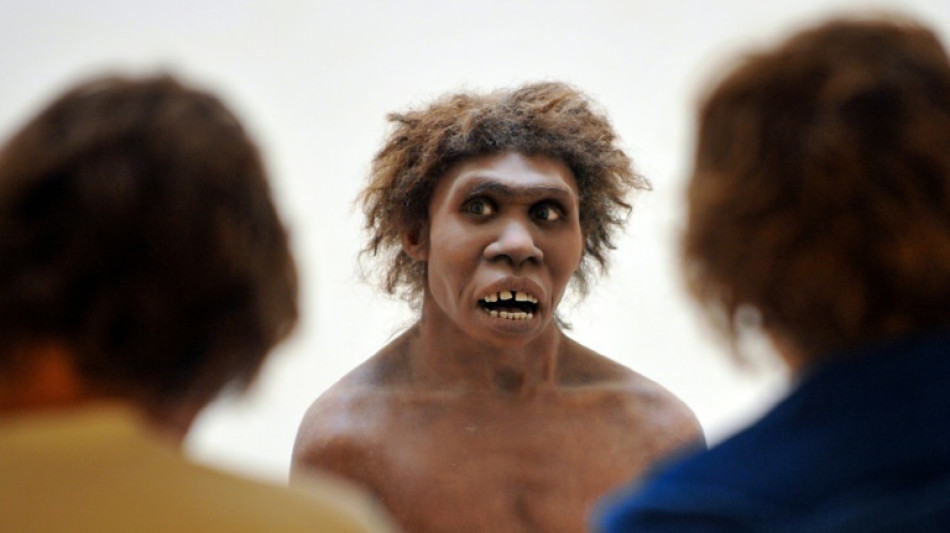
Homo erectus, not sapiens, first humans to survive desert: study / Photo: PIERRE ANDRIEU - AFP/File

 Indians living in Japan on stand-by to house Asian Games athletes

 Trump signs bill authorizing sweeping Russia sanctions

 Protesters form human chain at Kennedy Center after Trump threat

 Death toll from attack at police HQ in Pakistan rises to 31

 Trump says Denmark to give US 'permanent control' over Greenland security

 Kennedy Center: future unclear for iconic Washington arts hub

 Trump claims 'infinite' Greenland security deal with Denmark

 Helicopters battle wildfire threatening Ecuador's capital

 Brentford batter Chelsea to undo Alonso's promising start

 Kane hits Bundesliga century as Bayern rout Union

 Trump says CNN, MS NOW, Politico banned from White House

 Hushing and hedging: US companies retreat on climate

 Springboks to face Fiji before 2027 Rugby World Cup

 Nigeria miners struggled to breathe in cell before 37 died: survivors

 McIlroy on the charge at PGA Championship as Reed withdraws

 McIlroy on the charge at PGA Championship

 Crisis-wracked Volkswagen warns of 10-bn-euro hit to profits

 Costa Rica's Grynspan tops third informal poll for UN chief: diplomat

 Stock markets retreat after central bank rate hikes

 Russia labels director of Cannes Grand Prix winner a 'foreign agent'

 Macron warns of Russian 'hybrid' threat after meeting presidential hopefuls

 UN holds third informal poll for new chief

 Kulusevski return can spark Spurs: De Zerbi

 Shakira to cap off world tour with Madrid 12-gig run

 Isolated Syrian-Druze city blames Damascus for shortages

Our ancestor Homo erectus was able to survive punishingly hot and dry desert more than a million years ago, according to a new study that casts doubt on the idea that Homo sapiens were the first humans capable of living in such hostile terrain.
The moment when the first members of the extended human family called hominins adapted to life in desert or tropical forests marks "a turning point in the history of human survival and expansion in extreme environments," lead study author Julio Mercader Florin of the University of Calgary told AFP.
Scientists have long thought that only Homo sapiens, who first appeared around 300,000 years ago, were capable of living sustainably in such inhospitable regions.
The first hominins to have split off from the other great apes were believed to be limited to less hostile ecosystems, such as forest, grasslands and wetlands.
One of the world's most important prehistoric sites, Olduvai Gorge in modern-day Tanzania, was thought to home to those easier types of landscapes.
But this steep ravine in East Africa's Great Rift Valley, which has played a key role in the understanding of human evolution, was actually a desert steppe, according to the study published in the journal Communications Earth & Environment on Thursday.
After collecting archaeological, geological and palaeoclimatic data, the international team of researchers were able to reconstruct the gorge's ecosystem over the years.
Fossilised pollen of the Ephedra shrub -- which commonly lives in arid areas -- as well as traces of past wildfires and signs in the soil show there was an extreme drought in the area between one and 1.2 million years ago.
- Homo erectus: underestimated? -
Evidence collected from the Engaji Nanyori site in the gorge suggests that Homo erectus adapted to this hostile environment "by focusing on ecological focal points such as river confluences where water and food resources were more predictable", Mercader Florin said.
"Their ability to repeatedly exploit these focal points... and adapt their behaviours to extreme environments demonstrates a higher level of resilience and strategic planning than previously assumed."
Specialised tools found at the site, such as hand axes, scrapers and cleavers, showed that Homo erectus had also worked out how to process animal carcasses.
The bones of animals such as cows, hippopotamuses, crocodiles and antelopes also had cut marks, indicating they had been skinned and had their bone marrow extracted.
"This suggests they optimised their resource use to adapt to the challenges of arid environments, where resources were scarce and needed to be exploited fully," Mercader Florin said.
"Our findings show that Homo erectus was capable of surviving long term in extreme environments characterised by low density of food resources, navigational challenges, very low/very high plant life, temperature/humidity extremes, and the need for high mobility," he added.
"This adaptability expands Homo erectus's potential range into the Saharo-Sindian region across Africa and into similar environments in Asia."
P.L.Madureira--PC



