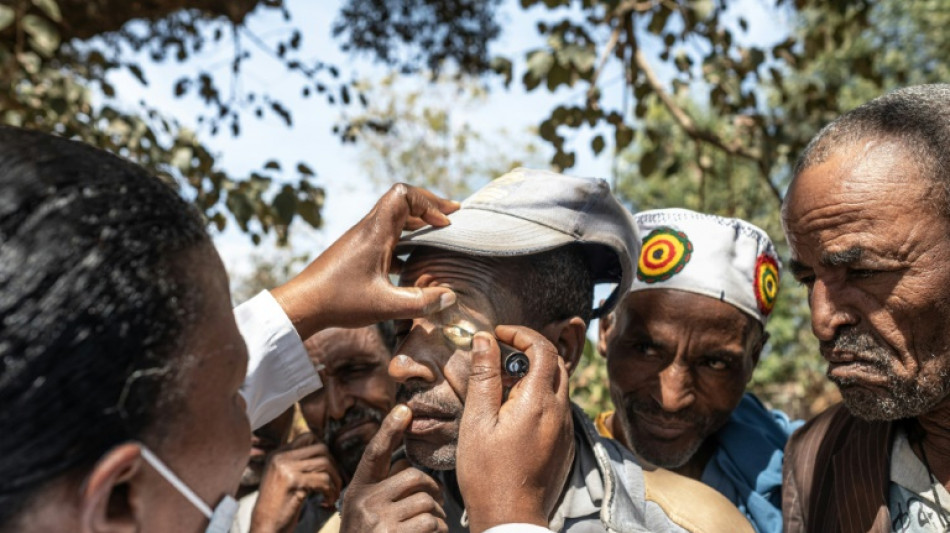
'I rip out my lashes to ease pain': Eye disease afflicts Ethiopia / Photo: Marco Simoncelli - AFP

 Indians living in Japan on stand-by to house Asian Games athletes
 Trump signs bill authorizing sweeping Russia sanctions

 Protesters form human chain at Kennedy Center after Trump threat

 Death toll from attack at police HQ in Pakistan rises to 31

 Trump says Denmark to give US 'permanent control' over Greenland security

 Kennedy Center: future unclear for iconic Washington arts hub

 Trump claims 'infinite' Greenland security deal with Denmark

 Helicopters battle wildfire threatening Ecuador's capital

 Brentford batter Chelsea to undo Alonso's promising start

 Kane hits Bundesliga century as Bayern rout Union

 Trump says CNN, MS NOW, Politico banned from White House

 Hushing and hedging: US companies retreat on climate

 Springboks to face Fiji before 2027 Rugby World Cup

 Nigeria miners struggled to breathe in cell before 37 died: survivors

 McIlroy on the charge at PGA Championship as Reed withdraws

 McIlroy on the charge at PGA Championship

 Crisis-wracked Volkswagen warns of 10-bn-euro hit to profits

 Costa Rica's Grynspan tops third informal poll for UN chief: diplomat

 Stock markets retreat after central bank rate hikes

 Russia labels director of Cannes Grand Prix winner a 'foreign agent'

 Macron warns of Russian 'hybrid' threat after meeting presidential hopefuls

 UN holds third informal poll for new chief

 Kulusevski return can spark Spurs: De Zerbi

 Shakira to cap off world tour with Madrid 12-gig run

 Isolated Syrian-Druze city blames Damascus for shortages

Scheicho Scheifa is haunted by the fear of going blind.
A disease called trachoma has turned his eyelids inwards, causing his eyelashes to scar his corneas so badly that one has already turned opaque.
The 35-year-old farmer and baker, who blinks frequently and suffers in sunshine, said the pain is so fierce he has now "stopped working entirely".
He has been mostly bound to his home in the small village of Asano, around 100 kilometres (60 miles) from Ethiopia's capital, Addis Ababa.
"Recently, I learned that the surface of my eye is wounded, and the left eye is severely damaged. The pain affects my ability to work and perform daily tasks," the father-of-two told AFP.
"Each time it flares up, I rip out my lashes to ease the pain," he added.
"The fear of going blind worries me whenever the pain strikes."
Trachoma is caused by infection with the bacterium Chlamydia trachomatis, which is spread through contact with the eyes or nose of infected people.
Flies that have touched infected people's eyes or noses can also transmit the disease.
- Two million blinded -
Women are blinded up to four times as often as men -- normally between the ages of 30 to 40 -- most likely because they are in more regular contact with children, the main reservoir of the disease.
According to the World Health Organization (WHO), trachoma is "hyperendemic in many of the poorest and most rural areas" of the world, and Africa is the most affected continent.
Around 103 million people worldwide live in the endemic areas for the disease, nearly half in Ethiopia.
Despite being in pain since childhood, Scheicho was initially reticent to undergo surgery -- which involves cutting into his eyelids and rotating the eyelashes away from his cornea -- since this had not improved his mother's condition.
He was finally convinced by Gizachew Abebe, an ophthalmologist and member of the Germany-based charity Christian Blind Mission.
The NGO has sought to inform "the community and patients to take care of their personal hygiene... a very important point to prevent trachoma", Gizachew said.
"You need to wash your face with clean water," he told a gathering of dozens of people in a small village near Asano.
That is not easy for this rural community, which is a three-hour walk to the nearest river and shares water with livestock.
- 'Hard to cut' -
The charity is working on improving access to clean water, and uses loudspeakers in markets in Butajira, the region's biggest town, to urge people to get tested for trachoma.
The least advanced cases can be treated with antibiotics or creams but more serious cases like Scheicho's require surgery.
He finally went under the knife in a small health centre without electricity in Asano, during AFP's visit.
After administering a local anaesthetic, Sister Tadelech made an incision on his upper eyelid.
"It is hard to cut," the ophthalmologist said.
But half an hour later, the operation was successfully completed.
"I feel better," a groggy Scheicho managed afterwards.
By the end of last year, 21 countries including Togo and Ghana, had eliminated trachoma as a public health problem, according to the WHO.
In Ethiopia, it could be possible to minimise the disease but "we will not eradicate" it until "people's standard of living" improves, Gizachew said.
A.Santos--PC



