Conservation efforts can shift nature loss to more vulnerable regions: study / Photo: Pablo PORCIUNCULA - AFP

 Indians living in Japan on stand-by to house Asian Games athletes
 Trump signs bill authorizing sweeping Russia sanctions

 Protesters form human chain at Kennedy Center after Trump threat

 Death toll from attack at police HQ in Pakistan rises to 31

 Trump says Denmark to give US 'permanent control' over Greenland security

 Kennedy Center: future unclear for iconic Washington arts hub

 Trump claims 'infinite' Greenland security deal with Denmark

 Helicopters battle wildfire threatening Ecuador's capital

 Brentford batter Chelsea to undo Alonso's promising start

 Kane hits Bundesliga century as Bayern rout Union

 Trump says CNN, MS NOW, Politico banned from White House

 Hushing and hedging: US companies retreat on climate

 Springboks to face Fiji before 2027 Rugby World Cup

 Nigeria miners struggled to breathe in cell before 37 died: survivors

 McIlroy on the charge at PGA Championship as Reed withdraws

 McIlroy on the charge at PGA Championship

 Crisis-wracked Volkswagen warns of 10-bn-euro hit to profits

 Costa Rica's Grynspan tops third informal poll for UN chief: diplomat

 Stock markets retreat after central bank rate hikes

 Russia labels director of Cannes Grand Prix winner a 'foreign agent'

 Macron warns of Russian 'hybrid' threat after meeting presidential hopefuls

 UN holds third informal poll for new chief

 Kulusevski return can spark Spurs: De Zerbi

 Shakira to cap off world tour with Madrid 12-gig run

 Isolated Syrian-Druze city blames Damascus for shortages

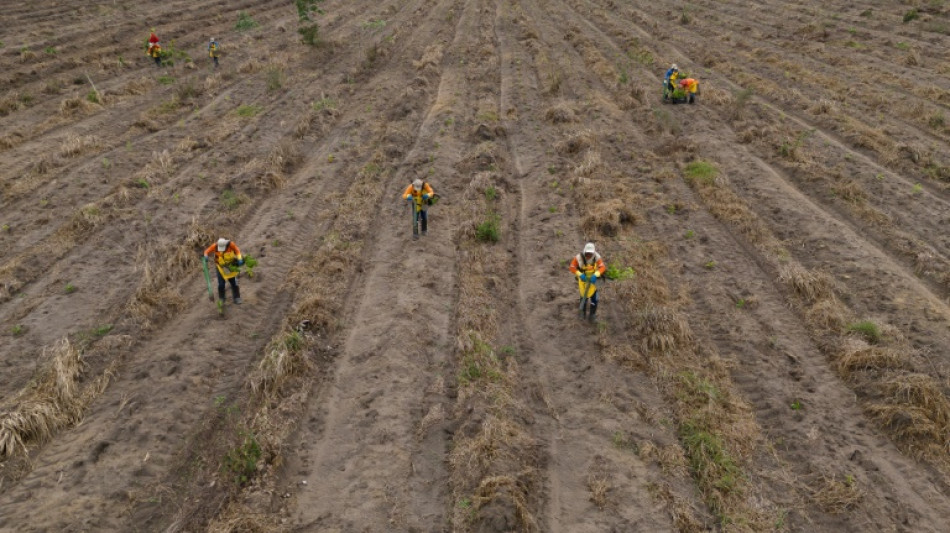
Could restoring the environment in one place -- say by turning farmland in Europe into a nature reserve -- harm plants and animals on the other side of the planet?
An international team of researchers on Thursday said these types of unintended consequences from well-meaning conservation efforts are more common than thought, yet are rarely considered or even properly understood.
In a new study, they warn that reducing farming and forestry in wealthy countries to meet local conservation goals can heap pressure on poorer regions to produce more food and timber.
The burden often falls on biodiversity hotspots rich in plant and animal species to make up this shortfall, said the study's lead author, Andrew Balmford.
These countries -- mostly in developing nations in Africa, Asia and South America -- are of much greater importance to nature yet pay the price for conservation gains in wealthier climes.
"In some cases, we might cause more harm than good," Balmford, from the University of Cambridge's Department of Zoology, told AFP.
The authors pointed to a case in the United States, where an effort to curb deforestation in old-growth forests simply shifted logging operations to neighbouring regions.
Balmford said a ban on domestic logging in China saw a sharp increase in timber imports from southeast Asia, a region of much higher biodiversity value.
It is a complex problem in terms of global trade, and one that is difficult to quantify.
For this study, published in the peer-reviewed journal Science, the authors applied real-world data to two hypothetical scenarios to illustrate the trap of so-called "biodiversity leakage".
- Tradeoffs -
In one, they found that rewilding a large soybean crop in Brazil would shift production elsewhere, but deliver a net gain for conservation because of the country's high biodiversity value.
But giving the same area of UK farmland back to nature would result in higher commodity imports from countries with greater plant and animal diversity, outweighing any local conservation gain.
The authors said the simple premise that intervening in one location could have knock-on impacts in another was hardly new.
Yet this uncomfortable reality had barely registered at the highest levels of government and global policymaking.
"At larger scale there is, extraordinarily, no mention of the problem" in the UN's flagship conservation policy to protect 30 percent of Earth's land and oceans by 2030, they said.
The UN's next biodiversity meeting is this month in Rome.
Balmford said Europe for example expected to set aside one-third of its land for nature and feed its people without also shifting the cost elsewhere.
"We can't always have our cake and eat it... there are some somewhat awkward tradeoffs there," he said.
Balmford said the authors -- conservation scientists and economists from over a dozen institutions -- were "passionate about conservation and very much want it to succeed".
This paper was "constructive criticism from within, but where we feel that there is a significant issue that has largely been overlooked in conservation, and that it's serious".
A.S.Diogo--PC



