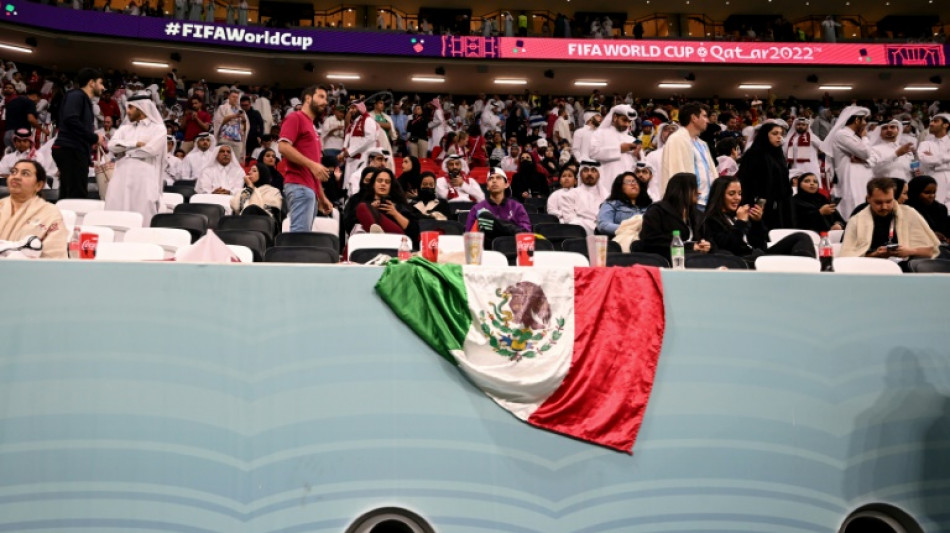
Triple-hosted World Cup: huge ambition at a hefty cost to planet / Photo: MANAN VATSYAYANA - AFP/File

 Ed Sheeran returns to stage after Palestinian controversy

 Asian Games to open in Japan after troubled build-up
 Drone owners rush to offload devices ahead of Beijing ban

 Trump's beef policies irk Texas ranchers, testing their loyalty

 Nvidia, OpenAI CEOs to attend Xi dinner at White House

 Anthropic picks Accenture for in-house AI safety evaluation

 Balogun returns as Monaco beat Lens to continue strong Ligue 1 start

 'Pause' on overt repression in Venezuela, but reforms still needed: HRW

 Global stocks mixed as yen falls despite Bank of Japan rate hike

 Cuba hit with seventh major blackout of the year

 Murray out with concussion so Wentz will start for Vikings

 UN chief 'deeply regrets' US visa refusal to Abbas for annual meeting

 England quick Carse to face no charges over alleged nightclub assault

 Mancini brings nine newcomers into the first squad of his Italy comeback

 Czechs level Davis Cup tie against USA as South Korea eye Finals

 New France boss Zidane confirms Mbappe as captain after naming first squad

 California governor signs order to explore AI 'kill switch'

 Head leads run spree as Australia win Zimbabwe ODI series

 In-form Raphinha wants to finish career at Barcelona

 Warren Buffett steps down as Berkshire Hathaway chairman

 Carrick confident Man Utd can 'work through' tough time

 Mbappe ends Nike partnership to join Swiss brand On

 Liverpool boss Iraola puts Bournemouth love affair on hold

 'A disaster' if Man City do not win says Maresca after flawless start

 Kerry James Marshall: American 'blackness' painter celebrated in Europe

The largest and most far-flung World Cup kicks off in 12 months with a record 48 teams spread across Canada, the United States and Mexico and sceptics are asking whether its frenzied growth is worth the environmental cost.
FIFA, the governing body of world football, like the International Olympic Committee, insists it is working to reduce the carbon footprint. But the expansion from 32 competing nations to 48 and the resulting shift to multiple hosts both next year and in 2030, leads critics to question that claim.
"Unlike the case of the Olympic Games, where the carbon footprints have been reducing over the last several editions, this is totally opposite in the case of the men's World Cup," David Gogishvili, a geographer at the University of Lausanne and a specialist in mega-sports events, told AFP.
While the 2022 World Cup in Qatar was certainly compact, it drew criticism for its oversized, air-conditioned stadiums built at breakneck speed in a small country with a scorching climate.
For 2026, all 16 stadiums -- ranging in capacity from the 45,000-capacity Toronto Stadium to the 94,000-capacity cauldron of Dallas Stadium -- already existed when the bid was made.
- '5 million fans' -
One problem is the distances.
Foxborough Stadium, outside Boston, is 3,700 kilometres (2,300 miles) from the Azteca in Mexico City. The Stadium at BC Place in Vancouver is 4,500km from Miami Stadium. That multiplies air travel for teams, officials, media and the "more than five million fans" who, FIFA says, "are expected to attend".
Organisers say the 72 matches in the first round -- when teams will play in 12 four-team groups -- will pivot on three "regional hubs". Yet distances will still be huge. Group B, for example, has matches in Toronto as well as in Los Angeles, San Francisco, Seattle and Vancouver on the Pacific Coast.
For the 32 matches in the five-round knockout phase teams will be flying all over the map.
FIFA, whose president Gianni Infantino proclaimed his "determination" to combat global warming at COP 26 in Glasgow, committed itself in 2018 to "measuring, reducing and offsetting" the emissions associated with its World Cups.
Yet, since it was nailed in June 2023 by the Swiss Fairness Commission for boasting of the "climate neutrality" of the 2022 World Cup, without being able to prove the claim, FIFA has refrained from making assessments or promises concerning 2026.
The only official estimate of the carbon impact -- a record 3.7 million tonnes of CO2 -- was made before the number of matches was increased from 80 to 104.
"FIFA's insatiable appetite towards growth," Gogishvili said, means "more athletes, more fans, more hotel infrastructure, more flights. It's kind of a never-ending cycle".
- 'Environmental denial' -
A joint British report on football and the environment published in February by the New Weather Institute and Scientists for Global Responsibility, punningly entitled 'Dirty Tackle', said one men's World Cup finals match generates emissions "between 26 times and 42 times that for a domestic elite game" or the equivalent of "between 31,500 and 51,500 average UK cars driven for a whole year".
"With every game added to the football calendar, international football associations make the world less safe," the report said.
Next year's World Cup is not a blip.
"It seems that the environmental denial of the FIFA World Cups will continue," wrote Gilles Pache, professor at the University of Aix-Marseille, in the Journal of Management.
He pointed to 2030 that will open with matches in Argentina, Uruguay and Paraguay, to celebrate the centenary of the first World Cup, before switching across the Atlantic to the three hosts Morocco, Spain and Portugal for the remaining 101 matches.
The 2034 World Cup, will be held in Saudi Arabia, in a climate comparable to that of Qatar, but with 40 more matches.
Saudi giant Aramco, the world's leading oil company, became a major FIFA sponsor of FIFA last year.
F.Santana--PC



