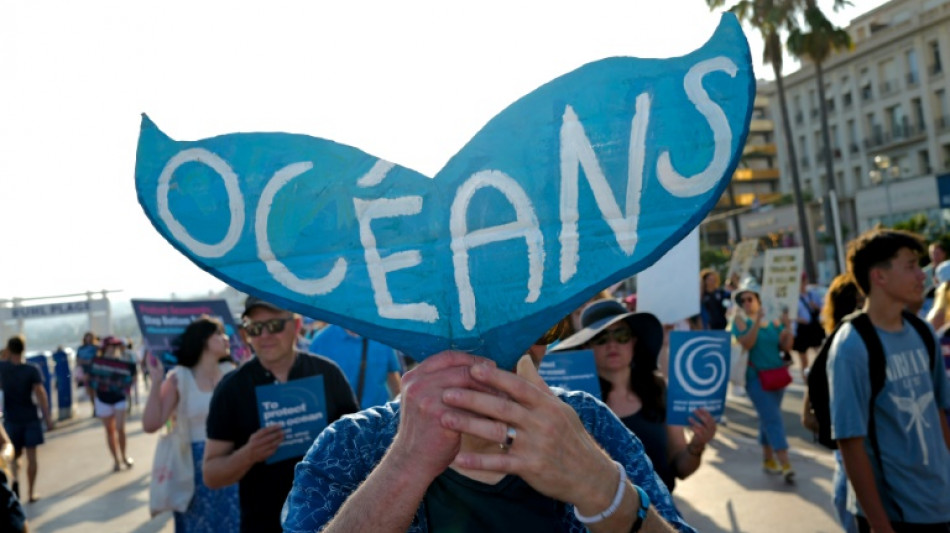
Don't let deep sea become 'wild west', Guterres tells world leaders / Photo: Valery HACHE - AFP

 Ed Sheeran returns to stage after Palestinian controversy

 Asian Games to open in Japan after troubled build-up

 Drone owners rush to offload devices ahead of Beijing ban

 Trump's beef policies irk Texas ranchers, testing their loyalty

 Nvidia, OpenAI CEOs to attend Xi dinner at White House

 Anthropic picks Accenture for in-house AI safety evaluation

 Balogun returns as Monaco beat Lens to continue strong Ligue 1 start

 'Pause' on overt repression in Venezuela, but reforms still needed: HRW

 Global stocks mixed as yen falls despite Bank of Japan rate hike

 Cuba hit with seventh major blackout of the year

 Murray out with concussion so Wentz will start for Vikings

 UN chief 'deeply regrets' US visa refusal to Abbas for annual meeting

 England quick Carse to face no charges over alleged nightclub assault

 Mancini brings nine newcomers into the first squad of his Italy comeback

 Czechs level Davis Cup tie against USA as South Korea eye Finals

 New France boss Zidane confirms Mbappe as captain after naming first squad

 California governor signs order to explore AI 'kill switch'

 Head leads run spree as Australia win Zimbabwe ODI series

 In-form Raphinha wants to finish career at Barcelona

 Warren Buffett steps down as Berkshire Hathaway chairman

 Carrick confident Man Utd can 'work through' tough time

 Mbappe ends Nike partnership to join Swiss brand On

 Liverpool boss Iraola puts Bournemouth love affair on hold

 'A disaster' if Man City do not win says Maresca after flawless start

 Kerry James Marshall: American 'blackness' painter celebrated in Europe

United Nations Secretary General Antonio Guterres said on Monday the world could not let the deepest oceans "become the wild west", at the start in France of a global summit on the seas.
World leaders are attending the UN Ocean Conference in Nice as nations tussle over contentious rules on mining the seabed for critical minerals and the terms of a global treaty on plastic pollution.
US President Donald Trump has brought urgency to the debate around deep-sea mining, moving to fast-track US exploration in international waters and sidestepping global efforts to regulate the nascent sector.
The International Seabed Authority, which has jurisdiction over the ocean floor outside national waters, is meeting in July to discuss a global mining code to regulate mining in the ocean depths.
Guterres said he supported these negotiations and urged caution as countries navigate these "new waters on seabed mining".
"The deep sea cannot become the wild west," he said, to applause from the plenary floor.
Many countries oppose seabed mining, and France is hoping more nations in Nice will join a moratorium until more is known about the ecological impacts of the practice.
French President Emmanuel Macron said a moratorium on deep-sea mining was "an international necessity".
- Wave of commitments -
"I think it's madness to launch predatory economic action that will disrupt the deep seabed, disrupt biodiversity, destroy it and release irrecoverable carbon sinks -- when we know nothing about it," the French president said.
The deep sea, Greenland and Antarctica were "not for sale", he said in follow up remarks to thunderous applause.
Macron said a global treaty to govern the high seas had received enough ratifications to enter into force and was "a done deal", without specifying a timeline.
The agreement struck in 2023 required ratifications from 60 signatory countries to become international law and Macron said the numbers "had been reached, which allows us to say that the high seas treaty will be implemented."
Other commitments on ocean conservation are expected on Monday in Nice, where around 60 heads of state and government will join thousands of business leaders, scientists and civil society activists.
On Monday, the United Kingdom is expected to announce a partial ban on bottom trawling in half its marine protected areas, putting the destructive fishing method squarely on the summit agenda.
Bottom trawling sees huge fishing nets dragged across the ocean floor, sweeping up everything in their path, a process shockingly captured in a recent documentary by British naturalist David Attenborough.
Greenpeace welcomed the UK announcement on trawling but said in a statement it was "long overdue".
- Words into action -
Macron said on Saturday that France would restrict trawling in some of its marine protected areas but was criticised by environment groups for not going far enough.
French environment minister Agnes Pannier-Runacher told reporters on Sunday that other countries would make "important announcements" about the creation of new marine protected areas.
Samoa led the way this past week, announcing that 30 percent of its national waters would be under protection with the creation of nine marine parks.
Just eight percent of global oceans are designated for marine conservation, despite a globally agreed target to achieve 30 percent coverage by 2030.
But even fewer are considered truly protected, as some countries impose next to no rules on what is forbidden in marine zones or lack the finance to enforce any regulations.
Nations will face calls to cough up the missing finance for ocean protection, which is the least funded of all the UN's 17 sustainable development goals.
Small island states are expected in numbers at the summit to demand money and political support to combat rising seas, marine trash and the plunder of fish stocks.
The summit will not produce a legally binding agreement at its close like a climate COP or treaty negotiation.
But diplomats and other observers said it could mark a much-needed turning point in global ocean conservation if leaders rose to the occasion.
"The UN Ocean Conference gives us all an opportunity to turn words into bold and ambitious action," said Enric Sala, founder of ocean conservation group Pristine Seas.
np-aag-fcc-fff/gil
M.Gameiro--PC



