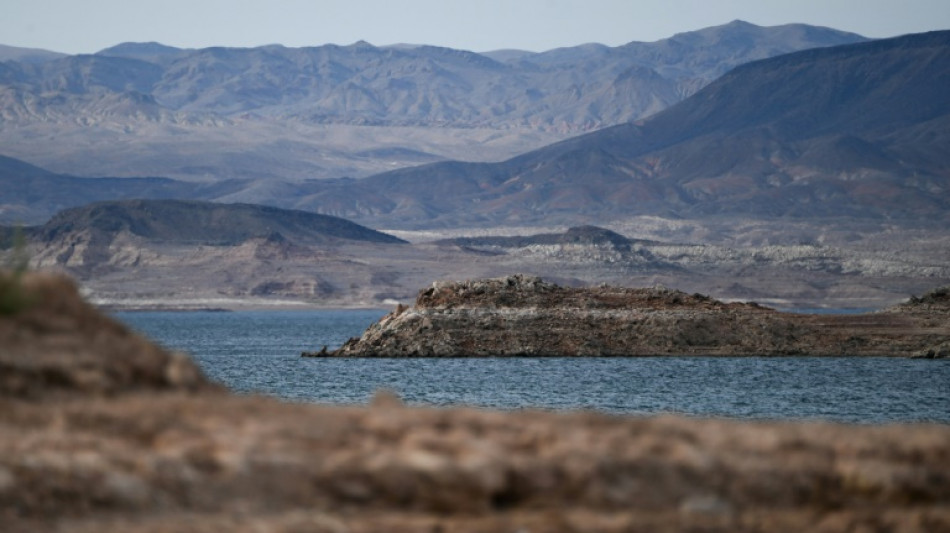
US mega drought makes boating rough on Lake Mead / Photo: Patrick T. FALLON - AFP

 Trump's beef policies irk Texas ranchers, testing their loyalty

 Nvidia, OpenAI CEOs to attend Xi dinner at White House

 Anthropic picks Accenture for in-house AI safety evaluation

 Balogun returns as Monaco beat Lens to continue strong Ligue 1 start

 'Pause' on overt repression in Venezuela, but reforms still needed: HRW

 Global stocks mixed as yen falls despite Bank of Japan rate hike

 Cuba hit with seventh major blackout of the year

 Murray out with concussion so Wentz will start for Vikings

 UN chief 'deeply regrets' US visa refusal to Abbas for annual meeting

 England quick Carse to face no charges over alleged nightclub assault

 Mancini brings nine newcomers into the first squad of his Italy comeback

 Czechs level Davis Cup tie against USA as South Korea eye Finals

 New France boss Zidane confirms Mbappe as captain after naming first squad

 California governor signs order to explore AI 'kill switch'

 Head leads run spree as Australia win Zimbabwe ODI series

 In-form Raphinha wants to finish career at Barcelona

 Warren Buffett steps down as Berkshire Hathaway chairman

 Carrick confident Man Utd can 'work through' tough time

 Mbappe ends Nike partnership to join Swiss brand On

 Liverpool boss Iraola puts Bournemouth love affair on hold

 'A disaster' if Man City do not win says Maresca after flawless start

 Kerry James Marshall: American 'blackness' painter celebrated in Europe

 Spain coach De la Fuente offers 'full support' to people of Ceuta

 Russia seizes assets of Nestle, French firms over West's Ukraine support

 England can build on World Cup 'spirit', says Tuchel

In the 15 years since Adam Dailey began boating on Lake Mead, the shoreline has receded hundreds of meters, the result of more than two decades of punishing drought that is drying out the western United States.
Launch spots that lined the edge of the lake, located outside Las Vegas, have been abandoned, and a single ramp is now the only way to get a boat in the water.
"We used to have more. So everyone's fighting to use one ramp... and still trying to figure out how to get along," said Dailey.
"It's kind of sad, what's going on. But we still come out and try to enjoy it when we can."
Lake Mead is the largest reservoir in the United States, a huge man-made body of water formed by the construction of the Hoover Dam in the early 1930s.
Its 247-square-mile (640-square-kilometer) surface area stores water for tens of millions of people and countless acres of farmland in the southwest.
But it's shrinking at a terrifying rate and now stands at just one-quarter full.
The National Park Service (NPS), which manages access to the lake, has spent more than $40 million since 2010 trying to keep the water open to boaters.
It costs them $2-3 million dollars to reconfigure the boat launch ramp every time the water levels fall another four feet (120 centimeters).
"Declining water levels due to climate change and 20 years of ongoing drought have reshaped the park’s shorelines," the NPS says on its website.
"As Lake Mead continues to recede, extending launch ramps becomes more difficult and more expensive due to the topography and projected decline in water levels."
- Bathtub ring -
A series of NPS signs show the shoreline at various points since 2001. The sign marking the level in 2021 is 300 paces from the water.
In the mud, the receding waters leave behind bottles, cans, fire extinguishers and other detritus that somehow made its way overboard in years gone by.
The rocks that form the hard edges of the reservoir offer a stark illustration of just how far water levels have fallen.
A white band of mineral deposits stains the mountainsides like the ring on a bathtub, showing where the water was at its high point after a flood in 1983.
"We used to water ski race here," Jaxkxon Zacher told AFP.
"And the island -- only the tip... was out 25 years ago. So now we can't even race here anymore. It's dropping drastically."
The growing islands in the middle of the lake point to the uneven topography of the valley that was flooded -- and the hazards that await.
"Every day someone's ripping a drive off, because last week, where there was no rock, it's now a foot down or two feet down so things are exposed," boatseller Jason Davis said.
"You've got houseboats getting beached and stuck, and people are ripping their lower units off."
And with vessels that can retail at hundreds of thousands of dollars, a weekend outing can turn into a costly mistake.
- A new job -
For some people, the risk of an accident and the sheer hassle of having to wait so long to get a boat into the water and then out again at the end of the day means Lake Mead is no longer a viable recreation option.
Below the Hoover Dam, stretches of river remain relatively unscathed by the dropping water levels.
At Willow Beach, across the state line in Arizona, kayakers frolic in the shallows, unloading water pistols on each other as 104 Fahrenheit (40 Celsius) sunshine beats down.
A small marina there offers Steve McMasters a place to stage his pontoon, just a short distance from his home in Boulder City.
"It can be a four-to-five-hour wait on weekends to get your boat out of the water (at Lake Mead), so this is big to have," he said.
"I waited like four months on a waiting list to get it. I got lucky here."
Climatologists say two decades of drought is not unheard of in the western United States, but combined with human-caused global warming, it is transforming the region.
Higher temperatures mean less moisture falls as snow on the Rocky Mountains, and what snowpack does form melts more quickly.
This leaves the Colorado River without the slow and steady feed that supplied it year-round in the centuries and millennia before the region was settled.
In climatic terms, Lake Mead is a baby; in existence for less than 90 years.
But in human terms, it is vanishing at a startling pace.
Jason Davis, the boatseller, says more people need to witness the stark changes for themselves.
"If you haven't come to see these rings, you know, you don't quite comprehend," he said.
And if the water keeps dropping?
"I'll need a new job."
M.Gameiro--PC



