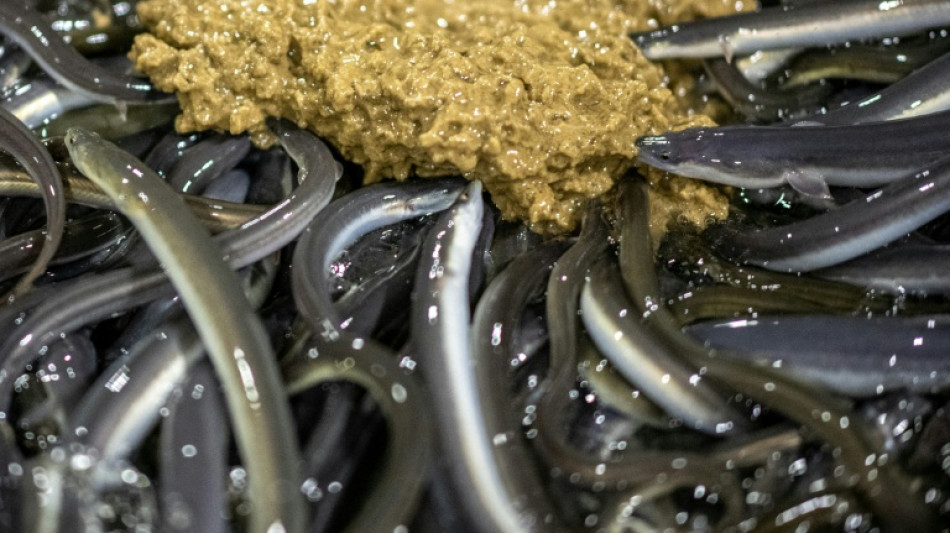
Japan's eel delicacy faces global conservation pressure / Photo: Philip FONG - AFP

 Drone owners rush to offload devices ahead of Beijing ban

 Trump's beef policies irk Texas ranchers, testing their loyalty

 Nvidia, OpenAI CEOs to attend Xi dinner at White House

 Anthropic picks Accenture for in-house AI safety evaluation

 Balogun returns as Monaco beat Lens to continue strong Ligue 1 start

 'Pause' on overt repression in Venezuela, but reforms still needed: HRW

 Global stocks mixed as yen falls despite Bank of Japan rate hike

 Cuba hit with seventh major blackout of the year

 Murray out with concussion so Wentz will start for Vikings

 UN chief 'deeply regrets' US visa refusal to Abbas for annual meeting

 England quick Carse to face no charges over alleged nightclub assault

 Mancini brings nine newcomers into the first squad of his Italy comeback

 Czechs level Davis Cup tie against USA as South Korea eye Finals

 New France boss Zidane confirms Mbappe as captain after naming first squad

 California governor signs order to explore AI 'kill switch'

 Head leads run spree as Australia win Zimbabwe ODI series

 In-form Raphinha wants to finish career at Barcelona

 Warren Buffett steps down as Berkshire Hathaway chairman

 Carrick confident Man Utd can 'work through' tough time

 Mbappe ends Nike partnership to join Swiss brand On

 Liverpool boss Iraola puts Bournemouth love affair on hold

 'A disaster' if Man City do not win says Maresca after flawless start

 Kerry James Marshall: American 'blackness' painter celebrated in Europe

 Spain coach De la Fuente offers 'full support' to people of Ceuta

 Russia seizes assets of Nestle, French firms over West's Ukraine support

At an eel restaurant near Tokyo, four friends sit down to eat a Japanese delicacy now the subject of a heated international debate as its numbers decline.
The eel, hugely popular across Japan, is also endangered and will be discussed at a key global forum that regulates trade of threatened wildlife, starting in Uzbekistan on Monday.
"It's a luxury dish that we eat to treat ourselves or to celebrate an occasion," Yukiko Takahashi, a 52-year-old saleswoman told AFP as she tucked into her food at Hiranuma Suisan.
"Today, we friends came here to lift our spirits."
Japan is strongly opposed to a proposal by the European Union, Panama and Honduras to list all 17 species of eels worldwide under the Convention on International Trade in Endangered Species (CITES), which restricts trade of protected wildlife.
Up to 85 percent of global eel consumption takes place in East Asia, particularly Japan, which imported almost three-quarters of the 61,000 tons consumed there last year.
Eel populations are falling worldwide, scientists say, largely due to factors linked to human activity such as the pollution of waterways, destruction of wetlands, hydroelectric dams, and fishing.
Estimating population sizes remains difficult because of the mysterious life cycle of the snake-like fish.
The Japanese eel, a common species in East Asia, reproduces west of the Mariana Islands, 2,000 to 3,000 kilometres (1,240-1,865 miles) from the Japanese coast.
Its larvae develop into glass eels (juveniles) as they approach the coast, then live in freshwater for 5 to 15 years before making the reverse journey.
The Japanese eel, along with the American variety, is listed as endangered on the International Union for Conservation of Nature's (IUCN) Red List.
The European eel is considered critically endangered.
- A luxury dish -
Eels, called "unagi" in Japan, have been consumed there for millennia and are now typically grilled on skewers and dipped in a soy and rice wine sauce.
People are willing to face ever-increasing prices to continue the culinary tradition, driven by significant year-to-year fluctuations in supply.
"Customers understand that it's a luxury dish," chef Tomoyuki Takashino said from behind the stove as he skewered an eel he had just killed and filleted.
Unaju, an eel served over rice in a lacquered box, is priced at 5,250 yen ($34), more than double what the dish might have cost 15 years ago, Takashino said.
Nearly all eels consumed in Japan come from aquaculture, which relies entirely on the capture or import of glass eels because they do not reproduce in captivity.
Catches of glass eels in Japan have dropped to less than 10 percent of their 1960s levels.
"We buy the glass eels, which we raise in these tanks," said Takayuki Hiranuma, president of a high-tech aquaculture farm that operates the restaurant.
Behind him, some 80,000 eels are kept in six huge reservoirs in 30C filtered water.
Their weight will increase a thousandfold over 10 months of farming before they are sold or cooked on site.
If eels are listed under Appendix II of the CITES convention, as will be discussed in Uzbekistan, their trade would be more strictly regulated, requiring export permits from the country of origin.
"This is a point that worries us greatly," Hiranuma said.
Japan argues that it has implemented fishing quotas and farming permits, and cites a study by Tokyo University of Marine Science and Technology that says the Japanese eel population has tripled across East Asia since 1990.
"And we are cooperating with China, South Korea, and Taiwan -- territories where the Japanese eel lives -- to limit the quantities of glass eels captured and improve stock management," Tetsuya Kawashima, an official from the Japanese Fisheries Agency, told AFP.
A United Nations Food and Agriculture Organization expert advisory panel also said in a report this year that the risk of extinction for Japanese and American eels was "low".
- 'Greatest wildlife crime' -
But for Andrew Kerr of the Sustainable Eel Group, such findings fail to take into account eel trafficking, which he calls the "greatest wildlife crime" on the planet.
Due to the fact that eels look alike, "all sorts of games are played pretending it's one species when it's another", he said. "So trafficking can thrive."
Asian supply has long relied on the smuggling of glass eels from the EU, which banned their export in 2010.
Approximately 100 tons of glass eels transit each year, according to the European police agency Europol.
But with the dismantling of illegal supply chains, European supply has diminished and there's been a rise in shipments from the Caribbean, threatening that population, Kerr warned.
"It's not about their imminent risk of extinction. It's about how do we create some sort of world order in the trade of eel. It's a global game," he said.
C.Amaral--PC



