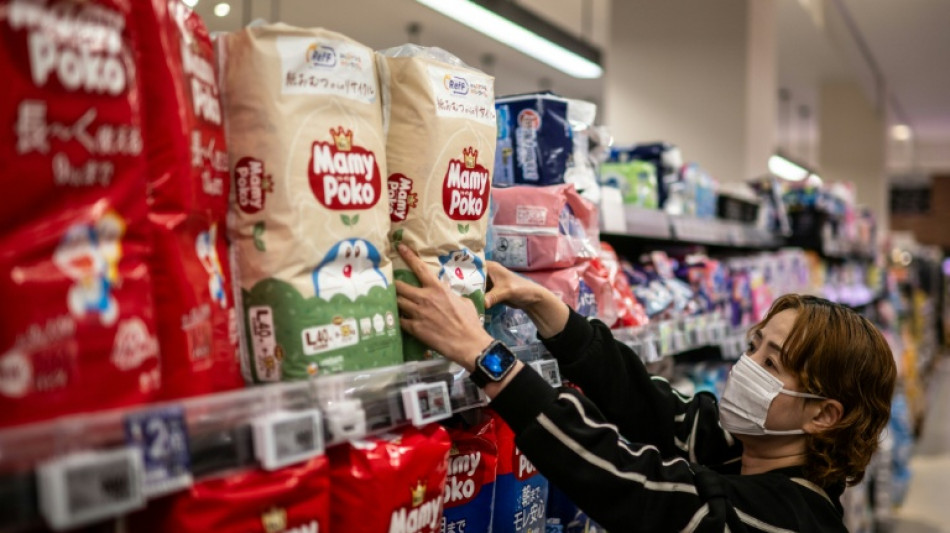
Dirty diapers born again in Japan recycling breakthrough / Photo: Philip FONG - AFP

 UEFA's legal move 'massive escalation' in bitter Infantino feud

 MEXC Launches Earn Plus With Limited-Time Event Offering Up to 800% APR Booster

 Norway's new King Haakon VIII, popular face of shaken monarchy

 Stocks rise ahead of Fed chair's policy speech

 Norway's new King Haakon VII, popular face of shaken monarchy

 Last-wicket duo take England to 290 all out in 2nd Test against Pakistan

 MPSC Drug Inspector Exam Leak: Rutuja Patil Allegedly Paid Rs 50 Lakh for Leaked Paper

 Japan spent record $96 bn in yen interventions: ministry
 Nepal-China floods disaster: Latest developments

 Duplantis needs A-game to fend off Karalis pressure

 Architect Minenhle Makhanya Ordered to Repay R147 Million for Nkandla Upgrades

 Iran says still open to diplomacy as war with US hits six months

 20,000 Salmon Return to Klamath River Following Dam Removal, Yet Recovery Faces Ongoing Challenges

 King Harald, 'symbol' of Norway, dead at 89

 Norway's new King Haakon, popular face of shaken monarchy

 Most stocks rise as attention turns to Warsh speech
 Japanese rugby U-turns on limits on naturalised players

 Norway's King Harald dead at 89

 Climate change hits trout and salmon in UK's prized chalk streams

 Škoda Octavia Marks 30 Years With Nearly 7.9 Million Units Produced
 Nepal seeking to reach survivors in tunnel as risk of new floods rises

 Anger in Austria over business park on former Nazi camp site
 In shadow of Premier League, Serie A flexes financial muscle

 Tanker pays record $5.3 mn to transit Panama Canal: administrator

 Pilgrims seeking peace caught in deadly Nepal-Tibet floods

Billions of dirty diapers end up buried or burned every year in Japan -- more from seniors than babies -- but a recycling breakthrough has given them a new lease of life, one hot mess at a time.
A pilot project, billed as a world first, reuses the main ingredient in nappies to make new ones, offering hopes to ease bloated landfill sites and respond to a growing need for adult diapers in ageing Japan.
"Demand for baby diapers is falling. But a growing number of elderly people wear diapers, and more recently, even pets do too," Takahisa Takahara, president of Japanese hygiene product maker Unicharm, the firm behind the new initiative, told AFP.
"If we can transform the sense of guilt ordinary consumers may feel about using disposable products into something positive, and make using recycled products the norm in society, it will become economically viable," he said.
Unicharm is testing the scheme in two pioneering southern Japanese municipalities, Shibushi and Osaki, which recycle 80 percent of household waste -- four times the Japanese average.
The two localities, home to about 40,000 people, decided to take radical action around 25 years ago after predictions that their communal rubbish dump would be full by 2004.
Now, the landfill site will stay open for another four decades.
In 2024, diapers were included in the recycling drive, with residents required to write their names on designated bin bags.
"Ultimately, our top priority is to reduce our trash and extend the life of the landfill," Shibushi environment official Kenichi Matsunaga told AFP.
- Nappy ending -
The collected diapers are shredded, washed and separated into pulp, plastic and super-absorbent polymer (SAP).
Unicharm has been able to recycle these materials into products with less rigorous sanitary requirements, like toilet paper.
It has also achieved the breakthrough of managing to use the pulp, which makes up the bulk of a diaper, to make new ones.
The process follows a special ozone treatment for sterilisation, bleaching and deodorisation.
By 2028, Unicharm aims to recycle the plastic and absorbent polymer from soiled diapers to make new ones as well, Tsutomu Kido, senior executive officer of Unicharm's recycling business, told AFP.
For now, its recycled products are on sale only in some local stores, priced around 10 percent higher than those with fresh raw materials, or distributed to selected childcare and senior care centres.
The company is also testing a method to cut the amount of water in the recycling process, and aims to team up with 20 municipalities by 2035 to recycle their diapers.
- Ageing nation -
Japan has a poor recycling rate, reusing not even 20 percent of municipal waste, according to the National Institute for Environmental Studies.
That compares to 67 percent in Germany, 44 percent in Britain and around 32 percent in the United States.
Waste per capita, however, is less than two-thirds the OECD average -- a typical American throws almost three times more.
Japan does relatively well on generating electricity by incinerating trash, too.
In the ageing nation, home to almost 100,000 people over 100, diapers and related products are used more by seniors than babies.
In 2024, Japan produced 9.6 billion adult diapers and incontinence pads, compared to eight billion for babies, according to the Japan Hygiene Products Industry Association.
The group predicts Japan will throw away 2.6 million tons of dirty diapers every year by 2030, up from around 2.2 tons in 2020.
By that date, the share of dirty diapers in Japanese trash by weight will rise to 7.1 percent from 5.2 percent in 2020, the environment ministry said.
By 2030, the national government wants at least 100 of more than 1,700 municipalities to start recycling diapers, or at least talk about it.
M.A.Vaz--PC