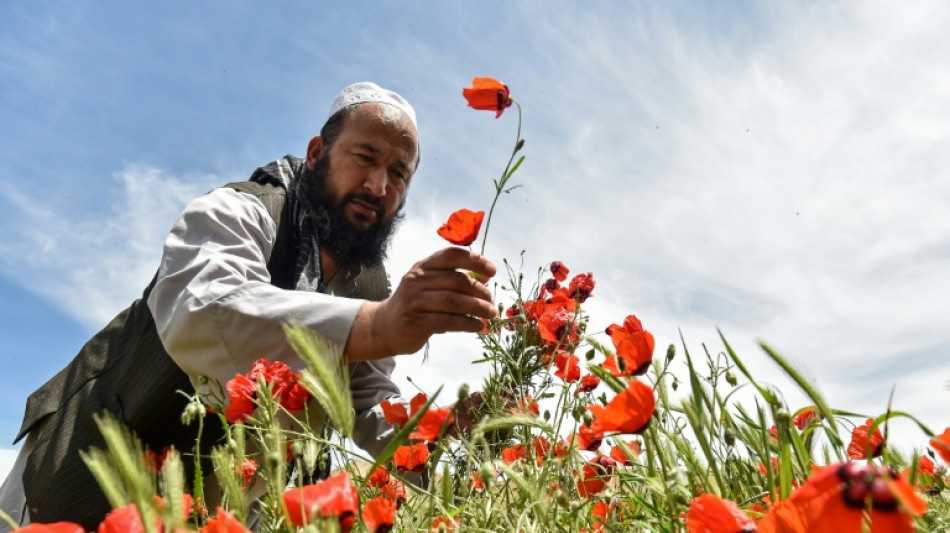
Afghans celebrate spring in bright red poppy fields / Photo: Atif ARYAN - AFP

 Trump's beef policies irk Texas ranchers, testing their loyalty

 Nvidia, OpenAI CEOs to attend Xi dinner at White House

 Anthropic picks Accenture for in-house AI safety evaluation

 Balogun returns as Monaco beat Lens to continue strong Ligue 1 start

 'Pause' on overt repression in Venezuela, but reforms still needed: HRW

 Global stocks mixed as yen falls despite Bank of Japan rate hike

 Cuba hit with seventh major blackout of the year

 Murray out with concussion so Wentz will start for Vikings

 UN chief 'deeply regrets' US visa refusal to Abbas for annual meeting

 England quick Carse to face no charges over alleged nightclub assault

 Mancini brings nine newcomers into the first squad of his Italy comeback

 Czechs level Davis Cup tie against USA as South Korea eye Finals

 New France boss Zidane confirms Mbappe as captain after naming first squad

 California governor signs order to explore AI 'kill switch'

 Head leads run spree as Australia win Zimbabwe ODI series

 In-form Raphinha wants to finish career at Barcelona

 Warren Buffett steps down as Berkshire Hathaway chairman

 Carrick confident Man Utd can 'work through' tough time

 Mbappe ends Nike partnership to join Swiss brand On

 Liverpool boss Iraola puts Bournemouth love affair on hold

 'A disaster' if Man City do not win says Maresca after flawless start

 Kerry James Marshall: American 'blackness' painter celebrated in Europe

 Spain coach De la Fuente offers 'full support' to people of Ceuta

 Russia seizes assets of Nestle, French firms over West's Ukraine support
 England can build on World Cup 'spirit', says Tuchel
In the middle of a field filled with bright red poppies, Afghans frolic among the spring flowers in a tradition deeply rooted in the country's north.
Families flocked to the valleys of Shirin Tagab district, near the border with Turkmenistan, to be among thousands of flowers that appeared after abundant rain.
"There has been a drought for almost 10 years. No flowers or greenery grew," said Ghawsudin, who only uses one name.
"This year has been very good, and God is merciful," said the 79-year-old, who drove for three hours just to see the flowers.
Mohammad Ashraf, a 35-year-old visitor, said he hadn't seen so many poppies for more than a decade.
"Now there are so many red flowers, and you see people come here for picnics," he told AFP.
The landscape in Shirin Tagab is brightened by the common poppy, not the opium poppy that authorities have banned.
- 'Vitality and freshness' -
Many Afghans living in the north used to travel to see the poppies after celebrating Persian New Year, Nowruz, in the city of Mazar-i-Sharif.
The Taliban government, which applies a strict interpretation of Islamic law, has stopped such celebrations each spring.
But the tradition of visiting the poppies, which are widely revered in poems and songs, has endured.
Oriane Zerah, a photographer who published a book about Afghans and flowers, said they are an integral part of daily life.
"As soon as an Afghan has a little space in their garden, they plant a flower. Even in displacement camps, there'll be a flower somewhere. They put them on their pakol, one of their traditional hats, and there are desserts made with flowers," she told AFP.
The poppy has also been associated with wartime in the country, with the flower often placed on the coffins of fighters, according to Afghan writer Taqi Wahidi.
"Dying in the path of the homeland, or in the path of religion and faith, was considered a kind of new resurrection and entry into a new life," he told AFP.
The same flower is widely used in countries, such as Britain, Australia and New Zealand, where people wear artificial poppies to remember those killed in past conflicts.
Nowadays in Afghanistan, however, the poppy "symbolises vitality and freshness", according to Wahidi.
"At the same time that nature is renewed, human beings also want to bring new colours into their lives," he said.
strs-qb-iw/rsc/lga
A.Aguiar--PC



