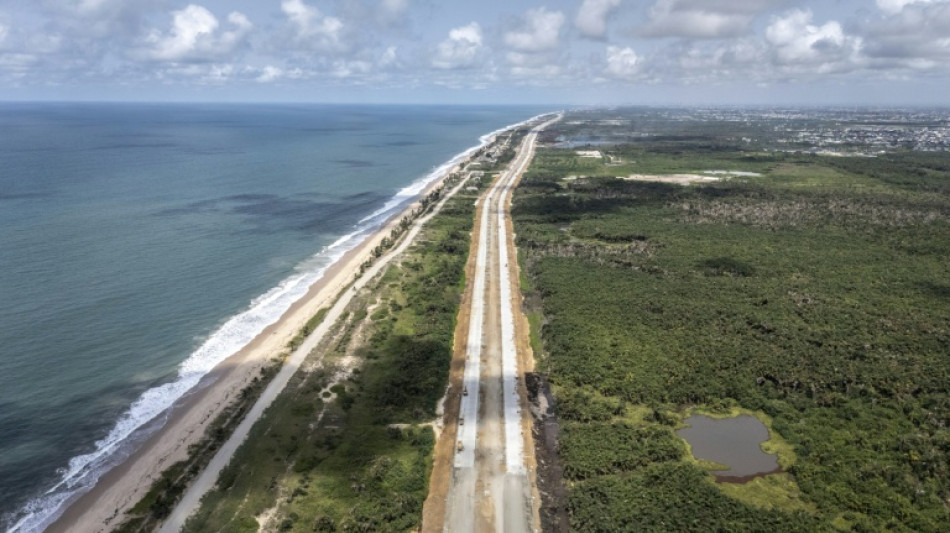
Nigerian mega-highway faces down rising seas, protected forests / Photo: OLYMPIA DE MAISMONT - AFP

 Trump's beef policies irk Texas ranchers, testing their loyalty

 Nvidia, OpenAI CEOs to attend Xi dinner at White House

 Anthropic picks Accenture for in-house AI safety evaluation

 Balogun returns as Monaco beat Lens to continue strong Ligue 1 start

 'Pause' on overt repression in Venezuela, but reforms still needed: HRW

 Global stocks mixed as yen falls despite Bank of Japan rate hike

 Cuba hit with seventh major blackout of the year

 Murray out with concussion so Wentz will start for Vikings

 UN chief 'deeply regrets' US visa refusal to Abbas for annual meeting

 England quick Carse to face no charges over alleged nightclub assault

 Mancini brings nine newcomers into the first squad of his Italy comeback

 Czechs level Davis Cup tie against USA as South Korea eye Finals

 New France boss Zidane confirms Mbappe as captain after naming first squad

 California governor signs order to explore AI 'kill switch'

 Head leads run spree as Australia win Zimbabwe ODI series

 In-form Raphinha wants to finish career at Barcelona

 Warren Buffett steps down as Berkshire Hathaway chairman

 Carrick confident Man Utd can 'work through' tough time

 Mbappe ends Nike partnership to join Swiss brand On

 Liverpool boss Iraola puts Bournemouth love affair on hold

 'A disaster' if Man City do not win says Maresca after flawless start

 Kerry James Marshall: American 'blackness' painter celebrated in Europe

 Spain coach De la Fuente offers 'full support' to people of Ceuta

 Russia seizes assets of Nestle, French firms over West's Ukraine support

 England can build on World Cup 'spirit', says Tuchel

The long, grey concrete road stretches out a stone's throw from the Atlantic Ocean waves relentlessly crashing against the Nigerian shore.
Driving down the new six-lane highway, the hustle and bustle of Lagos gradually gives way to palm groves torn in two by the road, and fishing villages squeezed between it and the ocean.
The newly built expressway, which is to connect the megacity of Lagos -- in the southwest of Africa's most populous country -- to Calabar city, near the border with Cameroon, will run along the Nigerian coastline for 700 kilometres (435 miles) by 2028.
It is one of the flagship projects of President Bola Tinubu, who is seeking a second term in elections in January. The highway is meant to deliver on his campaign promises to "revolutionise" transportation and boost tourism.
"We have a road that will outlive all of us here," he said at the inauguration of the first stretch of the highway, held the same day as his two-year anniversary in office.
But many are questioning the sustainability of this mega-project amid rising sea levels that are eroding the coast along the Gulf of Guinea.
Officially dubbed the Lagos-Calabar Coastal Highway, it is being built at an estimated cost of $11 billion, through a private contract awarded to a Nigerian company, Hitech, owned by Lebanese businessmen Gilbert and Ronald Chagoury, close associates of the head of state.
The same company developed Eko Atlantic, a neighbourhood built on land reclaimed from the ocean and often touted as the "Dubai of Africa", which is for the moment mostly empty land and a few scattered skyscrapers.
- 'Climate denial' -
Nigeria's leading environmentalist, Nnimmo Bassey, called the project "an epitome of climate denial".
"We are experiencing very rapid sea level rise along Nigeria's coastline," he said, warning that the highway could be "very vulnerable".
According to a 2022 study published in the Journal of African Earth Sciences, 89 percent of Lagos state's coastline receded by an average of 2.8 metres (more than nine feet) per year between 1973 and 2019.
An environmental impact assessment for the section of the road covering Lagos state, done by Nigerian consultancy Natural Eco Capital and submitted to the public works ministry in May 2024 -- two months after construction began -- states that "a water level rise of 0.5 metres around the coast of Lagos will not affect the proposed Lagos-Calabar coastal road".
The study specifies that a 1.5C rise in global temperatures would result in a 0.48-metre rise in sea level, and 0.55 metres in the event of a 2C increase.
Yet projections by the Intergovernmental Panel on Climate Change (IPCC) find that warming will probably exceed 3 degrees by 2100, bringing sea level rise past 0.6 metres.
To reduce risks, the consultancy proposes erecting sea walls and natural barriers such as mangroves and dunes "to reduce erosion".
There are currently no offshore dikes or shoreline mangroves along the first 60 kilometres of the highway that have so far opened to traffic.
Africa often finds itself on the front lines of climate change, even though it contributes the least to global greenhouse gas emissions.
Rising sea levels are driven by global warming through rising sea temperatures and the accelerated melting of glaciers.
The rise in sea levels poses a major threat to Nigerian coastal areas, and several entire communities have already been swallowed up by the waters.
Videos shared on social media in recent weeks showed water submerging houses in the town of Ayetoro, in Ondo state, not far from the highway's future route, and flooded roads in Lekki neighbourhood of Lagos, where the highway passes through.
In Mosherel Kawga, about 30 kilometres from where the road starts, 53-year-old fisherman Lukman Igara said that around 20 years ago, the shoreline was a long walk away, "but now, we can see the ships... on the high sea".
Just 100 metres away on the other side of the village, the sound of passing cars buzzed away, the highway having already opened to traffic on the completed portions.
Igara's neighbour, Wasiu Adesanya, 50, marvelled at the new highway, which has opened up this small village -- where there are no schools, running water, electricity or healthcare infrastructure -- and made travel to Lagos easier.
"Now new people are coming into the town," including to buy fish that fishermen's wives dry in the sun.
However, rumours of imminent eviction are causing concern among villagers, with some residents claiming that government officials have told them their land will soon be bought up and that they will be forced to vacate.
In a country with weak land rights and a history of violent, deadly evictions of the poor, those concerns carry weight.
"What we find hard to swallow is the rumour that we will be relocated. This is our ancestral home," said Igara, adding he fears they will be moved far from the sea, jeopardising his livelihood.
Already, right next to the Mosherel Kawga houses -- modest abodes of concrete, with tin roofs -- stands an imposing construction site: a future hotel, where rooms with ocean views will fetch a premium price.
The public works ministry, the Lagos state government and Hitech did not respond to AFP’s requests for comment on the villagers' concerns.
- Carbon sink to source -
In Akwa Ibom state, five states away in the southeast, the highway will cut through Stubbs Creek Forest, the largest in the state and a protected area home to endangered species.
The west African nation has already lost nearly 90 percent of its forest cover over the past 30 years, according to the Nigerian Conservation Foundation.
Constructing the highway through the Stubbs Creek Forest Reserve is estimated to generate 3.5 million tonnes of CO2 -- roughly "0.6 percent of Nigeria's total annual emissions", says Joel Benson, an Abuja-based academic.
The road would turn the forest "from a major carbon sink into a significant carbon source".
He estimated the cost of emissions linked to the project at $554.8 million, based on the carbon prices set by the World Bank of $158 dollars per tonne.
"It's a biodiversity hotspot," providing natural defences for Niger Delta communities, said Tijah Bolton Akpan of the NGO Policy Alert, which is calling for the highway to be rerouted.
The Delta region in southern Nigeria has for decades been ravaged by environmental pollution linked to oil and gas exploitation. Nearly two percent of the country's mangroves have already disappeared, according to the Global Mangrove Watch platform.
Local residents "have continued to suffer the negative impacts of oil and gas operations", Akpan said.
Losing the forest, which they’ve depended on for centuries for their livelihoods, he said, "would be like another level of loss".
F.Moura--PC



