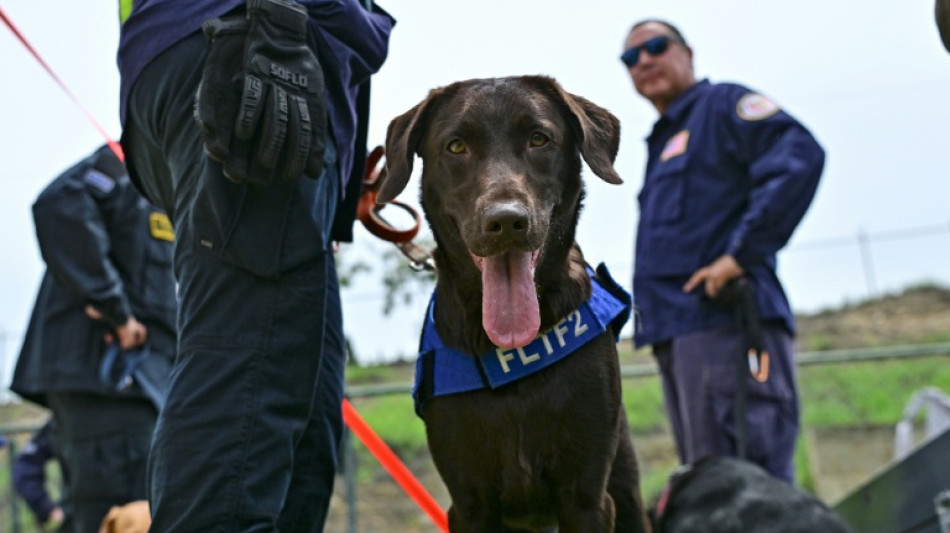
Four-legged rescuers lead way after Venezuela quakes / Photo: MARTIN BERNETTI - AFP

 Trump's beef policies irk Texas ranchers, testing their loyalty

 Nvidia, OpenAI CEOs to attend Xi dinner at White House

 Anthropic picks Accenture for in-house AI safety evaluation

 Balogun returns as Monaco beat Lens to continue strong Ligue 1 start

 'Pause' on overt repression in Venezuela, but reforms still needed: HRW

 Global stocks mixed as yen falls despite Bank of Japan rate hike

 Cuba hit with seventh major blackout of the year

 Murray out with concussion so Wentz will start for Vikings

 UN chief 'deeply regrets' US visa refusal to Abbas for annual meeting

 England quick Carse to face no charges over alleged nightclub assault

 Mancini brings nine newcomers into the first squad of his Italy comeback

 Czechs level Davis Cup tie against USA as South Korea eye Finals

 New France boss Zidane confirms Mbappe as captain after naming first squad

 California governor signs order to explore AI 'kill switch'

 Head leads run spree as Australia win Zimbabwe ODI series

 In-form Raphinha wants to finish career at Barcelona

 Warren Buffett steps down as Berkshire Hathaway chairman

 Carrick confident Man Utd can 'work through' tough time

 Mbappe ends Nike partnership to join Swiss brand On

 Liverpool boss Iraola puts Bournemouth love affair on hold

 'A disaster' if Man City do not win says Maresca after flawless start

 Kerry James Marshall: American 'blackness' painter celebrated in Europe

 Spain coach De la Fuente offers 'full support' to people of Ceuta
 Russia seizes assets of Nestle, French firms over West's Ukraine support
 England can build on World Cup 'spirit', says Tuchel

Sisu tackles her missions in the rubble left by Venezuela's two earthquakes with the same determination and energy she uses to chase her favorite toy, an orange and blue ball.
Wearing her blue harness, this restless brown Labrador retriever ventures into the debris of buildings that collapsed in the earthquakes of June 24.
She searches for survivors with nothing but her sense of smell.
The work of dogs like Sisu, a member of the US rescue team Florida Task Force 2, has proven crucial in finding people alive in a race against time.
Eleven days after one of Latin America’s worst earthquake disasters killed nearly 3,000 people, international teams are winding up their missions with little hope of finding more people alive.
But the dogs played a key role.
The animals are the first to act when teams arrive at a location where survivors are believed to be buried in the rubble. The twin quakes toppled dozens of residential complexes mostly in the coastal La Guaira area.
"Their work is based on detecting where there are humans" by identifying the temperature, body odor, and carbon dioxide exhaled by the victims, Alexander Parada, also of Florida Task Force 2, told AFP, alongside Piper, a Labrador retriever, who rescued two people in Venezuela, her first mission.
"They do a job we can't do."
When a dog alerts to something, rescuers send a second animal to confirm the finding, said Sylvia Arango, a canine handler since 1998 who manages Sisu.
From there, radar or cameras refine the coordinates of where the victims might be.
With their sense of smell, search dogs expedite rescue efforts by quickly inspecting large areas, Parada said, which is crucial given that the chances of finding people alive decrease as the initial 72-hour window passes.
- 'Safe' -
Sisu was one of more than 120 four-legged rescuers from a dozen countries deployed to expedite rescue efforts in several communities in La Guaira, the area most affected by the powerful 7.2 and 7.5 magnitude earthquakes.
Some, like Tsunami, a local border collie with one blue eye and one brown eye, touched Venezuelans with stories of overcoming adversity: in Tsunami's case, from being an animal rescued from abuse to saving the lives of others.
Like their human companions, they worked in 12-hour shifts on dangerous missions.
The animals operated in the high temperatures of La Guaira, exposing themselves to dehydration and abrasions to their fur, something visible on Sisu's neck.
They also made their way through the rubble, even through narrow tunnels formed in the jumble of broken walls, columns, and beams, searching for survivors.
The operations caused some of them injuries and fractures.
But risk is part of the job.
"The minute that we walk onto those rubble piles, there's no guarantee that we're going to be safe," Arango said. "We have to trust our training."
- Puppy love moments -
But what qualities must a dog have to become a rescuer? Lots of energy, but also the ability to move fearlessly in unstable environments.
Arango said it is generally strength of character and a desire to investigate.
Although the dogs on this American team are mostly Labrador Retrievers, there are also Border Collies, Golden Retrievers, Belgian Malinois, and German Shepherds.
On Saturday, ten days after the earthquakes that have left 2,954 dead and thousands still missing, Brazilian and Spanish missions continued inspecting destroyed areas alongside their dogs.
But for Sisu and Piper, it was time to pack up their toys and prepare to go home.
At the close of operations, Arango emphasized that what moved her most about Sisu's first mission was seeing her bring joy in a sea of sadness.
"It's been a devastating situation," Arango said.
"When someone comes up whose heart is hurting, we can get them to smile, and children are able to come up to our dogs and pet them," she said.
"It's also that opportunity to connect with other people, to try to maybe, for that really one moment, not think about what's happening in the horrors that are happening, and just maybe be loved by a happy puppy."
X.Brito--PC