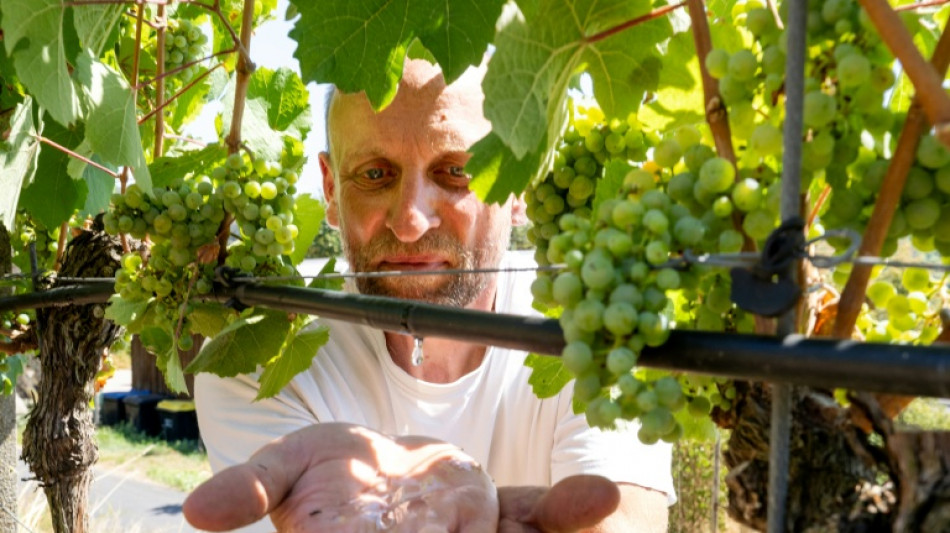
Heat is on as German winegrowers struggle to protect vines / Photo: Torsten Silz - afp/AFP

 Hong Kong court set to sentence activist Joshua Wong in security case

 Australia raises benchmark rate to highest level in 18 years

 'The Remarried Empress' Cast Discusses Bringing Fantasy Royal Drama to Life
 Asian stocks retreat as AI worries outweigh steep oil-price drop

 Hamad International Airport stages emergency drills during WATAN 2026

 Global failure to punish attacks leaves journalists at continuing risk

 Researchers Warn 'Bookkeeping Trick' Masks Beef Industry's Methane Emissions

 Climate Change Intensified Atlantic Hurricanes, Study Finds

 Qatar solar expansion opens scope for technical performance gains

 IXOPAY Announces IXO One, a Modular Payments Platform Built for an Era of Fluid Commerce
As Europe bakes in yet another heatwave, German winegrower Florian Weingart has scattered straw on the ground to keep moisture trapped in the earth and protect his prized vines from extreme temperatures.
It is one of several measures that he is taking in a bid to ensure his small vineyard produces a decent crop despite a historically hot summer and low rainfall.
"The harvest is hanging by a thread," he told AFP from his vineyard in the village of Spay, looking out over the Rhine and hills scorched a deep brown by the heat. The river has fallen to record lows.
Climate change has had some advantages for Germany's winegrowers over the years, allowing them to experiment with grape varieties better suited to warmer climes and making cultivation possible in new areas.
But lengthier and more frequent periods of hot and dry weather are increasingly a challenge. They have left vineyards struggling to sufficiently irrigate their plants, and caused crop yields to dwindle.
"We are at a tipping point," said Weingart. He now feels that the dangers of climate change "are starting to outweigh the advantages".
The 53-year-old, who took over the vineyard from his parents three decades ago, has covered around a third of the six-hectare site with straw, which helps to create a protective layer that prevents water from evaporating.
But "it really is a lot of work", he said. "Over the last four weeks, I have transported 1,000 small straw bales from the fields and scattered it around".
- 'Lost' without irrigation -
Scattering straw between vines, known as mulching, is not new, but what has changed is its purpose: from improving general soil health to helping vineyards withstand a warming climate.
"This whole aspect of evaporation protection and the fact that (straw) actually offers advantages in dealing with these climate challenges is something we only realised later on," said Weingart.
Irrigation is another key measure at the vineyard, which makes mostly white Riesling -- Germany's signature wine variety -- as well as some red Spaetburgunder, and sells its produce locally.
The vineyard has a system of piping spread across 1.85 hectares of the vines, which steadily drips water onto the ground around the plants' roots, and is turned on every few days.
The system, which was installed in 2013, is especially important for young vines, whose roots are not as deep.
"Without irrigation, this area would basically be lost for the harvest," he said.
"I will no longer plant any young (vines) without irrigation, because otherwise I simply consider the risk far too great that they won't grow at all in the first three or four years."
Weingart also sees maintaining healthy soil, with limited weed growth competing for water, as an important way of helping vines cope with extreme heat and drought.
- Earlier harvests -
He expects the harvest to come in September, which is typical for recent years but far earlier than in the past when it was usually in October.
But he fears that, without some substantial rainfall, the crop will be poor after such a hot, dry summer.
The vineyard's harvests have already been shrinking over the years, dropping to around 5,000 litres -- enough for about 40,000 bottles -- compared to around 6,000 litres in the past.
Some winegrowers elsewhere in Germany already started harvesting in the second week of August, which is exceptionally early, industry group the German Wine Institute said this week.
"We're easily a good four weeks ahead of where things were maybe 30 or 40 years ago," the group's spokesman Ernst Buescher told AFP.
P.Serra--PC