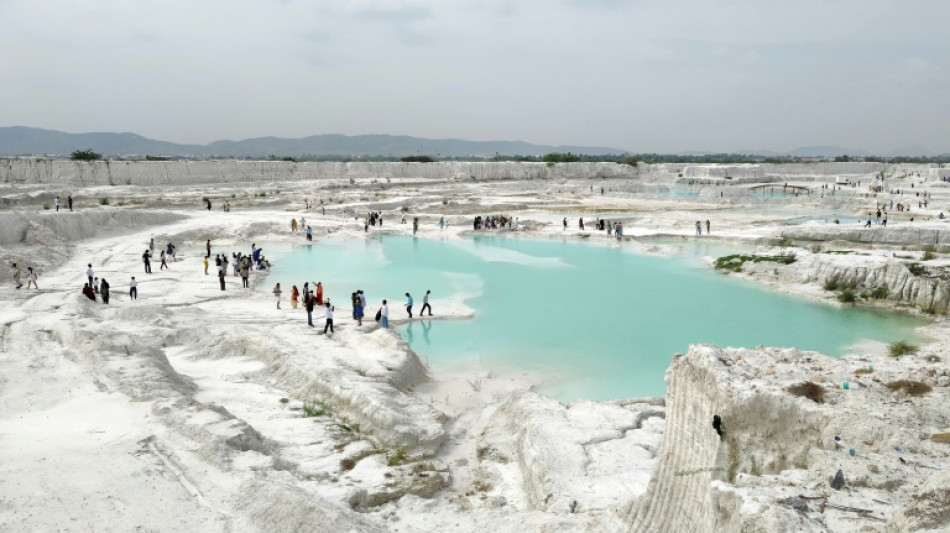
Indian marble waste dump becomes unlikely tourist attraction
/ Photo: Himanshu SHARMA - AFP

 Hong Kong court set to sentence activist Joshua Wong in security case

 Australia raises benchmark rate to highest level in 18 years

 'The Remarried Empress' Cast Discusses Bringing Fantasy Royal Drama to Life

 Asian stocks retreat as AI worries outweigh steep oil-price drop

 Hamad International Airport stages emergency drills during WATAN 2026

 Global failure to punish attacks leaves journalists at continuing risk

 Researchers Warn 'Bookkeeping Trick' Masks Beef Industry's Methane Emissions

 Climate Change Intensified Atlantic Hurricanes, Study Finds

 Qatar solar expansion opens scope for technical performance gains

 IXOPAY Announces IXO One, a Modular Payments Platform Built for an Era of Fluid Commerce
A sprawling expanse of white marble waste in India is drawing tourists, filmmakers and social media enthusiasts to a landscape that looks more like a snow-covered valley than a dumping ground.
The site in Kishangarh, a major marble-processing hub in the northwestern state of Rajasthan, is blanketed in white slurry and discarded stone generated when marble and granite blocks are cut and polished.
Spread across 82 acres (33 hectares), it receives more than 5,500 tonnes of slurry every day from over 1,200 processing units, making it one of Asia's largest such disposal sites.
But the industrial wasteland has evolved into an unlikely attraction.
Couples pose among the chalk-white mounds for pre-wedding photographs, while filmmakers and music-video crews use the terrain as a backdrop.
Visitors ride horses across the undulating landscape, drawn by its unusual appearance.
Social media has fuelled the site's popularity, with visitors comparing its gleaming surface to snowy alpine scenery.
After rainfall, water collects in depressions between the waste piles, forming vivid blue pools that accentuate the illusion of a mountain vista.
Authorities have repeatedly warned about the environmental impacts of marble waste disposal in the region, citing risks ranging from airborne dust to groundwater contamination.
Studies have detected elevated levels of salinity, hardness and some heavy metals in water from the surrounding area.
India's top environmental court ordered a series of corrective measures in January, including guidelines aimed at promoting the reuse of slurry instead of uncontrolled dumping.
"There is no engineered liner system, no decanting wells, no dust suppression mechanisms, no monitoring of air or groundwater, and no protective green belt," the tribunal said in its order.
But those dangers have not yet deterred crowds of visitors from soaking in the striking, otherworldly scenery.
S.Caetano--PC