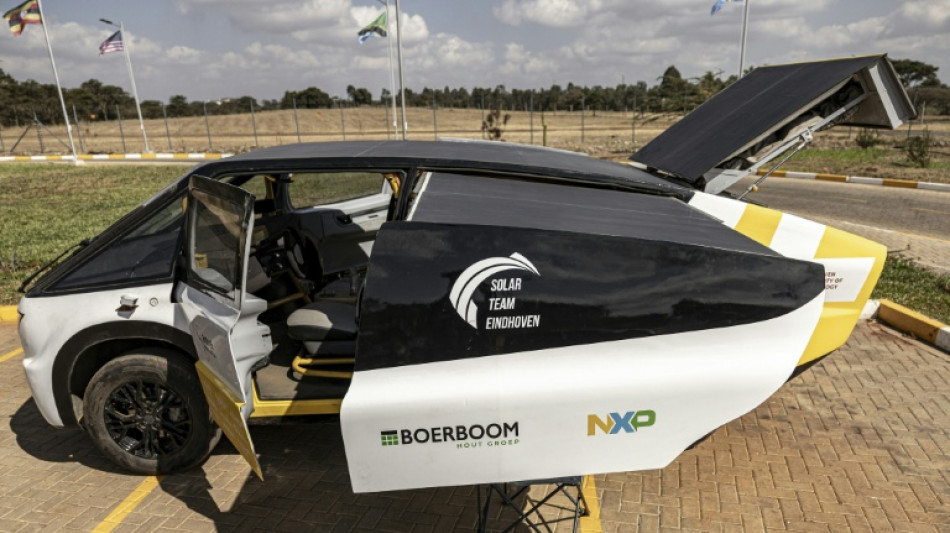
'Game-changer': solar ambulance completes test run in Kenya / Photo: SIMON MAINA - AFP

 Hong Kong court set to sentence activist Joshua Wong in security case

 Australia raises benchmark rate to highest level in 18 years

 'The Remarried Empress' Cast Discusses Bringing Fantasy Royal Drama to Life

 Asian stocks retreat as AI worries outweigh steep oil-price drop

 Hamad International Airport stages emergency drills during WATAN 2026

 Global failure to punish attacks leaves journalists at continuing risk

 Researchers Warn 'Bookkeeping Trick' Masks Beef Industry's Methane Emissions

 Climate Change Intensified Atlantic Hurricanes, Study Finds

 Qatar solar expansion opens scope for technical performance gains

 IXOPAY Announces IXO One, a Modular Payments Platform Built for an Era of Fluid Commerce
Dutch students on Friday celebrated a successful trial in Kenya of what they say is the world's first solar-powered ambulance, hoping to bring vital medical care to remote regions.
The futuristic yellow, black and white car -- named 'Stella Juva' -- is equipped with roof-mounted solar panels that power the engine.
It also carries testing kits for tuberculosis, cooled storage for vaccines, X-ray machines, and an ultrasound scanner.
The ambulance is designed to bring healthcare to the patient, rather than transport them to hospitals -- vital in regions where medical facilities are few, and maternal health is still precarious.
"This vehicle will be a game changer," said Geoffrey Sadera, of Amref Health Africa, which partnered on the project. Amref focuses on maternal and child health.
The two-seat ambulance can tackle off-road terrain, reach a top speed of 120 km/h (70 mp/h), and on a sunny day has a range of roughly 715 kilometres (440 miles).
Its solar-charged battery ensures the car and its equipment remains operational even at night or in cloudy conditions.
Student Isabella Wanningen, who worked on the project, told AFP the trial run in Kenya had been a runaway success.
"We've driven more than 800 kilometres and tested her capabilities both in whether she is able to go off-road and how she can actually deliver healthcare," she said.
Many team members put their studies on hold to work on this project, which took about a year to complete.
"We hope to inspire the industry, healthcare organisations and innovators to use sustainable technology to solve real-world problems," said Wanningen.
"If we can do this with 23 students in one year, that really shows how much is possible," she added.
P.L.Madureira--PC