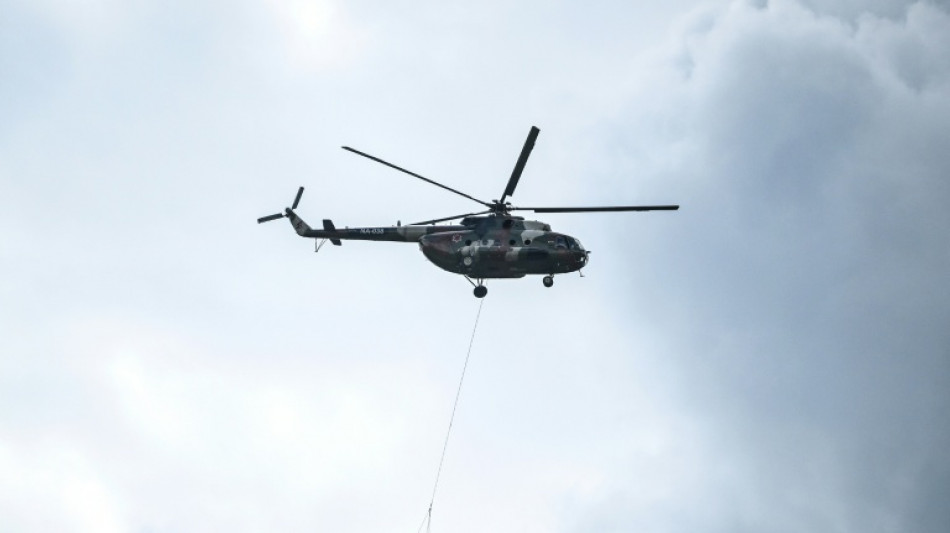
Swollen rivers, washed-out roads hamper Nepal rescue effort / Photo: Arun SANKAR - AFP

 In France's north, winegrowers bet on a warmer future

 Deadly virus stalks South Africa's sardines
 South Korea women's football body probes 'period' insult
 Transitional Fashion Essentials for Autumn: Key Pieces from M&S and Joe Browns

 China's Xi and Iran's Pezeshkian in Kyrgyzstan, Putin expected

 Rescuers hunt for missing after deadly N.Cyprus ferry accident
 Ethiopia's Abiy could consolidate power as 'executive president'
 Crude prices rise on US-Iran strikes, equities mixed after Warsh remarks
 South Korea court gives Unification Church leader 2 years prison
 US hosts G20 finance talks with growth, Iran pressure on agenda
 African players in Europe: Wissa flick seals Newcastle victory

 Venice film preview: Clooney, Oasis and Musk

 Poorly Djokovic crashes out of US Open first round
 Djokovic falls in US Open first round, earliest Grand Slam exit in 20 years

 Chinese guitar capital's stairway to export heaven

 Stocks drop as Warsh fans US rate hike bets, crude up on US-Iran strikes
 Injuries cloud tennis as US Open gets under way

 Iran retaliates after first US strikes in a month

 Itauma says 'I'll be back' after bruising heavyweight title loss

 Brilliant Palou clinches fourth straight IndyCar crown

 US strikes Iran for first time in a month, Tehran retaliates
 Yin holds off Kim to win sixth LPGA title, end title drought

 Top-ranked Scheffler storms to PGA Tour Championship win

 Root urges England to be 'grown-ups' after Pakistan series win

 Google Maps renames Lake Ontario 'Lake America' in US -- but not Canada

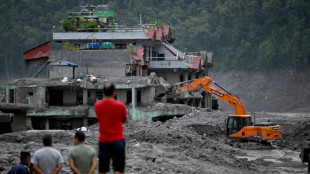
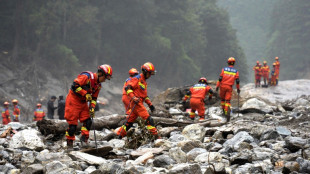
Nepali rescue teams battled difficult terrain, an unpredictable river and treacherous marshland on Monday, the sixth day in their search for survivors and victims of devastating floods.
The catastrophic flooding has killed more than 900 people, while the number of people unaccounted for has also risen, reaching more than 4,793 on Monday.
"There are too many challenges," said E. Hawadi, a police officer coordinating rescue efforts in the badly affected Nuwakot district.
"There are no roads, they have all been washed away, and many areas are just not accessible," he told AFP.
Floodwaters remained high in some areas. Elsewhere, the ground had turned into slushy mud, slowing movement and complicating operations.
"It is very difficult for my men. The area is still flooded, and elsewhere it is all marshland," Hawadi said.
Entire communities have been swept away, leaving families homeless in heavy rain or sheltering in temporary facilities.
Unidentified bodies are being buried in mass graves after DNA sampling.
- 'Deep and steep' -
The difficult conditions in Nepal's remote settlements have forced rescuers to depend heavily on helicopters, often the only viable means of reaching stranded communities.
"Once my men are dropped, they have to roam over large distances to conduct search and rescue," Hawadi said.
"But the helicopters have to return because there are not enough of them."
With supplies stretched and teams dispersed across a sprawling disaster zone, authorities have continued to bring reinforcements into Bidur, a small town on the banks of Trishuli River, which has become the main hub for rescue operations.
Foreign ministry spokesman Lok Bahadur Poudel Chhetri, appealing for international support, including specialist teams and kit to "locate people who may be buried under debris", said the mountain geography was adding to the challenge.
"This is the Himalayas... We have to be very careful when starting any rescue operation or relief operation," he told reporters on Monday.
"The gorges are very deep and steep, so that's the difficulty."
- 'Severely disrupted access' -
The International Federation of Red Cross and Red Crescent estimated that around 93,000 people may have been affected by the floods, and that "many homes have been destroyed or severely damaged".
More than 40 bridges have been damaged or destroyed.
India and China are sending prefabricated Bailey bridges that can be assembled quickly without heavy equipment.
Prime Minister Balendra Shah said that the task was "challenging due to adverse weather, difficult terrain, and ongoing risks".
"Damage to roads, bridges, settlements, and critical infrastructure has severely disrupted access to affected communities, creating significant challenges for relief operations," the UN World Food Programme said, which is shipping in 2.4 tonnes of high-energy biscuits for families with nowhere to cook.
Back in Bidur, Hawadi said rescue teams were struggling with a lack of adequate equipment, including flotation devices needed to operate safely in floodwaters.
The swollen river, already responsible for widespread destruction, continued to change course, forcing rescuers to constantly reassess their plans.
"For example, an area that was dry yesterday is completely flooded today," Hawadi said.
That unpredictability has made night-time operations impossible in many areas, despite pressure to accelerate the search.
"It is unpredictable," he said. "Floods can come at any time."
P.Cavaco--PC