Don't just blame climate change for weather disasters

 Trump's beef policies irk Texas ranchers, testing their loyalty

 Nvidia, OpenAI CEOs to attend Xi dinner at White House

 Anthropic picks Accenture for in-house AI safety evaluation

 Balogun returns as Monaco beat Lens to continue strong Ligue 1 start

 'Pause' on overt repression in Venezuela, but reforms still needed: HRW

 Global stocks mixed as yen falls despite Bank of Japan rate hike

 Cuba hit with seventh major blackout of the year

 Murray out with concussion so Wentz will start for Vikings

 UN chief 'deeply regrets' US visa refusal to Abbas for annual meeting

 England quick Carse to face no charges over alleged nightclub assault

 Mancini brings nine newcomers into the first squad of his Italy comeback

 Czechs level Davis Cup tie against USA as South Korea eye Finals

 New France boss Zidane confirms Mbappe as captain after naming first squad

 California governor signs order to explore AI 'kill switch'

 Head leads run spree as Australia win Zimbabwe ODI series

 In-form Raphinha wants to finish career at Barcelona

 Warren Buffett steps down as Berkshire Hathaway chairman

 Carrick confident Man Utd can 'work through' tough time

 Mbappe ends Nike partnership to join Swiss brand On

 Liverpool boss Iraola puts Bournemouth love affair on hold

 'A disaster' if Man City do not win says Maresca after flawless start

 Kerry James Marshall: American 'blackness' painter celebrated in Europe

 Spain coach De la Fuente offers 'full support' to people of Ceuta

 Russia seizes assets of Nestle, French firms over West's Ukraine support

 England can build on World Cup 'spirit', says Tuchel

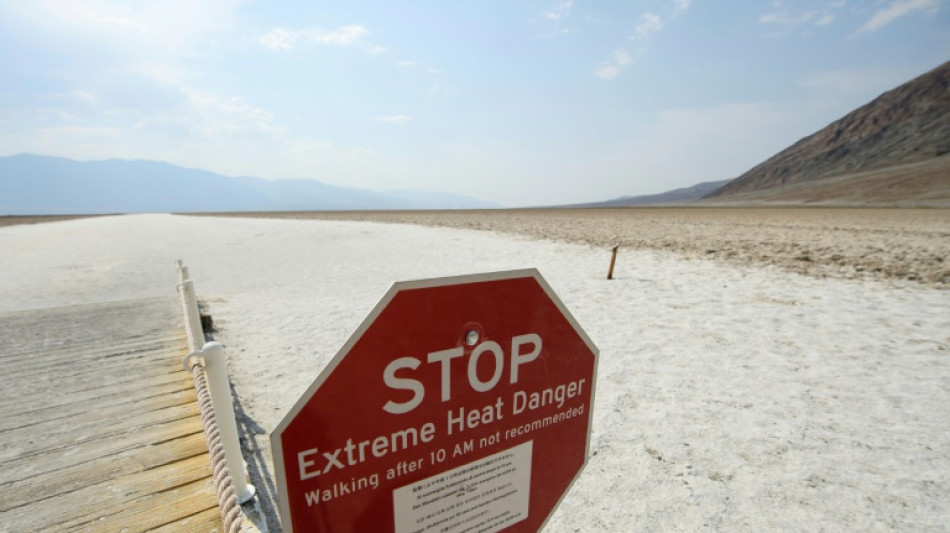
As a pioneer in so-called attribution science -- establishing a link between extreme weather and climate change -- Friederike Otto is adamant that the rising toll of heatwaves and hurricanes cannot be explained by global warming alone.
AFP spoke to Otto, a physicist at the Grantham Institute for Climate Change at Imperial College London, ahead of the release of a major UN climate report on climate change impacts and how humanity can adapt to them.
Q. Is 'natural disaster' a contradiction in terms?
To talk about natural disasters the way that we usually do is not very helpful because it turns the attention away from the agency that we have as humans.
You have to search very hard to find climate disasters that are purely natural. Even without climate change, if humans are involved, such disasters occur for the most part when vulnerability and exposure meet extreme weather events. Global warming just makes it worse.
Q. Can you give an example?
Last year there were major floods in western Germany which led to lots of lost lives, damaged property.
Yes, climate change made the rainfall more intense. But even without global warming there would have been a huge, heavy rainfall event. And it would have landed in a densely populated geography where the rivers flood very easily and the water has nowhere to go.
Q. Has attribution science led to blaming disasters just on climate change?
When we started to do attribution, everyone -– we, the media –- were excited to finally have an answer to the question: what is the role of climate change in these disasters? It was a breakthrough to be able to say an individual event was made, say, 10 times more likely.
But if we ignore vulnerability, then we also ignore to a large degree what we can actually do to cope with and protect ourselves from climate change.
Q. How do we assess responsibility for a natural disaster?
The goal... is not so much to pinpoint fault or blame, but to understand the causes. The next step is to ask: what do we need to change? Who has the agency to do that? Then you can ask about responsibility.
We know now that building mansions on the beach or cliffs of Malibu is probably a stupid idea. It is deliberately exposing oneself to risk.
A 1,000-year-old city built on what has now become a flood plain is different. But we still have to adapt: educate people not to build there anymore, build in a way -– on stilts, for example -- that can withstand floods. We also need better flood forecasting.
Q. Is it also an equity issue?
It's the vulnerable in society who suffer the greatest loss and damages. They live in houses that can't withstand natural hazards; they live in floodplains; they can't afford insurance. And it's not just Global North vs Global South. Who's still suffering today from the consequences of Hurricane Katrina, that devastated New Orleans in 2005? It's not the rich and white. It's the poor, and people of colour.
Q. What is 'maladaptation', and where does that fit in?
Just blaming climate for disasters can lead to maladaptation. If you think of climate disasters purely as a physical problem, you're likely to favour a technical solution, like building a dam. That may result in less flooding in a small part of a city but have bad consequences along the rest of the river.
If the measure you put in place to adapt makes things worse in the long run or for the majority of people, that's maladaptation. Adaptation also means education, governance, and so on. But investing in those things is harder, and it can take decades to see results.
Q. Have disasters been incorrectly blamed on climate change?
The drought and famine in Madagascar. Climate change is really not playing a role there. The population is extremely dependent on rain-fed agriculture, but the rains are just naturally not terribly reliable.
And there's a very high rate of poverty. Outside disaster assistance has been very short-term. Lots of things that have gone really wrong on the vulnerability side. But climate change is not really a driver.
Q. The UN identified Madagascar at the world's first climate-driven famine
Even without doing an attribution study, just from everything that we knew before from IPCC reports, it should have been clear that climate change is not the only, and not even a major driver of the drought in southern Madagascar.
I can see why they do that -– to raise funds and so on. But it's just not helpful to say, "everything is tickety-boo and then the big, bad climate change monster comes and eats us all". That's not how it works.
O.Salvador--PC



